

Our Verdict
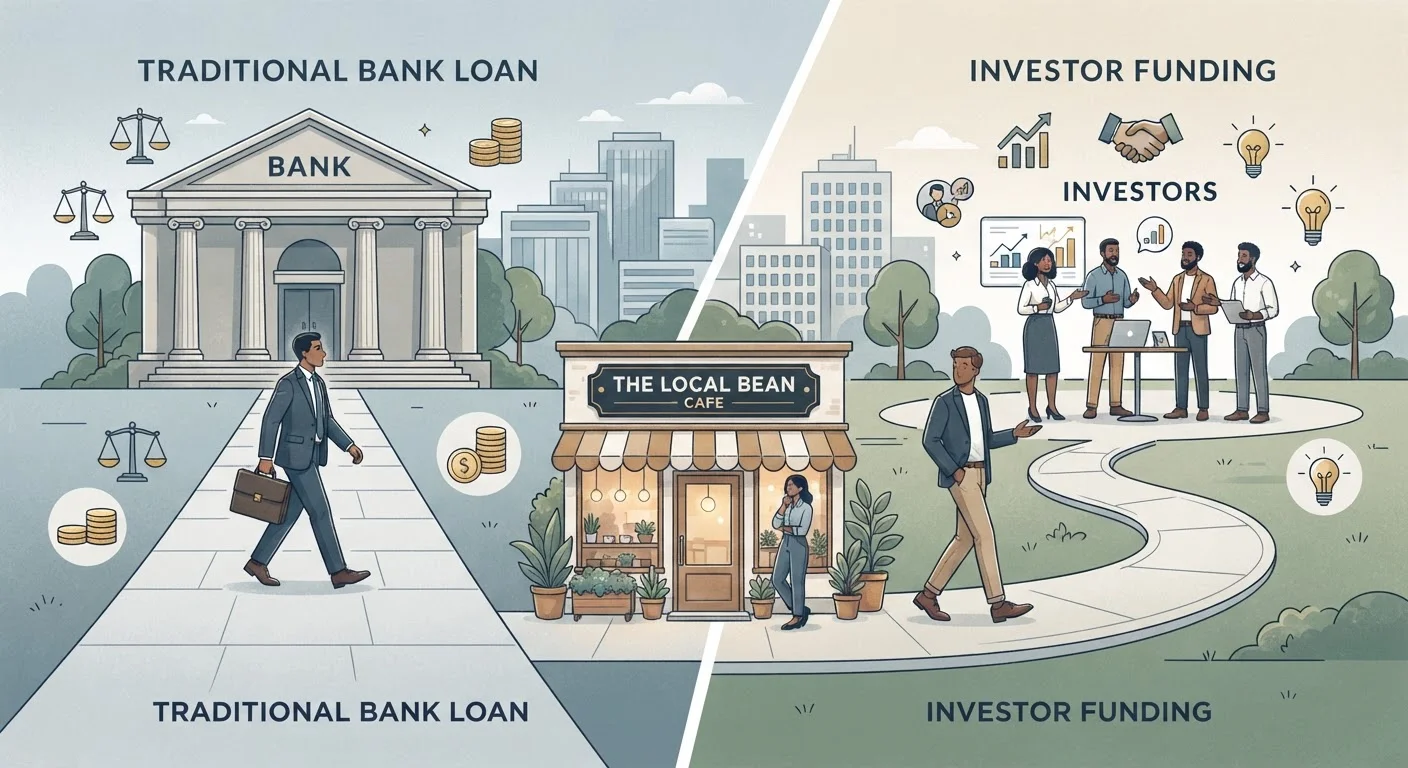
Neither debt nor equity financing is universally superior. Debt financing suits businesses with predictable cash flow that want to preserve ownership, while equity financing is better suited to high-growth ventures willing to share control and future profits. Most successful businesses use a combination of both over their lifecycle.
| Best for | Recommended |
|---|---|
| Businesses with steady revenue and strong cash flow | Debt Financing |
| Early-stage or high-growth startups needing large capital injections | Equity Financing |
| Owners who prioritize control and independence above all | Debt Financing |
| Businesses in sectors where investor expertise and networks add strategic value | Equity Financing |
What Each Financing Type Actually Means
Debt financing means borrowing money - from a bank, credit union, or other lender - that you agree to repay over time, typically with interest. Common forms include term loans, business lines of credit, and SBA-backed loans. The lender has no claim on your business ownership; they simply want their principal and interest returned on schedule.
Equity financing means raising capital by selling a stake in your business. Investors - whether angel investors, venture capital firms, or even friends and family - receive partial ownership in exchange for their money. They share in future profits (and losses) but don't receive fixed repayments.
Before diving deeper, it helps to be comfortable with foundational vocabulary. Our guide to key financial terms covers concepts like interest rates, equity, and capital structure that appear throughout this conversation.
The Real Costs: Beyond the Dollar Amount
Every funding source has a price. With debt, the cost is explicit: interest payments and fees. With equity, the cost is less visible but often more significant over time.
| Debt Financing | Equity Financing | |
|---|---|---|
| Ownership impact | None - you retain full ownership | Partial ownership sold to investors |
| Repayment obligation | Fixed schedule with interest | No mandatory repayment |
| Cost structure | Interest rate and fees | Equity dilution and profit sharing |
| Control over decisions | Full control retained | May share control or board seats |
| Qualification requirements | Credit history, revenue, collateral | Business potential and investor fit |
| Risk if business fails | Debt still owed; legal liability possible | Investors lose their stake alongside you |
| Best growth stage | Established with steady cash flow | Early-stage or high-growth |
Interest and fees on debt reduce your operating cash flow immediately. A loan with a high annual percentage rate (APR) can materially strain a business that doesn't yet generate consistent revenue. Before taking on new debt, it's worth working through the kind of checklist covered in our article on evaluating new debt.
Dilution is the equity equivalent. If you sell 30% of your business to raise capital, you've permanently given up 30% of future profits and 30% of any eventual sale proceeds. In a high-growth scenario, that dilution can represent far more value than a loan's interest ever would.
Consider Your Debt-to-Income Ratio First
Before applying for a loan, calculate how much debt your business can realistically carry relative to its income. Lenders scrutinize this ratio closely, and overextending can limit your options later. Our explainer on debt-to-income ratio walks through how the calculation works and what thresholds lenders typically look for.
Control, Risk, and Relationships
Debt doesn't change who runs your business. Your lender has no seat at the table, no vote on strategy, and no say in how you spend the proceeds - provided you make payments on time. That independence is a major reason many small business owners prefer debt when they can qualify for it.
Equity investors, by contrast, often expect influence. Depending on the deal structure, investors may receive board seats, voting rights, or approval authority over major decisions. That's not inherently bad - experienced investors can bring expertise, networks, and mentorship that accelerate growth. But it does mean sharing control in ways that can create friction if goals diverge.
Risk allocation also differs. If your business struggles, debt obligations remain - missed payments damage credit and can trigger legal consequences. Equity investors, however, share in the downside. If the business fails, they lose their investment alongside you. This asymmetry is part of why equity investors demand higher potential returns than lenders do.
For a broader look at funding alternatives, funding a business without a bank loan explores approaches like crowdfunding and revenue-based financing that sit between traditional debt and equity.
When Each Approach Makes the Most Sense
Debt financing tends to work well when:
- Your business has steady, predictable cash flow to cover monthly payments
- You need capital for a specific, defined purpose (equipment, inventory, a lease)
- Maintaining full ownership is a non-negotiable priority
- You can qualify based on credit history and financial statements
Equity financing tends to make more sense when:
- You're pre-revenue or early-stage with limited cash flow
- You need large amounts of capital that debt markets won't support
- You're in a high-growth industry where speed matters more than ownership percentage
- Strategic value from investors - expertise, connections, credibility - would genuinely accelerate your business
Many businesses also consider whether to avoid outside funding altogether. Our comparison of bootstrapping trade-offs and bootstrapping versus outside funding can help you evaluate that path honestly.
This article is for general informational and educational purposes only and does not constitute personalized financial, legal, or investment advice. Consult a qualified financial advisor, accountant, or attorney for guidance specific to your business circumstances.
The content on this site is for informational purposes only and is not a substitute for professional advice. Always consult a qualified professional for guidance specific to your situation.