

What the Cuticle Has to Do With Everything
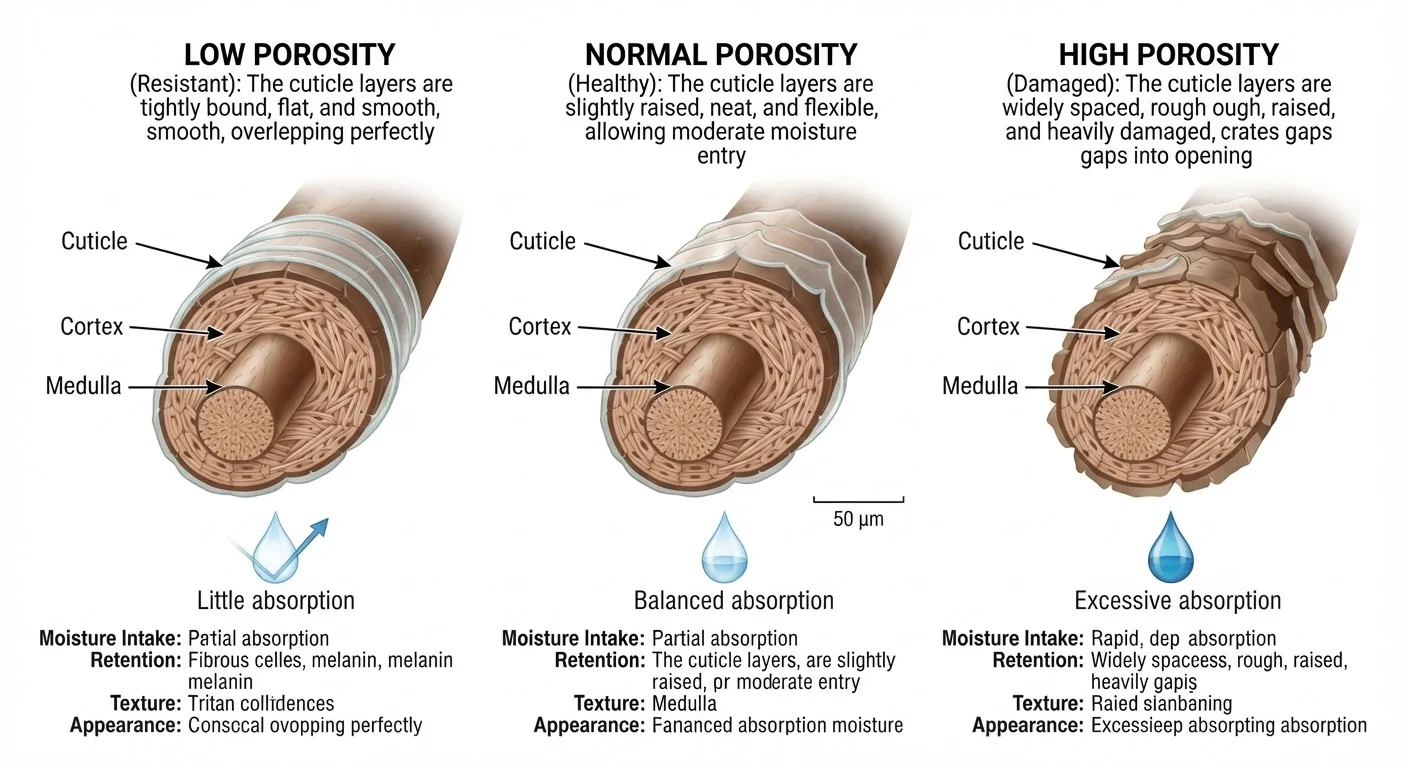
Your hair strand is made up of three layers: the medulla (innermost core), the cortex (middle layer that determines strength and color), and the cuticle (the outermost protective layer). The cuticle is composed of overlapping, scale-like cells - think of them like roof shingles. How flat or raised those shingles sit determines your porosity level.
When cuticle scales lie flat and tight, they form a strong barrier. Moisture has a harder time getting in - but it also has a harder time getting out. When the scales are raised or damaged, the opposite is true: water enters easily, but escapes just as fast. This single structural quality has a cascading effect on how your hair looks, feels, and responds to every product you apply.
Understanding this helps explain why two people can use the same shampoo and conditioner and get completely different results - it's not about the product failing. It's about the structural mismatch between what the product offers and what the hair actually needs.
The Three Porosity Types: What Each Means in Practice
Low porosity hair has tightly closed cuticles that resist moisture absorption. Products tend to sit on the surface rather than penetrating the strand, leading to buildup and hair that takes a long time to get fully wet in the shower. Once moisture does get in, though, it's retained well. Lightweight, water-based products generally perform better on low porosity hair, and applying conditioner with gentle warmth (such as covering hair with a shower cap) can help open the cuticle temporarily for better absorption.
Normal (medium) porosity hair has cuticles that are neither too tight nor too open. Moisture enters and exits at a balanced rate, making this hair type generally forgiving and responsive to a wide range of products. This is often considered the most manageable baseline, though it can shift toward high porosity with ongoing heat or chemical exposure.
High porosity hair - whether natural or the result of damage - has cuticles that are raised, uneven, or have gaps. It absorbs moisture quickly but loses it just as fast. Hair may feel dry, frizzy, or brittle even after conditioning. Richer products with occlusive ingredients help seal the cuticle after moisture is applied. Cold water rinses, which can help temporarily flatten the cuticle, are also a popular technique.
3 Layers
Structural layers that make up each hair strand
Each hair strand consists of the medulla, cortex, and cuticle - with the cuticle's condition being the primary driver of porosity behavior.
~50-100
Cuticle cells overlapping along a single strand
According to hair science literature, the cuticle layer comprises multiple overlapping scale-like cells whose alignment directly determines porosity level.
3 Types
Recognized porosity categories in hair science
Hair care professionals and researchers generally classify porosity into low, medium (normal), and high - each with distinct moisture absorption and retention characteristics.
For those caring for curly or coily hair, porosity considerations are especially relevant. Washing frequency and technique matter significantly when moisture retention is a central concern.
What Raises or Lowers Porosity Over Time
Genetics set your baseline. Some people naturally have tighter cuticles; others have more open ones. But porosity is not fixed - it can shift, almost always in one direction: toward higher porosity.
Repeated heat styling lifts the cuticle over time. Chemical processes like bleaching, perming, and relaxing are particularly disruptive to the cuticle structure. UV exposure and hard water (water high in mineral content) can also contribute to raised porosity. This is why hair that was once easy to manage can become progressively more porous and harder to keep hydrated.
Protect Porosity With Heat Discipline
One of the most consistent ways to prevent porosity from rising over time is limiting high-heat styling and always using a heat protectant when heat tools are necessary. Even modest reductions in styling temperature can meaningfully reduce cumulative cuticle damage over months of regular use.
It's worth noting that different sections of the same strand can have different porosity levels - the ends, which are older and have experienced more exposure, are often more porous than the roots. This helps explain why conditioning from mid-shaft to ends is a widely recommended practice.
The concept of locking in moisture with layering - applying a water-based product first, then sealing with an oil or butter - is rooted in porosity logic. It's the same principle that underlies broader skin hydration, as explored in our look at hydration versus moisture in skin care.
Applying Porosity Knowledge to Your Routine
Once you have a sense of your hair's porosity, product and technique choices become more purposeful. For low porosity hair, avoiding heavy butters and waxes that sit on the surface can prevent frustrating buildup. For high porosity hair, prioritizing ingredients that reinforce or seal the cuticle - rather than expecting the strand to hold moisture on its own - makes a practical difference.
The timing and type of conditioning products also matter. Knowing when to use a regular conditioner versus a deep conditioner or hair mask is closely tied to porosity: high porosity hair often benefits more from regular deep conditioning sessions, while low porosity hair may respond better to lighter, more frequent conditioning rather than heavy treatments that won't fully absorb.
Porosity doesn't need to become an obsession - but treating it as a practical lens, rather than a strict diagnosis, can meaningfully improve how you approach your hair care. Small adjustments in product weight, application technique, and routine frequency, informed by your hair's actual behavior, tend to yield more consistent results than chasing trending products or following routines designed for a different hair type.
This article is for general informational purposes only and is not a substitute for professional advice from a licensed cosmetologist or dermatologist. If you have concerns about scalp health or significant hair changes, consult a qualified professional.
Frequently Asked Questions
A commonly referenced method is the float test: drop a clean strand of hair into a glass of water and observe it after a few minutes. Hair that sinks quickly may be high porosity; hair that floats near the top may be low porosity. That said, product buildup can affect results, so many hair professionals recommend a combination of observation and touch-based assessment as more reliable indicators.
Yes. While your baseline porosity is largely genetic, repeated heat styling, chemical treatments like coloring or relaxing, and environmental exposure can raise porosity by damaging the cuticle layer. Healthy hair care habits can limit further damage, but fully reversing raised porosity typically isn't possible once structural changes have occurred.
Porosity applies to all hair types, but its effects can feel more pronounced in curly and coily textures. Because of the hair's curved structure, the cuticle can have more natural variation along the strand, and natural oils from the scalp travel less easily down textured strands, making moisture retention a more active challenge.
High porosity hair generally responds well to heavier, occlusive ingredients - such as butters and oils - that help seal the cuticle and slow moisture loss. Protein-based treatments can also help temporarily fill gaps in the cuticle. The goal is to lock in whatever moisture is absorbed before it evaporates.
This is a classic sign of low porosity hair struggling to absorb dense formulas. Products sit on the surface rather than penetrating the tightly closed cuticle. Lighter, water-based formulas and gentle heat during conditioning can help low porosity hair absorb moisture more effectively.
The content on this site is for informational purposes only and is not a substitute for professional advice. Always consult a qualified professional for guidance specific to your situation.