

Why Enrichment Belongs in Every Day, Not Just Special Occasions
Most pet owners focus on the basics: food, water, shelter, and a daily walk. But behavioral and veterinary experts generally agree that mental stimulation - giving animals opportunities to think, explore, and problem-solve - is equally critical to their quality of life. A pet that lacks cognitive engagement may develop stress-related behaviors like excessive vocalization, destructive chewing, or withdrawal.
The good news? Enrichment doesn't require a dedicated "activity hour." The most effective approach is weaving small, varied challenges into routines you already have. Whether you share your home with a dog, cat, rabbit, or bird, the strategies below are flexible enough to adapt to nearly any species, living space, or schedule. For a deeper look at why consistency matters, see how predictable routines reduce pet stress.
Turn Mealtimes Into a Mini Foraging Session
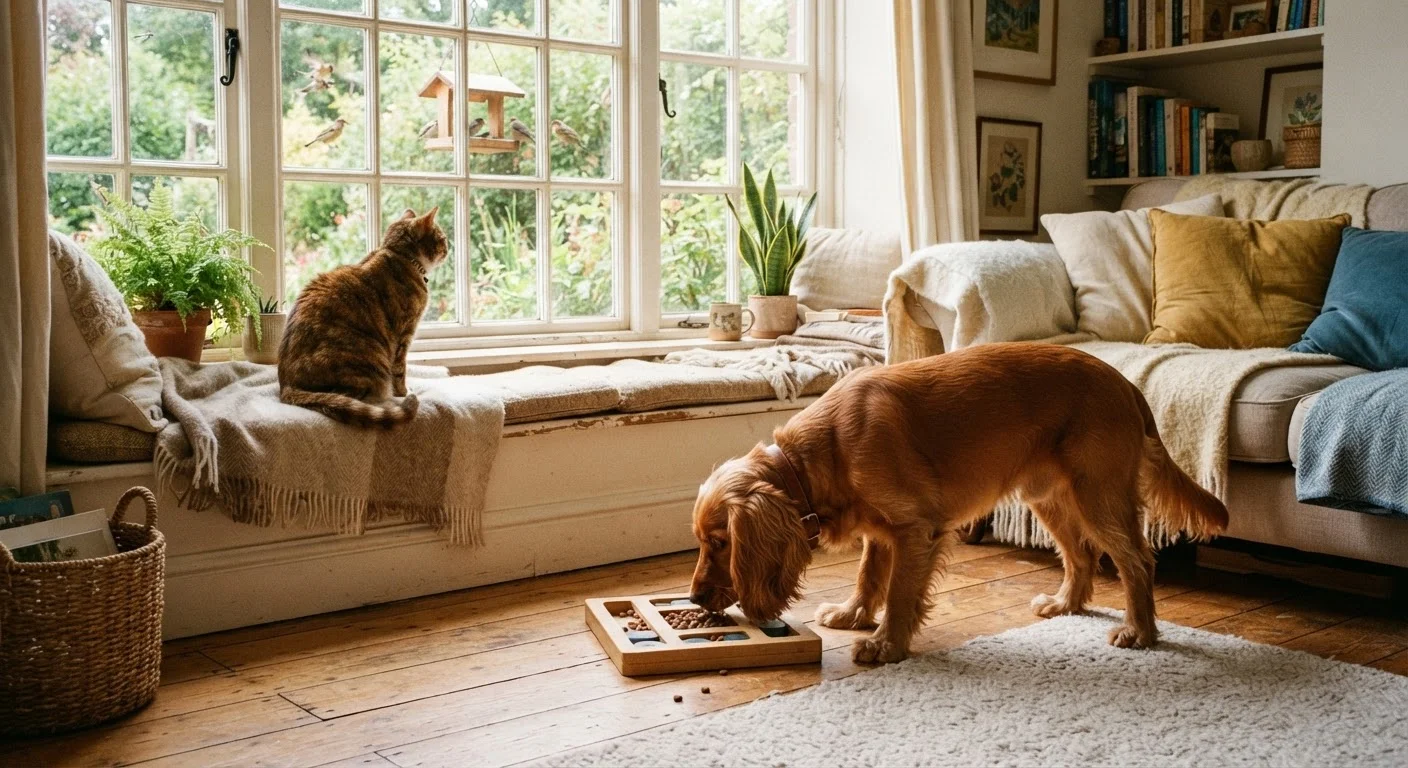
Rather than placing food directly in a bowl, scatter dry kibble across a snuffle mat, hide small portions in muffin tins covered with tennis balls, or simply spread it across a patch of grass. Foraging activates a pet's natural "seeking" instincts - a deeply satisfying behavioral drive that a bowl of food never fully engages.
This works for dogs, cats, and small mammals like rabbits and guinea pigs. For birds, try threading vegetables through cage bars or hiding seeds in paper cups. Even a two-minute foraging setup can make a measurable difference in how settled and content a pet seems afterward.
Foraging activates natural instincts that a standard food bowl simply can't satisfy.
Let Your Pet Lead on Smell, Not Speed
For dogs, the morning or evening walk is often rushed - a necessary potty break rather than a true sensory experience. Allowing your dog to stop and sniff freely, at their own pace and direction, provides genuine mental exercise. Scent processing is cognitively demanding; a fifteen-minute "sniff walk" can leave a dog calmer than a thirty-minute power walk.
Cats and small animals benefit from scent enrichment too. Rotating new objects - a pinecone, a piece of untreated wood, a dried herb sachet - into their environment gives them novel smells to investigate without any effort on your part beyond the initial swap.
A slow, sniff-led walk can be more mentally tiring for a dog than a brisk jog.
Use Training as a Daily Brain Workout
Short training sessions - three to five minutes, once or twice a day - provide structured mental engagement while reinforcing your relationship. You don't need to work on complex tricks. Teaching a sit, a paw, or a simple "find it" game challenges your pet to focus, make decisions, and work toward a reward.
This applies beyond dogs. Cats can learn targeting behaviors and recall cues. Rabbits respond well to name recognition and simple cued jumps. Even parrots and some fish species demonstrate learning under consistent positive-reinforcement training. Variety in cues keeps sessions fresh and avoids habituation.
Even three minutes of focused training counts as meaningful cognitive enrichment.
Introduce Environmental Novelty Gradually
Rotating toys, rearranging furniture slightly, or moving a cat tree to a new window keeps a familiar space feeling new. Novelty doesn't have to mean expensive purchases - an empty cardboard box, a paper bag with the handles removed, or a new perch position can prompt hours of exploration.
For indoor cats especially, window access to bird feeders or squirrel activity provides passive visual and auditory enrichment. If your cat is indoors-only, a structured indoor daily routine can help ensure their sensory needs are met throughout the day.
A cardboard box or a new window view can offer as much stimulation as a purchased toy.
Offer Species-Appropriate Sensory Play
Each animal experiences the world through a dominant sense, and enrichment lands best when it speaks to that sense. Dogs are primarily nose-led; cats respond strongly to visual movement and texture; birds are drawn to sound, color, and manipulable objects; small mammals like rabbits and guinea pigs are motivated by texture, tunneling, and safe materials to chew.
For small pets, this might mean a hay tunnel, a dig box filled with shredded paper, or a rotating selection of safe chew materials. Small animals have specific enrichment needs that are easy to meet once you understand what drives them.
Enrichment lands best when it's designed around how your specific species perceives the world.
Build in Quiet, Choice-Driven Time
Not every enrichment activity needs to be active. Allowing pets to choose how they spend part of their day - where to rest, what to investigate, whether to engage with you - is itself a form of enrichment. Autonomy and predictability together reduce chronic low-level stress in companion animals.
This means resisting the urge to constantly direct your pet's attention. Leave safe objects available for self-directed exploration. Create spaces where your pet can observe the household without being disturbed. Giving animals some degree of control over their environment is a well-recognized component of good welfare practice.
Letting pets choose how to spend unstructured time is a genuine welfare benefit, not laziness.
Making Enrichment a Natural Part of Your Day
The goal isn't to overhaul your schedule - it's to find the small gaps where enrichment already fits. A scatter-feed during breakfast prep, a sniff break on the evening walk, or a paper-bag crinkle session while you watch TV: these moments add up to a meaningfully richer life for your pet. A daily routine checklist can help you spot where enrichment activities slot in most naturally alongside feeding, hygiene, and exercise tasks.
Pay attention to how your pet responds. Energy level, curiosity, and engagement vary by individual, age, and species. When an activity sparks visible interest - a nose twitching, ears perked, focused attention - you've found something worth repeating. Small, consistent moments like these are also the foundation of a stronger human-animal bond. Trust between pets and owners grows through everyday interactions, not grand gestures.
This article is for general informational and educational purposes only. For guidance specific to your pet's health needs or behavior concerns, consult a licensed veterinarian or certified animal behaviorist.
Start Small and Build Consistency
If enrichment feels like one more thing to add to a busy day, start with just one activity - such as scatter-feeding at dinner - and do it consistently for a week. Once it becomes habit, layering in a second activity feels natural rather than burdensome. Consistency over time matters far more than occasional elaborate sessions.
The content on this site is for informational purposes only and is not a substitute for professional advice. Always consult a qualified professional for guidance specific to your situation.