

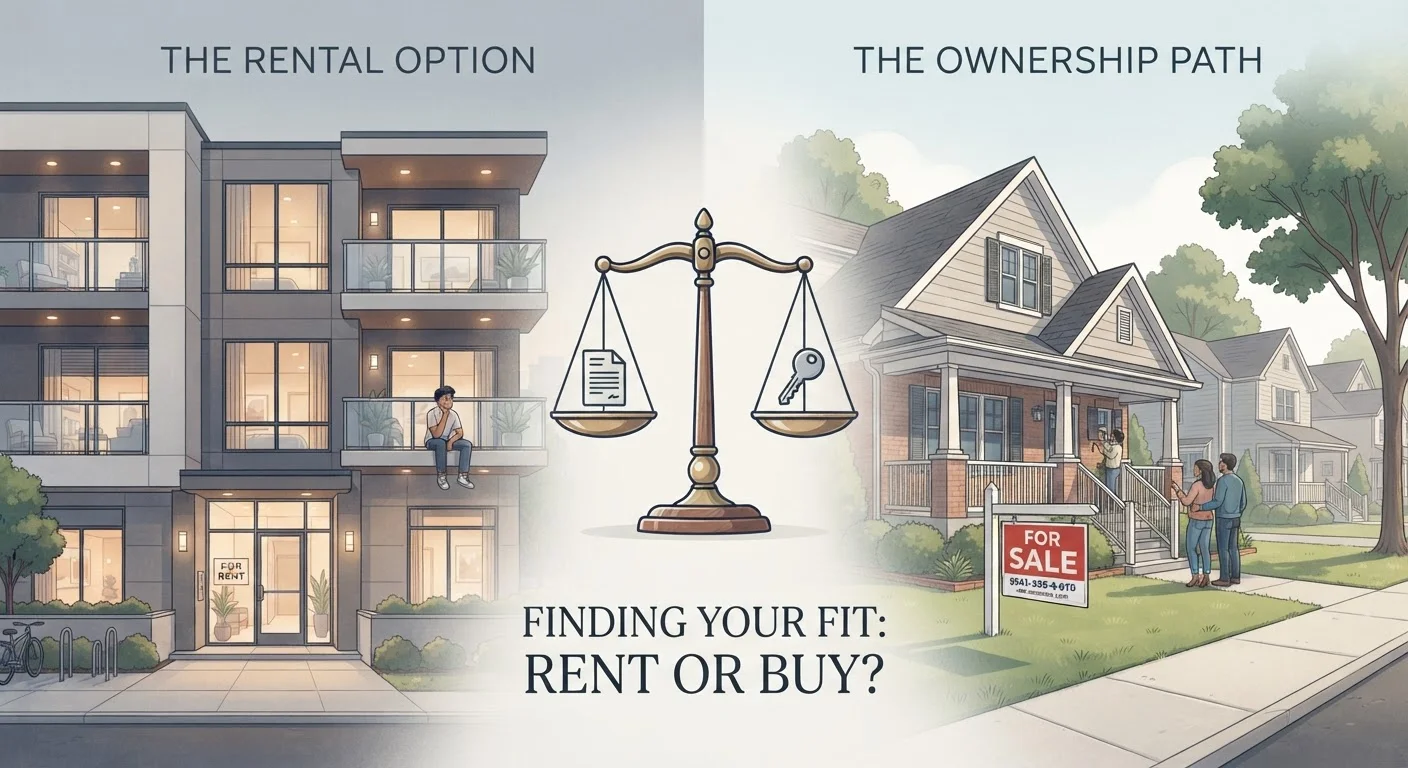
Our Verdict
Renting and buying each serve different financial profiles, timelines, and life priorities. Neither path is universally superior. The strongest indicator of which is right for you is how long you plan to stay put combined with your current financial footing.
| Best for | Recommended |
|---|---|
| Those planning to stay in one place fewer than 3-5 years | Renting |
| Those with stable income, a sufficient down payment, and long-term location commitment | Buying |
| Those prioritizing flexibility, lower upfront costs, or living in high-cost markets | Renting |
| Those seeking to build equity and establish long-term housing stability | Buying |
Why This Decision Is Harder Than It Looks
The rent-or-buy debate is often framed as a simple financial equation - but the math rarely tells the whole story. Housing markets vary dramatically by city and neighborhood, mortgage rates shift, and personal circumstances like job security or family plans can reshape the calculus entirely. For a deeper grounding in how the two options differ structurally, see our framework for evaluating renting vs. buying.
The goal here is not to declare a winner, but to give you a structured way to think through the decision based on factors that genuinely matter - not just the ones that show up in headlines.
| Renting | Buying | |
|---|---|---|
| Upfront costs | Security deposit + first month | Down payment + closing costs (5-25% of price) |
| Monthly cost predictability | Fixed rent; lease renewal risk | Fixed mortgage; variable taxes and insurance |
| Equity building | None | Yes, through principal paydown and appreciation |
| Flexibility to relocate | High (end of lease) | Low (selling takes time and money) |
| Exposure to market risk | None | Yes - values can decline short-term |
| Maintenance responsibility | Landlord handles most repairs | Owner bears all repair costs |
| Best time horizon | Under 3-5 years | 5+ years in the same location |
The Financial Factors That Actually Move the Needle
Monthly payment comparisons are a starting point, not a conclusion. When you rent, your largest upfront cost is typically a security deposit and first month's rent. When you buy, you're looking at a down payment - often 3% to 20% of the purchase price - plus closing costs that commonly range from 2% to 5% of the loan amount. Those costs must be recouped before buying becomes financially advantageous.
A commonly used rule of thumb is the break-even horizon: the point at which the cumulative costs of owning fall below the cumulative costs of renting the same or comparable home. Depending on the market and mortgage terms, this crossover can take anywhere from three to seven years. If you sell before that point, buying may have cost you more.
3-7 years
Typical break-even horizon for buying vs. renting
Industry analyses generally place the break-even point between three and seven years, depending on local market conditions and mortgage terms.
2%-5%
Typical closing costs as share of home purchase price
The Consumer Financial Protection Bureau notes that closing costs typically fall in this range and must be factored into the true cost of purchasing a home.
Another key variable is the price-to-rent ratio - a metric that compares the cost of buying a home to the annual cost of renting a comparable one. In markets where this ratio is high, renting is often more cost-efficient over medium time horizons. In markets where it's low, buying tends to pencil out faster.
Time Horizon: The Underrated Deciding Factor
How long you plan to stay in a given location may be the single most predictive variable in this decision. Short stays - say, under three years - typically favor renting because you don't accumulate enough equity to offset transaction costs. Longer stays increasingly favor buying, particularly when mortgage payments build principal over time while rent payments do not.
If your career requires mobility, or if you're in a life stage where significant changes are likely - a new relationship, growing family, or potential job relocation - that uncertainty has real financial value when you stay flexible. For more on how this calculus shifts across different life stages, see our piece on renting vs. buying at different life stages.
Non-Financial Considerations That Belong in the Equation
Beyond the numbers, the rent-or-buy decision involves quality-of-life tradeoffs that are genuinely difficult to monetize. Homeownership offers stability, creative control over your space, and the ability to put down roots in a community. Renting, on the other hand, generally means faster access to maintenance help, no exposure to unexpected repair costs, and the freedom to relocate without the friction of a sale.
Renters also avoid exposure to market risk - the possibility that property values decline after purchase, leaving a homeowner underwater on their mortgage. While home values have appreciated over most long-term periods, short-term downturns are real and can have serious financial consequences.
If you're new to renting or weighing a first rental, our guide to renting your first apartment walks through the practical steps from credit checks to lease signing. And don't overlook location - our guide on evaluating a neighborhood before committing to a rental covers how to research commute, safety, and services before you sign.
A Simple Framework for Making Your Own Call
Rather than searching for a universal answer, use these questions as a personal filter:
- How long do I realistically plan to stay? Under three years generally favors renting; five or more generally favors buying, all else being equal.
- What are my total upfront costs, and can I absorb them without depleting my financial cushion? Never drain an emergency fund to fund a down payment.
- What does the local price-to-rent ratio suggest? High ratios favor renting; lower ratios favor buying.
- How stable is my income, and does my debt-to-income ratio qualify me for favorable loan terms?
- What does flexibility mean to me right now? If major life changes are on the horizon, optionality has real value.
Whether you're exploring the renting essentials or the homebuying process, the best decision is the one grounded in your own financial reality and life priorities - not in general advice or market sentiment alone.
This article is for general informational and educational purposes only and does not constitute financial, legal, or investment advice. Consult a qualified financial advisor or real estate professional for guidance specific to your circumstances.
The content on this site is for informational purposes only and is not a substitute for professional advice. Always consult a qualified professional for guidance specific to your situation.