

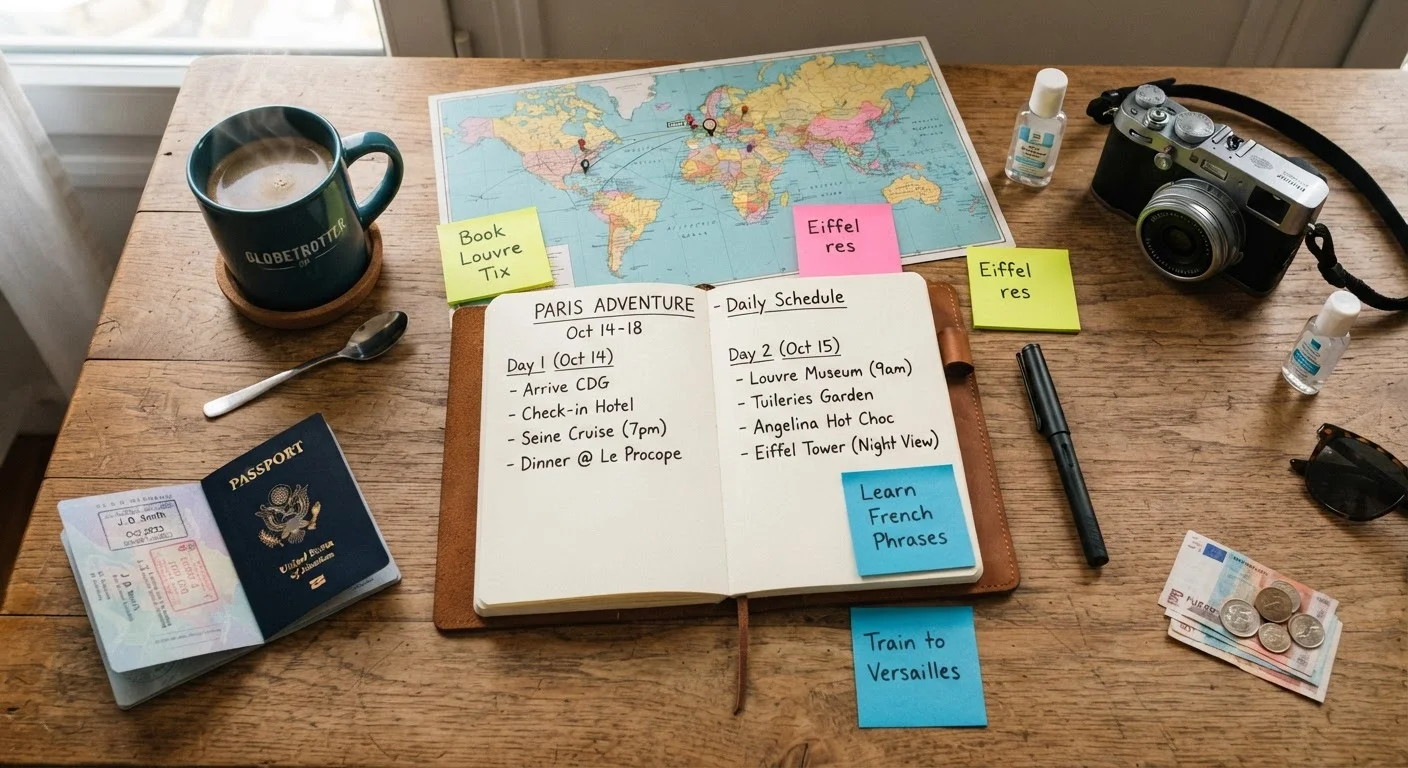
Why Most Itineraries Fall Apart
The most common itinerary failure isn't poor destination choice - it's overloading. Travelers routinely underestimate how long activities take, how draining transit is, and how quickly fatigue compounds over multiple days. The result is a schedule that looks achievable on paper but starts unraveling by day two.
A well-built itinerary does more than list what to do. It accounts for the time between things, the energy required for each activity, and the reality that plans rarely go exactly as written. The goal isn't a perfect schedule - it's a useful framework that keeps your trip on track while leaving room to adapt.
Whether you're planning a weekend city break or a two-week international trip, the same principles apply. The steps below walk you through building an itinerary that works in practice, not just on paper. For broader trip planning guidance, see The Complete Trip Planning Playbook.
What you will need
Tools You'll Need
You don't need specialized software to build a solid itinerary - the tools that work are the ones you'll actually use consistently throughout the planning process and on the road.
Spreadsheet or notes app
Draft and organize your day-by-day schedule with columns for time, activity, location, and booking status.
Destination map (digital or printed)
Visualize geographic clusters of attractions to minimize backtracking between locations.
Official tourism or park website
Verify opening hours, entry fees, permit requirements, and advance booking windows for key sites.
Calendar app with reminders
Set booking deadlines and confirmation check-ins ahead of your departure date.
List every activity you want to include
Start with a brain dump. Write down every attraction, meal, experience, or neighborhood you want to see - without worrying about order or feasibility yet. Include travel days, any pre-booked tours, and logistical stops like airport pickups or check-in windows.
Once your list is complete, mark each item as must-do, would like to do, or nice if time allows. This triage step prevents your itinerary from being dominated by low-priority filler while leaving your real priorities unfinished.
Estimate honest time for each activity
Assign a realistic time block to every item on your must-do and would-like-to-do list. Account for more than just the activity itself: include travel time to and from the location, entry queues, meals, and a small buffer for the unexpected.
A common planning mistake is treating transit as zero time. If a museum is 30 minutes from your hotel by subway, that's an hour of transit you haven't accounted for. Add it explicitly.
Group activities by geographic area
Use a map to identify which of your activities are physically close to each other. Cluster same-day activities within the same neighborhood or district whenever possible. Crossing a city multiple times in a day drains time, energy, and often money.
Assign geographic clusters to specific days, then sequence the days based on your arrival and departure logistics - keeping heavy travel or transit days at the start or end of the trip where they naturally fall.
Build in buffer time and rest
Every full day of travel should include at least one unscheduled window of 60-90 minutes. This isn't wasted time - it's the margin that absorbs a delayed train, a longer-than-expected meal, or simply the desire to sit in a park and decompress.
Multi-day trips also benefit from a lighter pace on day one, when jet lag or travel fatigue is most likely to affect your energy. For longer trips, consider building one genuinely low-key half-day into the middle of the trip. Slow travel principles offer useful guidance here - depth often matters more than quantity.
Verify logistics and confirm bookings
Before treating your itinerary as final, verify the operational details for each key item. Check official sources for current opening hours, seasonal closures, and whether advance tickets or permits are required. Some high-demand sites - popular national parks, historic sites, and guided tours - sell out days or weeks ahead.
National parks in particular often require timed-entry permits that must be secured well before your visit. Confirm all bookings, save confirmation numbers, and note cancellation policies in your itinerary document.
Build a working daily schedule
With your clustered activities, time estimates, and confirmed bookings in hand, lay out each day hour by hour in your chosen tool. Anchor the day around fixed commitments - booked tours, restaurant reservations, scheduled departures - then fill remaining slots with flexible activities.
Keep the schedule readable: one page or screen per day, with clear time blocks, location notes, and any booking reference numbers. Share a copy with travel companions, and if you're managing a complex multi-destination trip, the organizational strategies in staying organized across a multi-city trip can help you keep everything in one place.
Review and stress-test your plan
Read through each day from start to finish and ask: does this feel achievable, or does it feel rushed? If you feel anxious reading your own schedule, that's a sign it's overloaded. Cut lower-priority items or shift them to your backup list.
Check that each day has a logical geographic flow, that meals are accounted for, and that your pace is sustainable across the full trip - not just day one. A realistic plan you can adapt on the ground will always outperform a perfect-looking plan that collapses under real conditions. For more on finding the right balance, see how flexible itineraries differ from rigid travel schedules.
Fine-Tuning and Staying Flexible on the Ground
Even a well-built itinerary will need adjustments once you arrive. Weather shifts, unexpected closures, and simple fatigue are normal parts of travel. Treat your itinerary as a decision-support tool, not a rigid contract.
Experienced travelers know that the habits and mental frameworks you bring to a trip matter as much as the logistics. Habits that separate seasoned travelers from stressed ones covers the low-effort routines that reduce friction across any kind of trip.
Keep a Short Daily Debrief Habit
Each evening, take five minutes to review tomorrow's plan with fresh eyes. Adjust timing if today ran long, confirm any same-day bookings, and flag anything that needs a backup option. This small habit prevents compounding delays and keeps your itinerary useful throughout the trip.
If your destination or style leans toward solo exploration, visiting a new city solo offers practical advice on navigating an unfamiliar place without locking yourself into an overly rigid plan.
The content on this site is for informational purposes only and is not a substitute for professional advice. Always consult a qualified professional for guidance specific to your situation.