

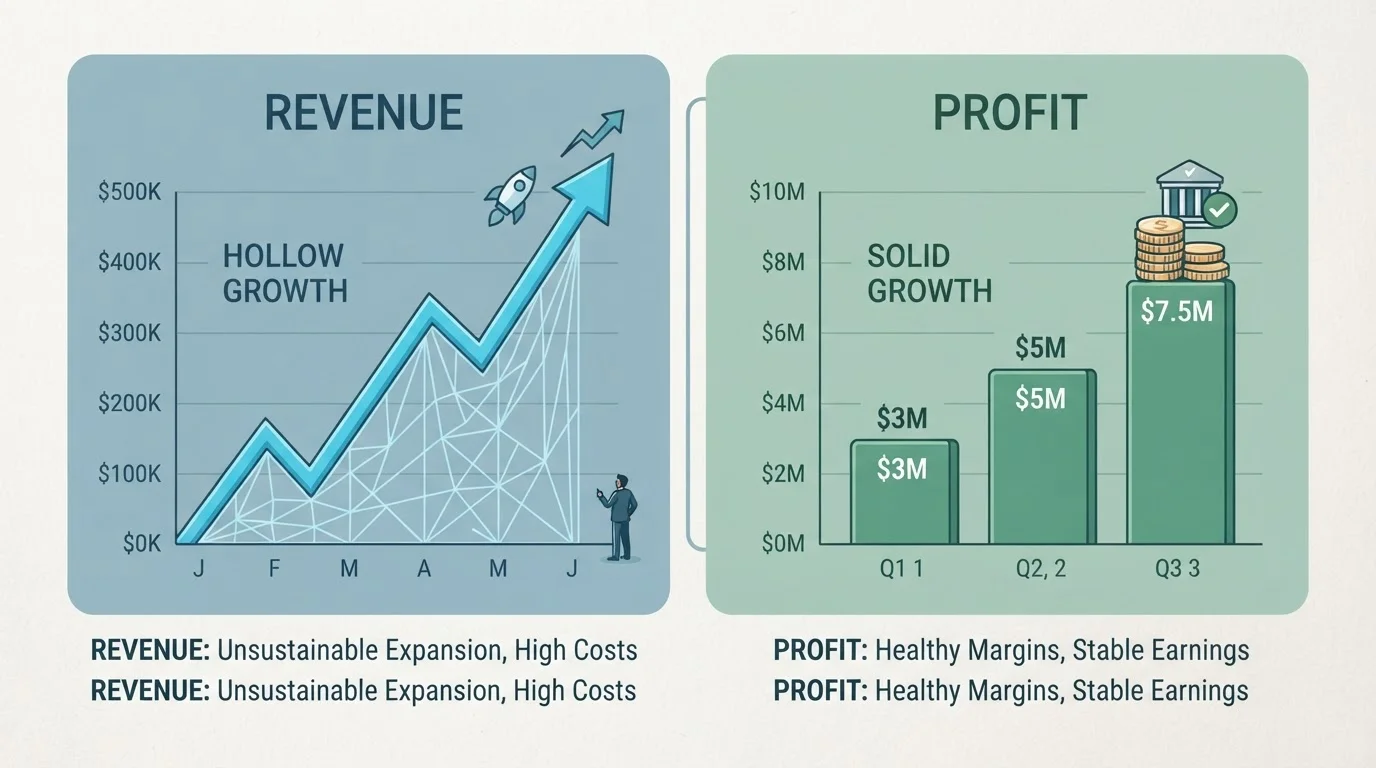
Option A
Revenue Growth
The headline number that signals market traction.
Best for: Demonstrating demand, attracting investors, and measuring top-line business scale.
Option B
Profit Growth
The bottom-line measure of sustainable business health.
Best for: Building long-term financial resilience, funding operations, and generating owner returns.
What Each Number Actually Measures
Revenue is the total income a business generates from sales before any costs are deducted. Profit - whether gross, operating, or net - is what remains after expenses are subtracted. These two numbers can move in entirely opposite directions, which is the core of why conflating them causes strategic problems.
A business that generates $1 million in revenue but spends $1.1 million to do so is not succeeding - it is accelerating toward insolvency. Yet revenue growth alone can make that same business look thriving on a pitch deck or in a press release. Understanding the gap between the two is foundational to sound decision-making.
There are three common profit measures worth distinguishing. Gross profit subtracts the direct cost of goods or services sold. Operating profit also accounts for overhead like rent and salaries. Net profit captures what remains after taxes and interest. Each layer tells you something different about where value is being created or destroyed.
| Criterion | Revenue Growth | Profit Growth |
|---|---|---|
| What it measures | Total income before expenses | Income remaining after all costs |
| Primary signal | Market demand and scale | Operational efficiency and viability |
| Can increase while the other falls? | Yes - often does | Yes - if costs shrink faster than sales |
| Risk if over-prioritised | Rapid scaling of unprofitable activity | Underinvestment in growth opportunities |
| Most relevant to | Investor reporting, market positioning | Owner pay, reinvestment, business survival |
| Typical focus stage | Early growth, market expansion | Maturity, stability, self-funded growth |
How Revenue Growth Can Mask Serious Problems
Many small business owners experience a period of exciting revenue growth - new customers, larger orders, expanded services - only to find themselves financially strained months later. This pattern has a straightforward cause: revenue growth funded by escalating costs produces the illusion of progress.
Common culprits include discounting to win volume, hiring ahead of demand, expanding into unprofitable product lines, or underpricing to outcompete rivals. Each of these strategies can inflate the top line while quietly eroding margins. If you are questioning common growth assumptions, this is one of the most important myths to examine: more revenue does not automatically mean a healthier business.
The risk compounds at scale. If your unit economics are broken - meaning each sale costs more to make than it returns - growing faster simply loses money faster. Catching this early, before volume magnifies the damage, is critical.
82%
Small business failures linked to cash flow or profitability issues
U.S. Bank research has long cited poor cash flow management as a leading cause of small business failure, underscoring why profit visibility matters as much as revenue.
~50%
Small businesses that survive past five years
According to U.S. Bureau of Labor Statistics data, roughly half of small businesses close within five years - a rate often tied to unsustainable cost structures despite growing sales.
When Revenue Growth Is the Right Priority
Revenue growth is not inherently misguided. For businesses in early stages establishing market presence, or those with a deliberate investment period where costs are front-loaded, prioritising top-line growth can be strategically sound. The key word is deliberate - the owner understands the margin trade-off and has a defined timeline for when profitability becomes the primary goal.
Venture-backed startups famously operate this way for years. But most small businesses are not venture-backed. For the majority of independent operators, treating revenue as the sole success metric is a structural risk. As explored in our look at why small businesses hit growth ceilings, the ceiling often arrives precisely because revenue was prioritised without a corresponding focus on margin discipline.
Building a Framework That Tracks Both
Sustainable growth requires holding both metrics in view simultaneously and knowing which one deserves more attention at your current stage. A practical starting point is to calculate your profit margin percentage - net profit divided by revenue - and track it month over month alongside revenue. If revenue rises while margin percentage falls consistently, costs need investigation before growth continues.
The metrics that matter most when scaling go beyond revenue alone: customer acquisition cost, average order value, and gross margin per product line all reveal whether growth is profitable or merely busy. Pairing these with an understanding of how cash flow differs from profit gives a complete financial picture.
A useful rule of thumb: if you cannot clearly explain where your profit goes as revenue grows, that is the gap that needs closing before your next expansion move.
Gross vs. Net Profit: Know the Difference
Gross profit tells you whether your core product or service is profitable before overhead. Net profit tells you whether the whole business is. A healthy gross margin with a weak net margin usually points to overhead costs - rent, payroll, software subscriptions - that have grown faster than the business can absorb. Reviewing both figures separately helps you pinpoint exactly where value is leaking.
This article is for general informational and educational purposes only and does not constitute financial or business advice. Consult a qualified accountant or financial adviser for guidance specific to your situation.
The content on this site is for informational purposes only and is not a substitute for professional advice. Always consult a qualified professional for guidance specific to your situation.