

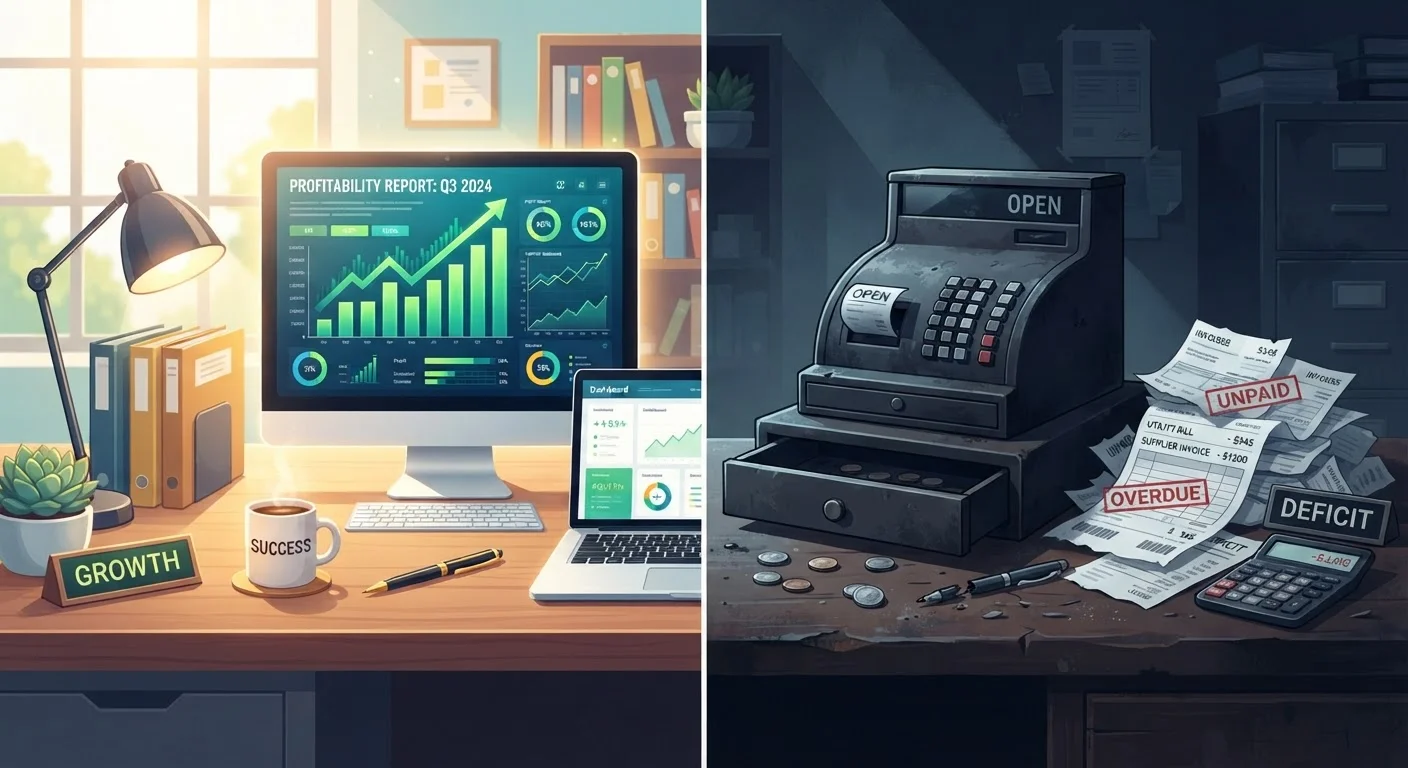
Option A
Cash Flow
The real-time pulse of your business's financial health.
Best for: Day-to-day operations, payroll, supplier payments, and ensuring the business stays solvent right now.
Option B
Profit
The long-term scorecard of whether your business model works.
Best for: Evaluating business viability, attracting investors, and measuring whether revenue exceeds total costs over time.
Two Numbers, Two Very Different Stories
Ask most small business owners how their business is doing, and they'll point to profit. And that's reasonable - profit is the headline figure that tells you whether revenue exceeds costs. But profit alone doesn't tell you whether there's money in the bank to pay next Friday's payroll.
Cash flow is a separate measure entirely. It tracks the actual timing of money moving into and out of your business. You can record a sale the moment a customer places an order, but if that customer has 60-day payment terms, you won't see that cash for two months. During those two months, your profit statement looks fine. Your bank account may not.
This gap - between recognizing revenue on paper and actually collecting it - is at the root of one of the most common and misunderstood problems in small business finance. Understanding how cash flow and profit interact is foundational to keeping your business solvent. For a broader look at the financial missteps that quietly derail small businesses, see where small business owners go wrong with their finances.
| Criterion | Cash Flow | Profit |
|---|---|---|
| What it measures | Actual money in vs. money out | Revenue minus total expenses |
| Timing | Real-time or near-real-time | Over an accounting period |
| Accounting basis | Cash basis (when money moves) | Accrual basis (when earned/incurred) |
| Can be positive while other is negative | Yes - collecting fast, spending little | Yes - profitable but slow to collect |
| Key report | Cash flow statement | Profit & loss (income) statement |
| Primary use | Short-term solvency and operations | Long-term viability and performance |
| Investor relevance | Important for operational health | Primary measure of business returns |
Why Profitable Businesses Run Out of Cash
The scenario plays out more often than most people realize. A business lands a major contract - strong revenue, healthy margins. But to fulfill the order, the owner buys inventory upfront, hires temporary staff, and ships product. The client pays on net-60 terms. Meanwhile, rent, wages, and supplier invoices arrive on schedule. The business is profitable on paper and broke in practice.
Several common situations create this mismatch:
- Extended customer payment terms: B2B businesses especially face long gaps between invoicing and payment collection.
- Rapid growth: Expanding fast requires spending now - on inventory, staff, and equipment - before new revenue materializes.
- Seasonal demand: Businesses with peak seasons must fund operations during slow periods, even if annual profit is positive.
- Large capital purchases: Buying equipment or vehicles depletes cash immediately, while the cost is spread across years on the profit statement through depreciation.
These timing mismatches are why cash flow analysis must stand alongside profit tracking - not replace it, but complement it. If you want to spot trouble before it becomes a crisis, warning signs your business finances are headed for trouble outlines the early indicators worth watching.
82%
Small business failures linked to cash flow problems
According to a widely cited analysis by U.S. Bank, approximately 82% of small businesses that fail do so because of poor cash flow management or a poor understanding of cash flow.
60+ days
Typical B2B invoice payment window
Many business-to-business contracts carry net-30 to net-60 payment terms, meaning sellers may wait two months or more to collect on completed work.
Managing Both Numbers Without a Finance Team
You don't need a CFO to stay on top of cash flow and profit. What you need is discipline around a few core practices.
Build a simple cash flow forecast. Project your expected inflows (customer payments, loans) and outflows (rent, payroll, supplier bills) week by week for the next 90 days. Even a basic spreadsheet surfaces gaps before they arrive.
Separate your financial reports. Your profit and loss statement (P&L) is not the same as your cash flow statement. Accounting software typically generates both. Review each independently - don't assume a positive P&L means you're liquid.
Tighten your receivables process. Invoice promptly, set clear payment terms, and follow up on overdue accounts before they age past 30 days. Faster collections directly improve cash flow without touching profit.
Maintain a cash reserve. Financial advisors commonly suggest businesses hold enough cash to cover several months of operating expenses. The right amount depends on your industry and revenue stability - consult a qualified financial professional to determine what makes sense for your situation.
For habits that support financial control as your business grows, managing business finances well covers practices that hold up at every stage. And if you're also thinking about the relationship between revenue and profit targets, revenue growth vs. profit growth explains why chasing the wrong number stalls businesses.
This article is for general informational and educational purposes only and does not constitute financial, legal, or accounting advice. Consult a qualified financial professional for guidance specific to your business situation.
The content on this site is for informational purposes only and is not a substitute for professional advice. Always consult a qualified professional for guidance specific to your situation.