

Option A
Cash Accounting
The simple, straightforward method for smaller operations.
Best for: Sole proprietors and small businesses that want simplicity and real-time visibility into actual cash on hand.
Option B
Accrual Accounting
The comprehensive method built for growth and complexity.
Best for: Growing businesses, those extending credit to customers, or companies required by the IRS to use accrual basis.
How Each Method Records Money
At the heart of this choice is a single question: when does a financial transaction count? The answer depends entirely on which accounting method you use.
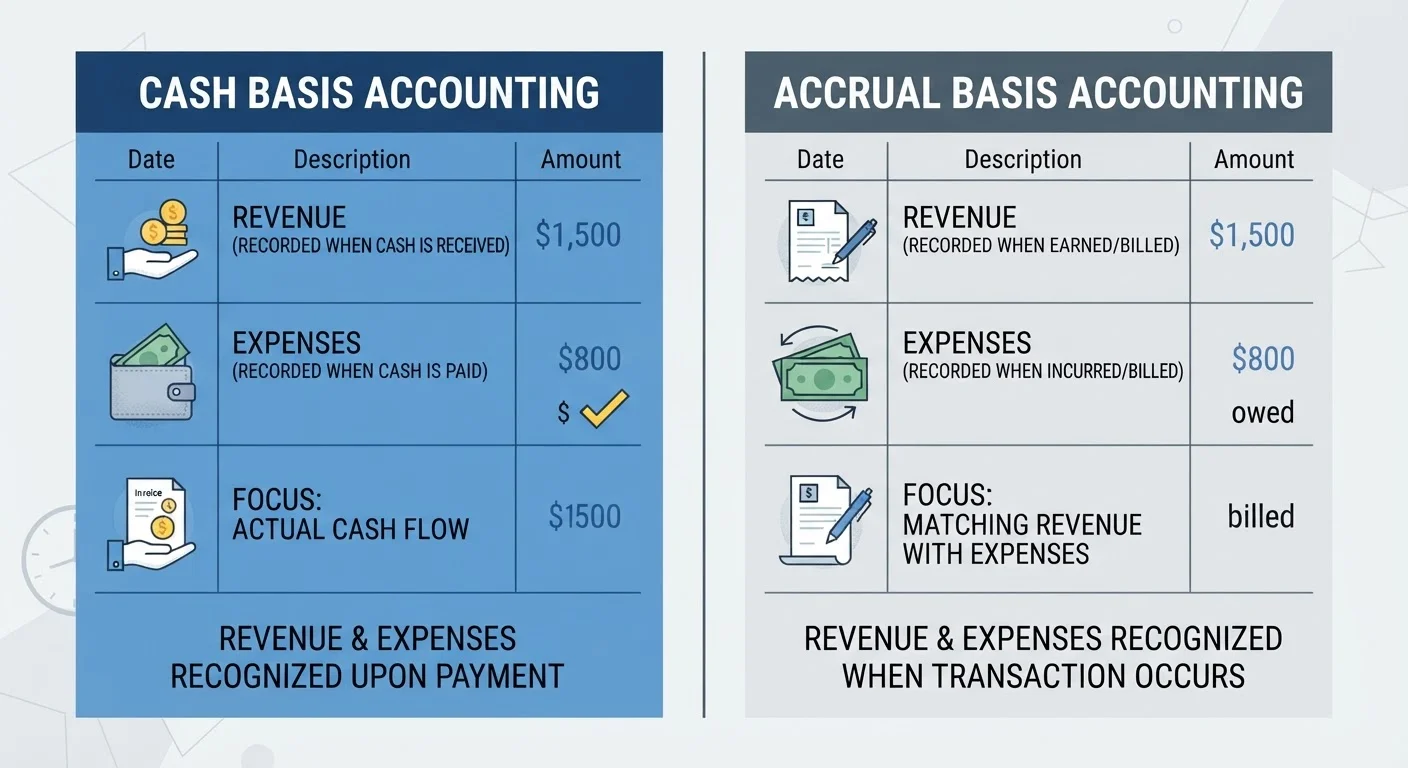
Cash accounting is the more intuitive of the two. Revenue is recorded when a customer pays you. An expense is recorded when you pay a bill. If you invoice a client in November but they pay in January, that income appears in January's books. What you see reflects actual cash movement - nothing more, nothing less.
Accrual accounting operates on a different principle. Revenue is recognized when it is earned - meaning when you deliver a product or complete a service - even if you haven't received payment yet. Expenses are recorded when they are incurred, not when the check clears. This approach follows what accountants call the matching principle: revenues and the expenses that generated them are recorded in the same period.
For a deeper grounding in these fundamentals, see our plain-English guide to small business accounting.
| Criterion | Cash Accounting | Accrual Accounting |
|---|---|---|
| Revenue recorded when | Payment is received | Service or product is delivered |
| Expenses recorded when | Payment is made | Expense is incurred |
| Complexity | Lower - easier to manage | Higher - requires more bookkeeping |
| Accuracy of financial picture | Reflects actual cash on hand | Reflects true economic performance |
| IRS eligibility | Generally up to $30M avg. gross receipts | Required above $30M; sometimes below |
| Best suited for | Small, cash-based businesses | Growing businesses, those extending credit |
| Loan or investor readiness | May be less persuasive to lenders | Generally preferred by lenders and investors |
Practical Implications for Your Business
The method you use shapes more than just your books - it affects how you understand your business's financial position at any given moment.
With cash accounting, a business can look profitable on paper simply because several large client payments arrived in the same week, even if major expenses are looming. Conversely, a business might appear to be struggling if payments are delayed, despite a full pipeline of completed work. This can make planning difficult.
Accrual accounting smooths out those timing gaps. Because it captures what you've earned and what you owe when those events occur, your income statement reflects economic reality more accurately over time. This matters when seeking a business loan, attracting investors, or simply trying to forecast next quarter's cash needs.
$30M
IRS gross receipts threshold for accrual requirement
Under IRS rules updated by the Tax Cuts and Jobs Act, most businesses averaging $30 million or less in gross receipts over three years may use cash-basis accounting.
Form 3115
IRS form required to change accounting methods
The IRS requires businesses to file Form 3115 and receive approval before switching from one accounting method to another, making the initial choice consequential.
That said, accrual accounting introduces complexity. You may show a profit while actually having very little cash available - a situation that catches many business owners off guard. This is why monitoring cash flow separately remains critical regardless of your accounting method. Our article on common financial missteps small businesses make covers this and related pitfalls in detail.
Tax Rules and IRS Requirements
The IRS does not leave the choice entirely open to every business. Under the Tax Cuts and Jobs Act, businesses with average annual gross receipts of $30 million or less (measured over the prior three tax years) generally qualify to use the cash method. Businesses above that threshold are typically required to use accrual accounting.
Additionally, certain types of businesses - including C corporations and tax shelters - face their own restrictions regardless of revenue size. Businesses that maintain inventory may also face requirements related to how that inventory is accounted for, which can influence method choice.
Changing Methods Requires IRS Approval
Switching accounting methods is not a simple administrative update. Businesses must file IRS Form 3115 (Application for Change in Accounting Method) and may be required to make a Section 481(a) adjustment to prevent income from being double-counted or omitted during the transition. The process can affect your taxable income in the year of the change. Always work with a licensed tax professional before initiating a switch.
Switching from one method to the other after you've established your books is not simply a matter of changing a setting. It requires IRS approval via Form 3115, and the transition can trigger adjustments that affect taxable income. This is one reason getting the choice right early - with the guidance of a qualified accountant or tax professional - is well worth the effort.
Your business structure can also intersect with this decision. If you're evaluating structure and accounting method together, our overview of sole proprietorships, LLCs, and corporations offers useful context.
This article provides general financial information for educational purposes only and does not constitute tax, accounting, or legal advice. Consult a licensed accountant or tax professional for guidance specific to your business situation.
The content on this site is for informational purposes only and is not a substitute for professional advice. Always consult a qualified professional for guidance specific to your situation.