

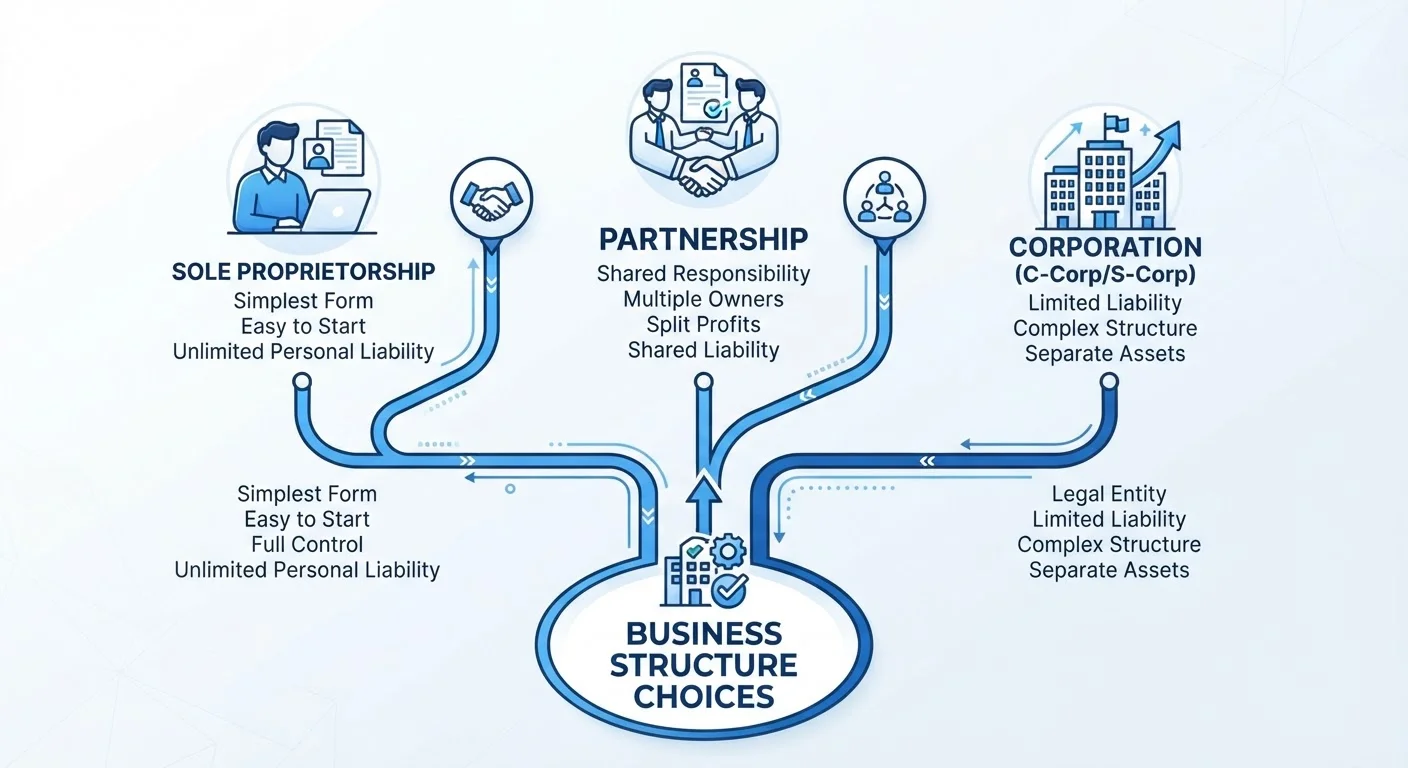
Our Verdict
No single business structure is universally best - the right choice depends on your risk tolerance, growth ambitions, and how much administrative complexity you can manage. Most first-time entrepreneurs running a low-risk solo operation start as sole proprietors, while those concerned about personal liability often find an LLC strikes the right balance. Corporations make sense primarily when outside investment or employee stock plans are on the horizon.
| Best for | Recommended |
|---|---|
| Solo operators testing a business idea with low startup costs | Sole Proprietorship |
| Small business owners wanting liability protection without heavy paperwork | LLC |
| Entrepreneurs planning to raise venture capital or issue stock | Corporation (C-Corp) |
| Small groups of owners wanting pass-through taxation with corporate structure | S-Corporation |
Why Your Business Structure Decision Matters
Before you accept your first dollar of revenue, you need to decide how your business is legally organized. That choice - sole proprietorship, LLC, or corporation - shapes how you're taxed, whether your personal assets are at risk if something goes wrong, and how you can bring in partners or investors later.
If you're new to entrepreneurship, the core concepts behind starting a business are worth understanding first. Once you have that foundation, the structure decision becomes much clearer.
This article lays out the practical differences between each major structure so you can weigh the trade-offs against your specific situation. It is general educational information - always consult a qualified attorney or CPA before making a final decision.
Sole Proprietorship: Simple but Exposed
A sole proprietorship is the default business structure - if you start working for yourself without filing any formal paperwork, you are automatically a sole proprietor in the eyes of the law and the IRS. It requires no formation documents and costs almost nothing to establish.
The significant downside is personal liability. There is no legal separation between you and the business, meaning creditors or lawsuit plaintiffs can pursue your personal savings, home, or other assets. All business income is reported directly on your personal tax return (Schedule C), and you'll owe self-employment taxes on net profits.
Sole proprietorships work reasonably well for freelancers, consultants, and early-stage side businesses where revenue is modest and risk is low. The moment you hire employees, take on client contracts with meaningful liability, or start accumulating assets, it's worth evaluating a more protective structure. For a deeper look at how this compares financially to the next step up, see our article on what the sole proprietorship versus LLC choice means for your finances.
Open a Separate Business Bank Account Immediately
Regardless of structure, mixing personal and business finances is one of the most common and costly mistakes new entrepreneurs make. A dedicated business checking account keeps your records clean, simplifies tax preparation, and - if you operate an LLC or corporation - helps protect your personal liability shield from being challenged.
LLC: Flexibility With a Safety Net
A Limited Liability Company (LLC) creates a legal separation between you and your business. If the business faces a lawsuit or debt, your personal assets are generally protected - though this shield can be pierced if you commingle personal and business funds or act fraudulently, so maintaining separate accounts is essential.
By default, the IRS treats a single-member LLC as a disregarded entity, meaning taxes still pass through to your personal return much like a sole proprietorship. Multi-member LLCs are taxed as partnerships by default. Importantly, an LLC can elect to be taxed as an S-Corporation, which may reduce self-employment taxes at higher income levels - a detail worth discussing with a CPA.
Formation requires filing Articles of Organization with your state and paying a filing fee (which varies by state). Some states also charge annual fees or franchise taxes. The real differences between an LLC and sole proprietorship go beyond liability - they include banking, credibility, and long-term scalability.
| Sole Proprietorship | LLC | S-Corporation | C-Corporation | |
|---|---|---|---|---|
| Formation complexity | None - automatic | Low - state filing required | Moderate - IRS election + state filing | High - articles, bylaws, board |
| Personal liability protection | None | Yes, if properly maintained | Yes | Yes |
| Tax treatment | Pass-through (Schedule C) | Pass-through by default | Pass-through to shareholders | Corporate tax + dividend tax |
| Self-employment tax | Full amount on net profit | Full amount (unless S-Corp election) | Only on reasonable salary | Not applicable to shareholders |
| Outside investment ability | Very limited | Limited | Restricted (100 shareholder cap) | Unlimited - preferred by VCs |
| Ongoing admin burden | Minimal | Low to moderate | Moderate | High |
| Best starting scenario | Solo, low-risk freelancing | Most small businesses | Profitable small businesses | High-growth, investor-backed startups |
Corporations: Built for Growth and Investment
A corporation is a fully separate legal entity that can own property, enter contracts, and be sued independently of its owners (shareholders). There are two main types for small business owners: the C-Corporation and the S-Corporation.
C-Corps face corporate income tax at the entity level, and shareholders also pay taxes on dividends - a situation called double taxation. However, C-Corps can issue multiple classes of stock and have unlimited shareholders, making them the structure of choice for venture-backed startups.
S-Corps avoid double taxation by passing income through to shareholders' personal returns, but they come with restrictions: no more than 100 shareholders, all of whom must be U.S. citizens or residents, and only one class of stock is allowed.
Both types require formal governance - bylaws, a board of directors, shareholder meetings, and detailed record-keeping. This administrative overhead is manageable for businesses with growth ambitions but burdensome for solo operators. Once you've settled on a structure, understanding what filings, licenses, and permits you actually need is the logical next step.
Making the Decision: Key Questions to Ask
Rather than defaulting to the simplest option, work through these questions before you register:
- How much personal risk is involved? If clients could sue you for significant damages, an LLC or corporation's liability shield matters greatly.
- Do you need outside investment? Investors typically require a corporation, often a C-Corp, before writing a check.
- How complex is your tax situation? Pass-through structures keep filing simpler; a CPA can model the actual tax impact for your income level.
- How many owners are involved? Partnerships and LLCs with multiple members need an operating agreement defining roles and profit-sharing from day one.
Your accounting method also interacts with your structure - understanding the difference between accrual and cash accounting will help you manage your books correctly from the start. And as your business takes shape, a solid business plan suited to your current stage will clarify which structure best supports your model.
This article is for general informational and educational purposes only and does not constitute legal, tax, or financial advice. Consult a licensed attorney or certified public accountant for guidance specific to your situation.
The content on this site is for informational purposes only and is not a substitute for professional advice. Always consult a qualified professional for guidance specific to your situation.