

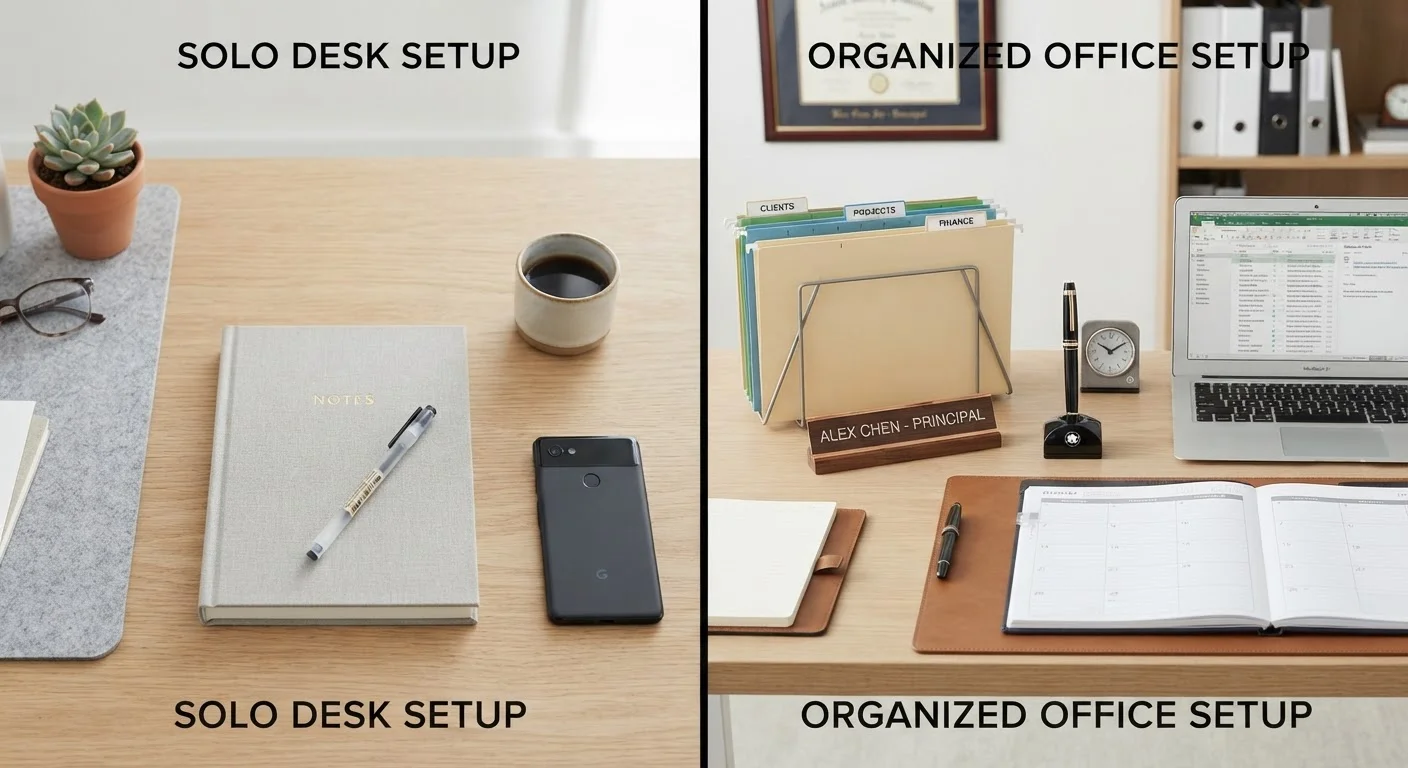
Option A
Sole Proprietorship
The default, zero-friction starting point for solo business owners.
Best for: Freelancers, consultants, or side-hustle operators who want to start quickly with minimal paperwork and overhead.
Option B
Limited Liability Company (LLC)
The structured middle ground between simplicity and legal protection.
Best for: Small business owners who carry financial or legal risk and want to protect personal assets without full corporate complexity.
The Core Financial Difference: Liability
When you operate as a sole proprietor, you and your business are the same legal entity. That sounds simple - and it is - but it carries a serious financial consequence: if your business is sued or cannot pay its debts, your personal bank account, car, and home are all fair game for creditors. There is no legal wall between what belongs to the business and what belongs to you.
An LLC (Limited Liability Company) exists specifically to build that wall. Once properly formed and maintained, an LLC is its own legal entity. In most circumstances, a creditor pursuing the business cannot touch your personal assets to satisfy a business debt. This protection is commonly called the "corporate veil," and it's the single most cited reason small business owners choose to form an LLC.
The protection is not absolute. If you personally guarantee a business loan, commingle personal and business funds, or engage in fraud, courts can "pierce the corporate veil" and hold you personally liable. This is why keeping personal and business finances strictly separate is essential for any LLC owner.
| Criterion | Sole Proprietorship | LLC |
|---|---|---|
| Personal liability | Unlimited - personal assets at risk | Limited - personal assets generally protected |
| Default tax treatment | Pass-through to personal return | Pass-through to personal return |
| Tax election flexibility | None - fixed as sole proprietor | Can elect S-corp or C-corp treatment |
| Formation cost | Essentially free (DBA may apply) | $50-$500+ state filing fee |
| Ongoing compliance | Minimal to none | Annual reports, fees in most states |
| How owner pays themselves | Owner's draw from profits | Draw or salary (required under S-corp) |
| Business credit & credibility | Harder to establish separately | Easier - business has its own legal identity |
How Each Structure Affects Your Taxes
Both structures are pass-through entities by default, meaning business profits pass directly to your personal tax return rather than being taxed at the business level first. That's where the similarity ends.
As a sole proprietor, 100% of your net business income is subject to both ordinary income tax and self-employment tax (covering Social Security and Medicare contributions). Self-employment tax is currently 15.3% on net earnings up to the annual Social Security wage base.
An LLC taxed as a disregarded entity (the default for single-member LLCs) works identically. However, LLCs have a powerful option sole proprietors don't: electing to be taxed as an S-corporation. Under an S-corp election, the owner-operator pays themselves a reasonable salary (subject to payroll taxes), and any remaining profit is distributed without being subject to self-employment tax. For businesses generating meaningful profit above a reasonable salary, this can represent a significant annual tax reduction. Consult a qualified tax professional to determine whether this election makes sense for your specific situation and income level.
15.3%
Self-employment tax rate on net earnings
The IRS applies this rate (covering Social Security and Medicare) to net self-employment income for both sole proprietors and single-member LLC owners by default.
$50-$500+
Typical LLC formation filing fees by state
State fees vary widely; some states like Kentucky charge as little as $40, while Massachusetts charges $500, according to state government fee schedules.
~70%
Share of U.S. businesses with no employees
The U.S. Census Bureau's nonemployer statistics show the vast majority of American businesses are operated by a single owner with no paid employees - the core audience for this decision.
For a deeper look at financial missteps tied to structure decisions, see common financial mistakes small business owners make.
Setup Costs, Ongoing Requirements, and How You Pay Yourself
Starting a sole proprietorship has virtually no cost. In most states, you simply begin conducting business. If you operate under a name other than your own legal name, you may need to file a "doing business as" (DBA) registration, which typically costs under $50.
Forming an LLC requires filing Articles of Organization with your state, paying a state filing fee that typically ranges from $50 to $500 depending on where you're located. Many states also require an annual report and fee to keep the LLC in good standing. Some states - notably California - charge a minimum annual franchise tax on LLCs regardless of revenue.
How you access your own money also differs. Sole proprietors take an owner's draw - they simply move money from the business account to a personal account. There's no payroll processing involved, though estimated quarterly tax payments are required. LLC members can also take draws, but those who elect S-corp status must run a formal payroll for their salary portion, which adds payroll administration costs.
If you're evaluating how to fund growth beyond your structure choice, the comparison of debt and equity financing is a useful next read.
State Rules Vary Significantly
LLC requirements, fees, and tax treatment differ from state to state. California, for example, imposes an $800 annual minimum franchise tax on LLCs, which may make the structure less cost-effective for very low-revenue businesses in that state. Always check your specific state's Secretary of State website or consult a local business attorney before forming an LLC.
For a side-by-side look at how these structures compare across liability, taxes, and paperwork in greater detail, see LLC vs. Sole Proprietorship: Understanding the Real Differences.
This article is for general informational and educational purposes only. It does not constitute legal, tax, or financial advice. Consult a licensed attorney, accountant, or financial adviser for guidance specific to your situation.
The content on this site is for informational purposes only and is not a substitute for professional advice. Always consult a qualified professional for guidance specific to your situation.