

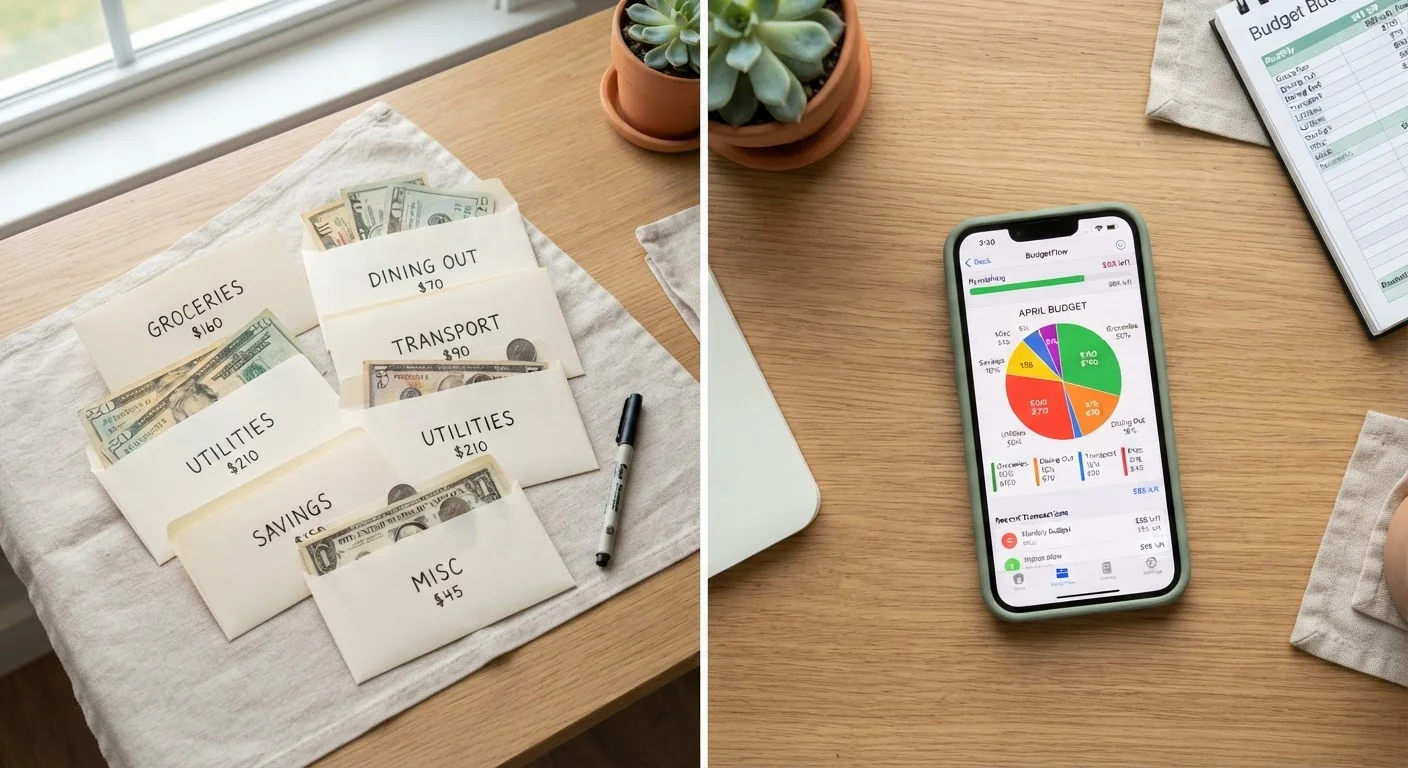
Option A
Envelope Budgeting
The tactile, cash-based system that makes limits impossible to ignore.
Best for: People who overspend with cards and benefit from physically handling money to feel the impact of each purchase.
Option B
Digital Spending Trackers
The data-driven, automated approach to monitoring where money flows.
Best for: People who primarily pay digitally and want a consolidated, real-time view of their finances across accounts.
How Each System Works
Envelope budgeting is straightforward: after each paycheck, you divide your available cash into labeled envelopes - one for groceries, one for gas, one for dining out, and so on. When an envelope is empty, spending in that category stops until the next funding cycle. There are no loopholes, no overdraft buffers, and no credit lines to fall back on. The system was popularized as a debt-elimination tool decades ago and remains a staple recommendation among personal finance educators.
Digital spending trackers work differently. They connect to your bank accounts, credit cards, and sometimes investment accounts, automatically categorizing transactions as they occur. You set budget targets inside the app, and the software alerts you as you approach or exceed each limit. Some trackers are standalone apps; others are built into banking platforms. Either way, the data does most of the recording work - your job is to review it regularly and act on what you see.
Understanding spending categories is the foundation of both systems. See how spending categories help you see where money actually goes for guidance on structuring your budget buckets before you pick a tracking method.
Head-to-Head Comparison
The two approaches differ across nearly every practical dimension - from setup effort to long-term usability. The table below captures the key distinctions.
| Criterion | Envelope Budgeting | Digital Spending Trackers |
|---|---|---|
| Payment type supported | Cash only | Cards, bank transfers, digital payments |
| Setup effort | Low - label envelopes, divide cash | Moderate - link accounts, configure categories |
| Spending feedback | Instant - empty envelope = stop | Delayed - relies on alerts and review |
| Historical data | None unless tracked separately | Months or years of transaction history |
| Online purchases | Not directly supported | Tracked automatically |
| Security risk | Cash loss/theft is unrecoverable | Data privacy and account security concerns |
| Best for overspending prevention | High - hard limit built in | Moderate - depends on user discipline |
| Ongoing maintenance | Weekly cash withdrawal and sorting | Regular review and category corrections |
One contrast worth emphasizing: envelope budgeting is inherently a forward-looking constraint tool. You allocate before you spend. Digital trackers are often used retrospectively - you review what already happened. Both serve a purpose, but if your goal is prevention rather than analysis, that distinction matters.
The Psychology Behind Each Method
Research in behavioral economics consistently shows that payment method affects spending behavior. Paying with physical cash tends to feel more "painful" than swiping a card, a phenomenon sometimes called the pain of paying. Envelope budgeting leverages this directly - you feel the depletion of each category in a visceral way that a low-balance notification rarely replicates.
Digital trackers, on the other hand, support what behavioral researchers call availability heuristic improvements: when your full financial picture is visible and easy to access, you're more likely to make decisions that align with your actual situation. The challenge is that convenience can also breed passivity. If you don't actively review the data, the tracker becomes a ledger rather than a guide.
~83%
Americans who primarily use cards over cash
Federal Reserve payment studies consistently show that the majority of U.S. consumer transactions are now made via debit card, credit card, or digital payment rather than cash.
Less
Typical spending when paying with cash vs. cards
Multiple behavioral economics studies have found that consumers tend to spend less when using physical cash compared to card or contactless payments, though effect sizes vary by individual and context.
If you've never tracked spending manually, even for a single month, it's worth the exercise before going fully automated. Tracking spending manually at least once builds the kind of category-by-category awareness that makes any subsequent system - digital or cash-based - more effective.
Practical Limitations to Know Before You Start
Envelope budgeting has real-world friction. Withdrawing and sorting cash takes time. Many merchants - particularly online retailers and subscription services - don't accept cash, so purely cash-based budgeting requires supplemental tracking for digital transactions. There's also a security consideration: carrying significant amounts of cash involves risk of loss or theft, and unlike a debit card, cash generally cannot be recovered if stolen.
Digital trackers carry their own limitations. Automatic categorization is imperfect; transactions are frequently miscategorized and require manual correction. Account syncing can break when financial institutions update their systems. More fundamentally, a tracker only changes behavior if you engage with it regularly - a well-designed dashboard left unreviewed offers no benefit.
Hybrid Approaches Are Common
Many people find that a hybrid system suits them best - using a digital tracker for the majority of card-based spending while maintaining one or two physical cash envelopes for categories where they consistently overspend, such as dining out or entertainment. There's no rule requiring you to commit fully to one method. The goal is sustainable awareness and control, not methodological purity.
Both methods fit within broader budgeting philosophies. For context on how the timing of your allocations affects outcomes, the comparison between pay-yourself-first and traditional expense-first budgeting is a useful companion read. Whichever tracking method you choose, pairing it with a monthly spending audit helps you close the loop and adjust allocations based on what actually happened.
This article is for general informational purposes only and does not constitute personalized financial advice. Consult a qualified financial professional for guidance specific to your circumstances.
The content on this site is for informational purposes only and is not a substitute for professional advice. Always consult a qualified professional for guidance specific to your situation.