

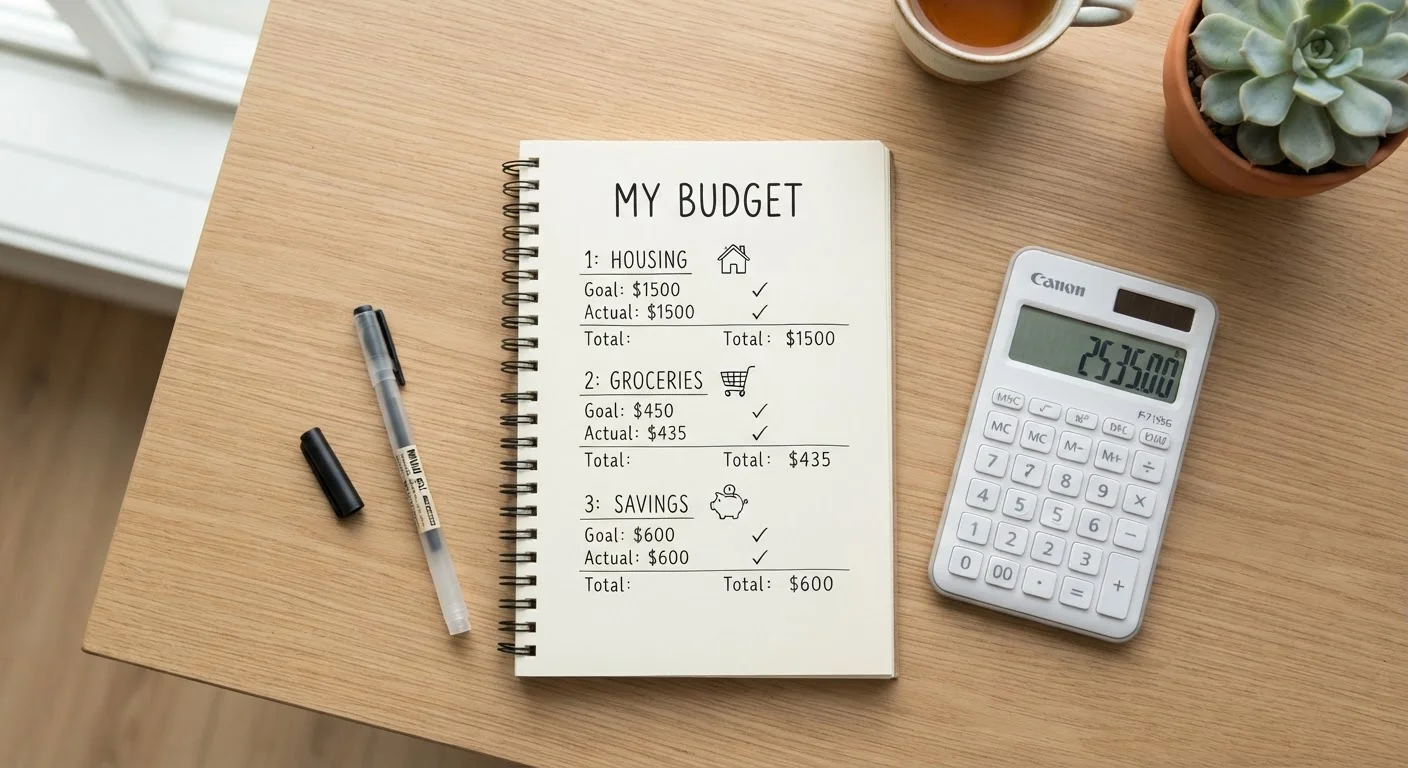
How the Three Buckets Work
At its core, the 50/30/20 rule asks one question: once your paycheck lands, where does it go? The framework answers with three broad categories applied to your after-tax income - also called net income or take-home pay.
- 50% - Needs: Rent or mortgage, groceries, utilities, health insurance, minimum loan payments, and essential transportation. These are expenses you face real consequences for skipping.
- 30% - Wants: Streaming services, restaurants, travel, hobbies, and clothing beyond the basics. These improve quality of life but are not obligations.
- 20% - Savings and debt repayment: Emergency fund contributions, retirement savings, and payments above the minimum on debts. This bucket builds financial resilience over time.
The appeal is its simplicity. Rather than tracking dozens of spending categories, you make three decisions. For a deeper look at how these categories fit into a full monthly plan, see everything that should go into a monthly budget.
~37%
Median share of income spent on housing by renters
According to U.S. Census Bureau data, many American renters spend well above the 30% housing-cost benchmark, which can strain the 50% needs ceiling under the 50/30/20 rule.
57%
Americans living paycheck to paycheck
A recurring finding in multiple consumer finance surveys suggests that a majority of U.S. adults have little financial buffer, making the 20% savings target aspirational for a significant portion of households.
$1,000
Emergency savings threshold many households lack
The Federal Reserve's Report on the Economic Well-Being of U.S. Households has consistently found that a notable share of Americans could not cover a $400-$1,000 emergency expense with existing savings.
When the 50/30/20 Rule Works Well
The framework is most effective when your financial picture is relatively stable. It suits people who:
- Earn a predictable salary or hourly wage
- Live in a region where housing costs consume a manageable share of income
- Have a moderate debt load without high-interest balances dominating their budget
- Want structure without the time commitment of granular expense tracking
For someone in these circumstances, the 50/30/20 rule provides enough guardrails to prevent overspending on wants while ensuring savings don't get neglected. It also pairs naturally with a pay-yourself-first approach, where the 20% savings portion is automated before discretionary spending begins.
Automate the 20% First
The most reliable way to protect the savings portion is to transfer it automatically on payday - before you have a chance to spend it. Even a modest automated transfer to a savings account or retirement contribution helps embed the habit. Once savings are automated, you can spend the remaining 80% more freely without tracking every dollar.
Real Limitations to Understand
The rule has meaningful blind spots that affect a large share of American households.
Housing costs in many markets exceed the ceiling
In high-cost cities, rent alone can absorb 40-50% of take-home pay for median earners, leaving nothing for other needs before the wants or savings buckets are even considered. The 50% threshold was more achievable when the framework was conceived; housing inflation in many U.S. metros has outpaced wage growth.
It ignores high-interest debt urgency
The rule treats all debt repayment the same, tucking it into the 20% bucket. But carrying credit card debt at 20%+ interest is a financial emergency that generally warrants reallocating funds from the wants category, not managing it alongside long-term savings at the same priority level.
Low incomes make the math difficult
When essentials consume 70-80% of income, meeting even basic needs can be a stretch. The rule can feel aspirational rather than practical in these cases. Personal finance on a tight budget explores how to adapt when the numbers don't cooperate.
The needs-vs-wants distinction is harder than it sounds
Is a car payment a need or a want? What about a phone plan? The framework assumes these lines are clear, but in practice they require judgment. For a more structured way to think through these distinctions, see understanding the difference between needs, wants, and financial priorities.
Adapting the Rule to Your Situation
The percentages in the 50/30/20 rule are not sacred. Think of them as a starting benchmark, then adjust based on your actual circumstances:
- Aggressive debt payoff: Consider a 50/20/30 split, temporarily cutting wants to accelerate repayment of high-interest balances.
- High housing costs: If needs genuinely require 60%, compress wants to 20% and protect savings at 20% rather than abandoning savings altogether.
- Building an emergency fund: Temporarily weight the 20% entirely toward liquid savings before diversifying into retirement or investment accounts.
- Irregular income: Apply percentages to your average monthly income or your lowest expected month, and rebuild any shortfall during higher-earning periods.
The framework's real value is encouraging you to assign purpose to every dollar - a habit that supports both saving and debt reduction over time. Modifying the percentages doesn't break the framework; abandoning intentionality does.
A nurse earning $5,000 per month after taxes rents an apartment for $1,400, spends $400 on groceries and utilities, and pays $300 toward a car loan - totaling $2,100, or 42% of income.
A graphic designer in a high-cost city takes home $4,800 per month but pays $2,200 in rent - nearly 46% of income - before factoring in any other essential expenses.
A recent college graduate earns $3,500 per month and carries $18,000 in credit card debt at 22% interest alongside federal student loans.
A freelance consultant earns between $3,000 and $7,000 monthly depending on client work, making fixed percentage budgeting unpredictable month to month.
This article is for general informational purposes only and does not constitute personalized financial, tax, or investment advice. Consult a qualified financial professional before making decisions based on your specific circumstances.
Frequently Asked Questions
Needs are expenses you cannot reasonably avoid: rent or mortgage payments, basic groceries, utilities, health insurance, minimum debt payments, and transportation to work. Subscriptions, gym memberships, and dining out are generally considered wants. The line between needs and wants can be blurry - see <a href="/finance/everyday-money-tips/understanding-the-difference-between-needs-wants-and-financial-priorities">this guide to categorizing spending</a> for a more nuanced breakdown.
For many low-income households, 50% of take-home pay does not cover essential expenses, making the rule difficult to apply as written. When income is tight, prioritizing essentials and any savings - even small amounts - matters more than hitting specific percentages. <a href="/finance/budgeting-basics/personal-finance-on-a-tight-budget-what-the-numbers-actually-tell-you">This guide for tight budgets</a> addresses strategies when the margin is thin.
Yes - the percentages are a starting point, not a rule carved in stone. Someone paying off high-interest debt might shift to 50/20/30, allocating more to debt repayment. Someone early in their career with low expenses might push more into savings. The goal is intentional allocation, not perfect adherence to specific numbers.
Zero-based budgeting assigns every dollar a specific purpose, requiring more detailed tracking but offering tighter control. The 50/30/20 rule is broader and simpler, trading granularity for ease of use. <a href="/finance/everyday-money-tips/zero-based-budgeting-vs-the-503020-rule">A direct comparison of the two methods</a> can help you decide which approach fits your style.
Generally yes - contributions to retirement accounts like a 401(k) or IRA are typically counted within the 20% savings and debt repayment bucket. If your employer makes pre-tax 401(k) deductions before you receive your paycheck, calculate your percentages based on your actual take-home pay and consider whether those contributions are already partially accounted for.
It can work with irregular income if you base the percentages on an average monthly figure or your lowest expected month rather than a variable paycheck. Some people with freelance or seasonal income prefer zero-based budgeting for its precision. Regardless of method, building a cash cushion to smooth income fluctuations is a priority before applying any fixed-percentage framework.
The content on this site is for informational purposes only and is not a substitute for professional advice. Always consult a qualified professional for guidance specific to your situation.