

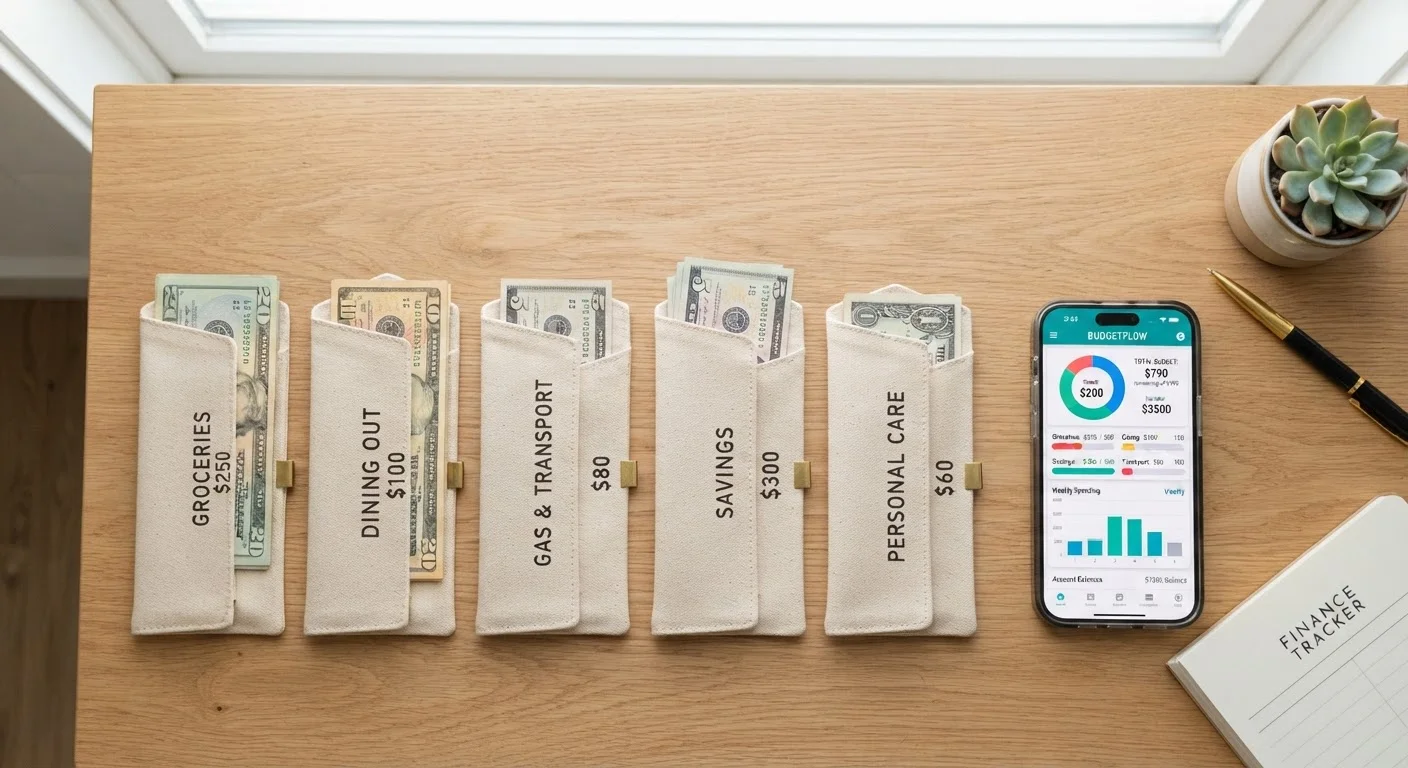
Option A
Cash Envelope System
The tactile, discipline-first approach to spending control.
Best for: People who overspend with cards and benefit from a physical, visible spending limit.
Option B
Digital Budgeting Apps
The automated, data-rich approach to modern money management.
Best for: People who want real-time tracking, automated syncing, and detailed spending reports.
How Each Method Works
The cash envelope system is a zero-based budgeting technique: each paycheck is divided into physical envelopes labeled by spending category - groceries, dining, entertainment, and so on. You spend only what's in each envelope. When it's empty, that category is closed until next pay period. The method traces back decades and was popularized as a tool for households struggling with discretionary overspending.
Digital budgeting apps take a different approach. After connecting to your bank accounts and credit cards, they automatically import and categorize transactions. You set spending limits per category within the app, and the software tracks your progress in real time, sending alerts when you approach or exceed a limit. Many apps also support bill reminders, savings goals, and net worth tracking.
Both systems follow the same foundational principle - allocate income into categories before you spend it - but the mechanism and feedback loop are fundamentally different. Understanding how spending categories work is the prerequisite for making either method effective.
| Criterion | Cash Envelope System | Digital Budgeting Apps |
|---|---|---|
| Setup effort | Low - label envelopes, divide cash | Moderate - link accounts, configure categories |
| Best for | Discretionary, in-person spending | All spending, including digital and recurring |
| Spending feedback | Immediate (envelope empties visually) | Real-time alerts and dashboards |
| Handles subscriptions | Poorly - not cash-based | Yes - auto-categorized from linked accounts |
| Historical reporting | None built-in | Charts, trends, monthly summaries |
| Cost | Free | Free to paid subscription tiers |
| Security consideration | Cash loss risk if envelopes are misplaced | Data privacy and account security risks |
The Psychology Behind Each Approach
Behavioral economists have long studied the "pain of paying" - the discomfort people feel when parting with money. Research consistently shows that cash payments tend to produce this sensation more acutely than card swipes or digital transactions, which feel more abstract. This psychological friction is the engine behind the envelope system's effectiveness for impulsive or habitual overspenders.
Digital apps, by contrast, leverage a different psychological lever: visibility and data. Seeing a pie chart showing that dining out consumed 30% of your monthly budget can motivate behavioral change even when no cash changed hands. Apps also reduce the cognitive load of manual tracking, which matters because budgeting fatigue is a common reason people abandon their systems entirely.
~12-18%
Reduction in spending linked to cash use
Multiple behavioral economics studies, including work by researchers at MIT and the University of Toronto, have estimated that consumers tend to spend meaningfully less when using cash versus card payment methods.
3 in 5
Americans who say they follow a budget
Surveys conducted by the National Foundation for Credit Counseling have found that a majority of Americans report having a budget, though consistent adherence remains a challenge across income levels.
Neither approach is universally superior. Personality, spending habits, and financial complexity all determine which mechanism resonates. A fully automated financial system may outperform both for people whose challenge is saving rather than discretionary overspending.
Practical Strengths and Limitations
The envelope system's primary strength is its hard constraint. It works well for cash-friendly spending categories and people who respond better to tangible cues than digital dashboards. Its limitations are real, however: it is impractical for online purchases, subscriptions, rent, and utility autopayments - all of which are increasingly central to household budgets. Carrying cash also introduces minor security risk.
Digital apps handle the modern, cashless economy seamlessly. They aggregate every account in one place and generate the kind of detailed spending history that supports a thorough monthly spending audit. The trade-off is setup complexity and a reliance on accurate automatic categorization, which often requires manual corrections. Some apps also carry subscription costs.
A practical middle ground: use physical envelopes for two or three categories where you know you overspend, and rely on an app for everything else. This hybrid model appears frequently among people who find that different budgeting philosophies work better applied selectively rather than as all-or-nothing systems.
Hybrid Budgeting Is a Valid Strategy
You are not required to choose one system exclusively. Many financial educators suggest applying envelope-style cash limits only to your highest-risk spending categories - dining out, entertainment, personal shopping - while using an app to monitor fixed expenses, savings goals, and overall cash flow. This preserves the psychological benefits of physical cash where they matter most without making cash management unwieldy. Experiment for one to two months with both and adjust based on what actually changes your behavior.
This article is for general informational and educational purposes only. It is not personalized financial advice. Consult a qualified financial professional for guidance tailored to your specific situation.
The content on this site is for informational purposes only and is not a substitute for professional advice. Always consult a qualified professional for guidance specific to your situation.