

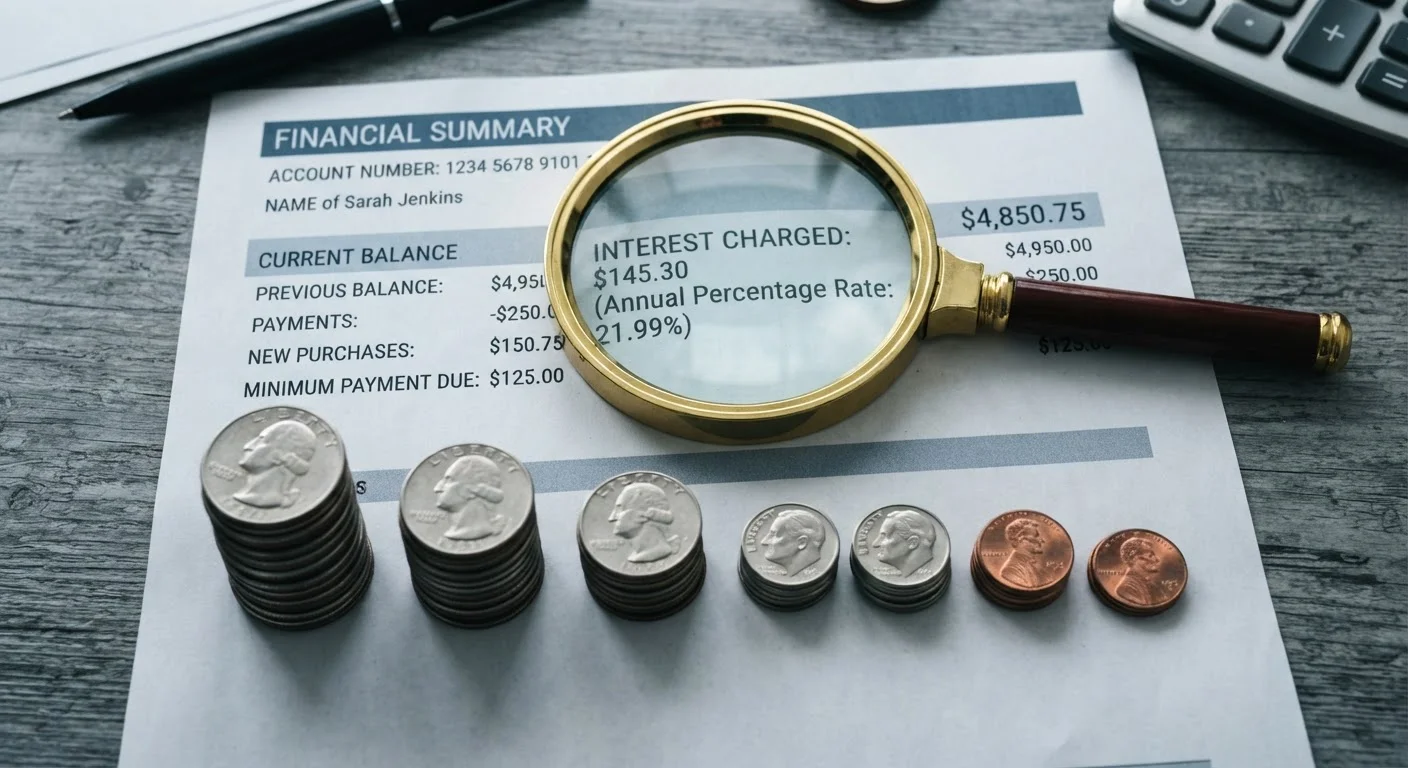
How Interest Quietly Compounds Against You
When you carry a balance on a high-APR credit card, interest does not simply sit still. Most credit card issuers compound interest daily - applying a fraction of your annual rate to your balance every single day. At a 24% APR, your daily rate is roughly 0.066%. That may sound trivial, but applied to a $5,000 balance every day, it generates approximately $3.29 in new interest charges - before you've made a single purchase.
What makes this especially consequential is that unpaid interest gets folded back into the balance. Next month, you're paying interest on last month's interest. This is the compounding effect, and it accelerates the growth of debt in ways that feel invisible until you look closely at a statement and notice your balance has barely moved despite months of payments.
Debt Consolidation: A Tool, Not a Cure
Some borrowers explore debt consolidation to simplify or reduce interest costs. While this can be a useful strategy in the right circumstances, it does not eliminate debt - it reorganizes it. Understanding what debt consolidation changes and what it doesn't is important before pursuing this path.
For readers interested in how broader financial habits contribute to this problem, financial moves that quietly set back debt payoff progress are often more subtle than people realize.
The Minimum Payment Trap
Credit card minimum payments are not designed to eliminate debt efficiently - they are structured to keep accounts in good standing while maximizing the amount of interest paid over time. A typical minimum payment might be 1-2% of the outstanding balance or a flat $25-$35, whichever is greater.
Consider a $6,000 credit card balance at 22% APR. Paying only the minimum each month could take more than 15 years to fully repay, with total interest paid exceeding the original balance. The total repayment in that scenario could approach $13,000 - more than double the amount originally borrowed.
20%+
Average credit card APR in the U.S.
According to Federal Reserve data, average credit card interest rates have exceeded 20% in recent reporting periods, a multi-decade high.
2x+
Potential total repayment vs. original balance
Consumer finance calculations consistently show that minimum-only payments on high-APR balances can result in repaying more than twice the original amount borrowed.
$1,000s
Interest saved by paying above the minimum
Standard amortization analysis shows that even modestly accelerated payments on a typical credit card balance can save thousands of dollars in interest over the life of the debt.
Increasing a monthly payment even modestly - say, an extra $50 or $100 per month - can shave years off the repayment timeline and save thousands in interest. The mathematical leverage of paying above the minimum is one of the most impactful, low-risk changes an individual can make to their debt trajectory.
The Savings-vs.-Debt Dilemma
A common source of confusion is whether to prioritize saving money or paying down debt. Both goals feel responsible, but when high-interest debt is involved, the math often points clearly in one direction: the interest rate on the debt typically exceeds any return available from a standard savings account.
Holding $3,000 in a savings account earning 4-5% annually while carrying $3,000 in credit card debt at 22% APR means you are effectively losing 17 or more percentage points on that money each year. This does not mean savings should be abandoned entirely - most financial professionals recommend maintaining a modest emergency fund as a buffer against unexpected expenses. But beyond that cushion, directing surplus income toward high-interest debt often produces a better measurable outcome than accumulating savings at lower yields.
It is also worth examining recurring charges quietly draining bank accounts, since freeing up even small monthly amounts can accelerate debt repayment meaningfully.
This article is for general informational and educational purposes only. It does not constitute personalized financial, tax, or legal advice. Please consult a qualified financial adviser before making decisions about your specific financial situation.
Frequently Asked Questions
Generally, any debt with an APR above 10-12% is considered high-interest, though credit cards often carry rates of 20% or more. Payday loans can carry effective APRs in the triple digits. The higher the rate, the faster an unpaid balance grows.
Minimum payments are typically calculated as a small percentage of your balance or a flat fee, whichever is greater. Most of that payment goes toward interest charges first, leaving very little to reduce the principal. This can extend a debt's repayment timeline by years.
This depends on your specific situation, including the interest rate on your debt and your financial safety net. A common guideline is to maintain a small emergency fund while aggressively paying down high-interest debt, since few savings accounts earn more than high-interest debt costs. Consult a qualified financial adviser for guidance tailored to your circumstances.
When interest compounds, it is calculated on both the original balance and previously accumulated interest. On a daily-compounding credit card, even a month's delay in payment results in interest charged on interest, causing balances to grow faster than a simple interest calculation would suggest.
Two widely recognized approaches are the avalanche method (paying the highest-interest debt first to minimize total interest paid) and the snowball method (paying the smallest balance first for psychological momentum). Neither is universally superior - the best approach is the one you can maintain consistently. A financial professional can help you choose.
The content on this site is for informational purposes only and is not a substitute for professional advice. Always consult a qualified professional for guidance specific to your situation.