

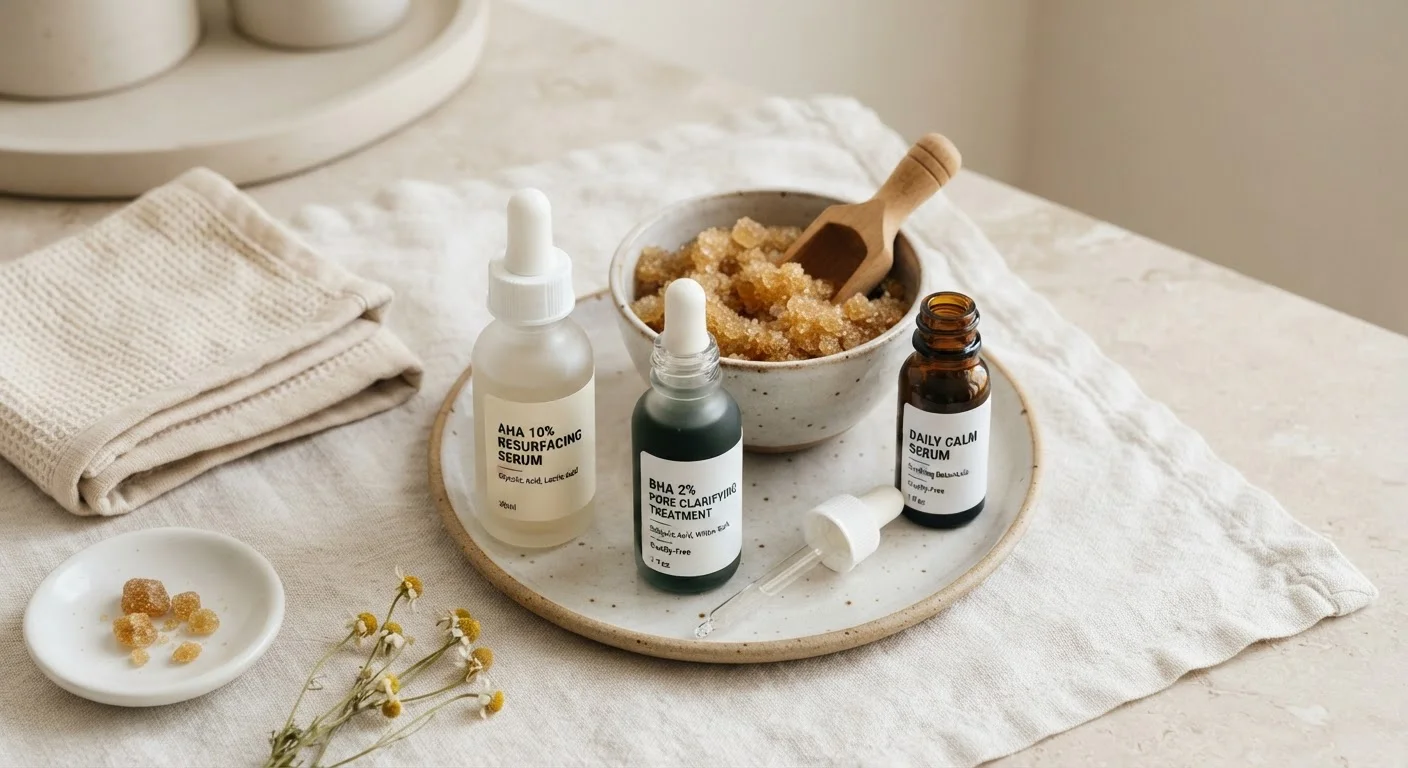
Option A
Chemical Exfoliants
The science-backed, formula-driven approach.
Best for: Those with sensitive, acne-prone, or uneven-toned skin who need targeted, controlled exfoliation without friction.
Option B
Physical Scrubs
The hands-on, texture-based classic.
Best for: Those seeking immediate tactile smoothness on resilient skin areas like the body, elbows, or feet.
How Each Method Actually Works
Exfoliation - removing dead cells from the skin's outermost layer - is a cornerstone of most effective skincare routines. But the mechanism behind each approach differs fundamentally, and that difference matters for safety and results.
Chemical exfoliants use active ingredients to dissolve the bonds between dead skin cells and the living layer beneath. The main categories are:
- AHAs (alpha hydroxy acids) - such as glycolic and lactic acid - work on the skin's surface, making them well-suited for texture, dullness, and mild discoloration. They are water-soluble and derived largely from fruit or milk sources.
- BHAs (beta hydroxy acids) - primarily salicylic acid - are oil-soluble and penetrate into pores, making them the more appropriate choice for oily or acne-prone skin.
- Enzymes - derived from sources like papaya or pineapple - offer a gentler alternative, breaking down keratin protein in dead cells. They are often suitable for sensitive skin types.
Physical scrubs rely on friction. Abrasive particles - sugar, salt, oat bran, rice powder, or finely ground walnut shell - are massaged across the skin to physically dislodge dead cells. The results are immediate: skin feels smoother right away. However, the abrasion is non-selective; it does not distinguish between dead cells and healthy ones.
Understanding your skin type is the starting point for deciding which method is appropriate for you.
| Criterion | Chemical Exfoliants | Physical Scrubs |
|---|---|---|
| Mechanism | Dissolves cell bonds via acids or enzymes | Manually buffs away dead cells via abrasion |
| Best skin area | Face, neck, décolletage | Body (elbows, heels, legs) |
| Suitable for sensitive skin | Yes, with low-concentration formulas | Riskier; friction can irritate |
| Results timeline | Gradual; improves with consistent use | Immediate tactile smoothness |
| Acne-prone skin | BHAs specifically recommended | Generally not advised; risk of spreading bacteria |
| Learning curve | Moderate; requires understanding pH, frequency | Low; straightforward application |
| Over-exfoliation risk | High if layering multiple actives | High with aggressive or daily use |
Benefits, Risks, and Who Each Suits
Chemical exfoliants, when used at appropriate concentrations, offer several evidence-informed advantages. AHAs have been studied for their role in stimulating collagen production and reducing the appearance of fine lines over time. BHAs are among the most clinically supported ingredients for managing comedonal acne. Both can be formulated precisely, allowing for consistent, controlled results with predictable pH levels.
The main risk with chemical exfoliants is overuse or combining multiple actives. Layering an AHA toner, a BHA serum, and a retinoid in the same routine, for example, can compromise the skin barrier, causing redness, peeling, and increased sensitivity. Overloading actives is one of the most frequent errors in new skincare routines.
Physical scrubs deliver immediate tactile satisfaction and require no knowledge of percentages or pH. For body use - on areas like the back, legs, or feet - they can be practical and effective. A twice-weekly gentle body scrub followed by moisturizer is a reasonable routine for most people.
The concern with physical scrubs, particularly on the face, is that irregular particles - especially crushed nut shells or coarse grains - can create microscopic tears in the skin. This is not a theoretical risk; dermatologists have long cautioned against overly aggressive facial scrubbing. Those with active acne should be especially careful, as friction can spread bacteria and worsen inflammation.
Sun Sensitivity After Chemical Exfoliation
AHAs in particular can increase the skin's sensitivity to UV radiation, which is why many dermatologists recommend using them in the evening. Daily broad-spectrum sunscreen (SPF 30 or higher) is important whenever you are incorporating chemical exfoliants into your routine, regardless of when you apply them. This isn't optional - it's a standard precaution to protect freshly exfoliated skin from sun damage.
After any exfoliation session, following up with a hydrating moisturizer is important. See the science-backed body moisturizing habits that support skin recovery and barrier function.
Building It Into Your Routine
Most adults do not need to exfoliate more than two to three times per week, regardless of the method chosen. Skin has a natural cell turnover cycle, and disrupting it too aggressively - even with gentle products - can lead to chronic irritation and a weakened barrier.
If you use chemical exfoliants, consider where in your routine they belong. AHAs and BHAs are generally applied after cleansing and before moisturizing, and many dermatologists suggest using them in the evening to reduce UV sensitivity risk - though sunscreen use the following morning is essential regardless. Your morning versus evening routine structure will affect how and when you incorporate these steps.
For physical scrubs used on the body, apply to damp skin and use light, circular movements. Avoid scrubbing broken, sunburned, or inflamed skin. Rinse thoroughly and follow with a moisturizer while skin is still slightly damp.
Some people use both methods - chemical exfoliants on the face, physical scrubs on the body - which can be a sensible division given how skin thickness and sensitivity vary across the body. What matters most is consistency, restraint, and paying attention to how your skin responds.
This article is for general informational and educational purposes only. It is not a substitute for professional medical or dermatological advice. If you experience persistent irritation, unusual skin reactions, or have concerns about a skin condition, consult a qualified healthcare professional.
The content on this site is for informational purposes only and is not a substitute for professional advice. Always consult a qualified professional for guidance specific to your situation.