

Start here
What Crate Training Actually Is
Clear your doubts
Common Misconceptions to Let Go Of
Get set up
Choosing and Setting Up the Crate
Take action
How to Introduce the Crate Step by Step
Set smart goals
Realistic Expectations for Puppies vs. Adult Dogs
What Crate Training Actually Is
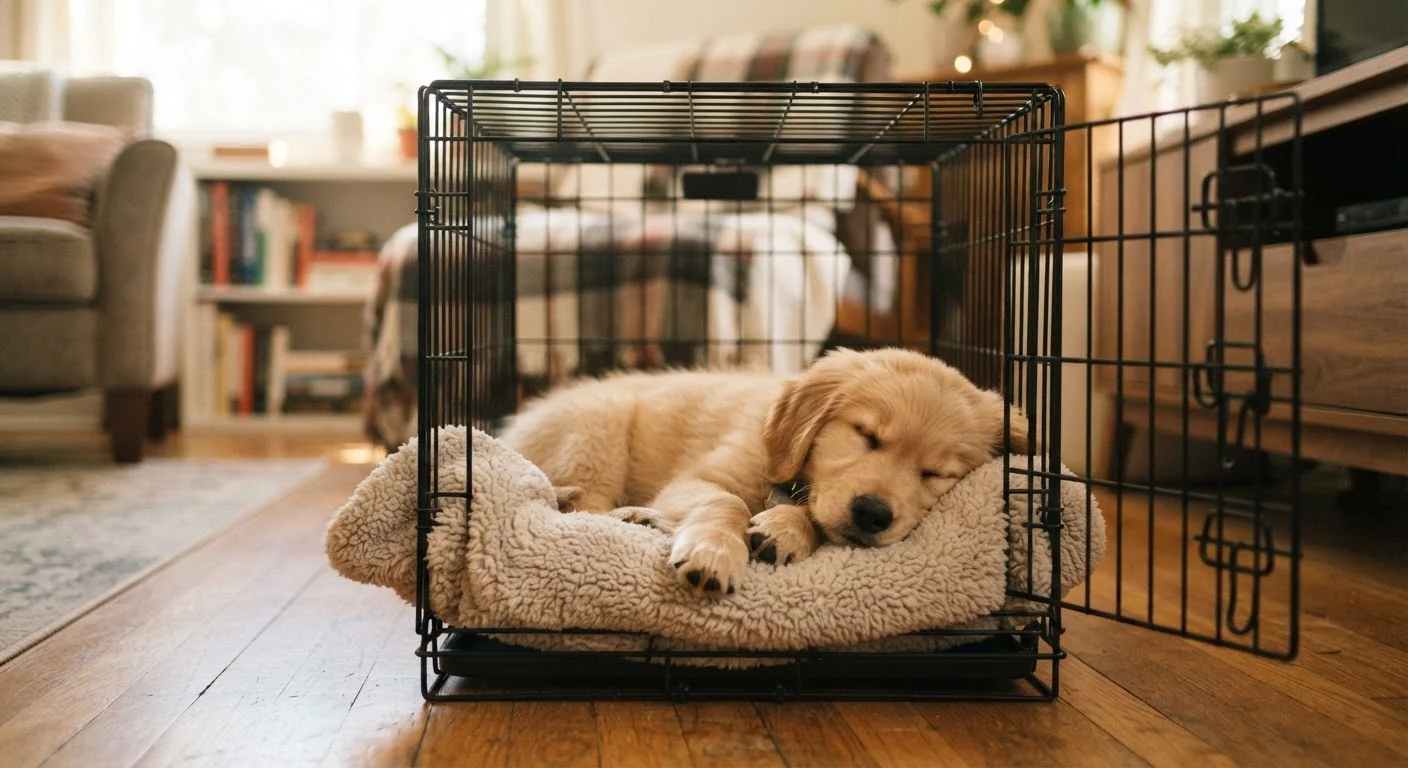
Crate training is the process of teaching a dog to see a crate - a wire, plastic, or fabric enclosure - as a safe, comfortable personal space. Done well, the crate becomes a place your dog chooses to go voluntarily, not one they're forced into.
The approach draws on a natural canine tendency: dogs, like many animals, are inclined to seek out small, enclosed spaces to rest and feel secure. A den-like spot reduces environmental stimulation and signals safety. Crate training channels that instinct in a domestic setting.
The practical benefits are real. A crate helps with house training by discouraging elimination in the sleeping space, gives a dog a predictable retreat during busy or stressful household moments, and provides a secure place during travel or veterinary stays. When woven into a consistent routine, it supports the kind of structure that helps dogs thrive - something explored in depth in our guide to building a daily schedule for a new dog.
Crate training
A process that teaches a dog to see a crate as a safe, comfortable personal space through gradual, positive exposure.
Den instinct
A natural tendency in dogs to seek out small, enclosed spaces to rest - a behavioral trait inherited from their ancestors.
House training
Teaching a dog to eliminate only in designated outdoor areas, not inside the home. Crate training is often used as a tool to support this process.
Positive reinforcement
A training method that rewards desired behaviors - such as entering a crate calmly - to make those behaviors more likely to occur again.
Confinement period
The amount of time a dog spends inside a closed crate. This should always be age-appropriate and humane, with sufficient breaks for exercise and bathroom needs.
Common Misconceptions to Let Go Of
The most persistent myth about crating is that it's inherently punishing. In reality, a crate only becomes aversive when it's used as punishment, when a dog is confined too long, or when the introduction is rushed. The crate itself is neutral - the training around it makes all the difference.
Another common misconception is that dogs instinctively understand what a crate is for. They don't - at least not at first. A new crate in the corner of a room is simply an unfamiliar object. Your dog needs time and positive experiences to associate it with comfort and safety.
Some owners also assume that a dog who initially resists a crate is proving it's wrong for them. Resistance is normal at first, just as it would be with any new experience. It doesn't mean the dog will never accept it. Behavior myths like these - including ideas about what dogs "understand" or "feel" about confinement - are worth examining critically. Our article on pet behavior myths many owners still believe unpacks several of these in more detail.
Choosing and Setting Up the Crate
The right crate size matters more than most people expect. Your dog should be able to stand, turn around, and lie down comfortably - but a crate that's too spacious can undermine house training, since a puppy may use one end as a bathroom and sleep in the other.
For growing puppies, look for a crate that includes a divider panel. You can start with a smaller enclosed space and expand it as your puppy grows, avoiding the cost of multiple crates over time.
Placement also shapes your dog's experience. Position the crate in a low-traffic area that still keeps your dog connected to household activity - not isolated in a back room. Many families find a corner of the living room or bedroom works well.
Inside the crate, keep it simple: a washable mat or folded blanket is enough to start. Add a few familiar-scented items to make it feel personal. Toys that are safe to chew unsupervised are fine; avoid anything with small parts that could be swallowed.
Make the Crate Feel Like It Belongs to Your Dog
Place an old T-shirt or worn item of clothing inside the crate so your dog associates it with your familiar scent. This simple step can noticeably ease anxiety during the early stages of introduction. Avoid washing the bedding too frequently at first - your scent is part of the comfort.
How to Introduce the Crate Step by Step
Rushing introduction is one of the most common mistakes owners make. The goal is to build a positive association over days - not hours. Here's a reliable progression:
- Let your dog explore freely. Leave the crate door open and allow your dog to sniff and investigate at their own pace. Don't push them inside.
- Toss treats near, then inside, the crate. Let your dog retrieve the treats without closing the door. Repeat across multiple short sessions.
- Feed meals near the crate. Gradually move the food bowl closer to the entrance, then just inside the door, and eventually fully inside - always at a pace your dog is comfortable with.
- Begin closing the door briefly. Once your dog is eating calmly inside, close the door for just a minute or two, then open it before any signs of distress. Increase duration gradually.
- Build up to longer periods. Work up to 20-30 minutes with you present, then with you out of sight. Only then start leaving the house for short intervals.
Throughout this process, positive reinforcement - rewarding calm, relaxed behavior - is the most effective approach. Scolding or forcing a dog into the crate works against what you're trying to build.
Realistic Expectations for Puppies vs. Adult Dogs
Puppies and adult dogs both benefit from crate training, but the process looks different for each.
Puppies have small bladders and limited physical control. A widely cited rule of thumb is one hour of crate time per month of age, up to a maximum of about four to five hours during the day. Exceeding this causes distress and can actually set back house training. Puppies also tend to adapt quickly when training is consistent - many accept the crate within one to two weeks.
Adult dogs, especially rescues, may take longer - particularly if they have unknown past experiences with confinement. The same gradual approach applies, but patience is especially important. Some adult dogs adapt in days; others may need several weeks. Progress isn't always linear, and that's normal. If your dog seems unusually fearful or anxious, it's worth speaking with a veterinarian or a certified animal behaviorist rather than pushing through.
Regardless of age, the goal isn't a dog who tolerates the crate - it's a dog who genuinely rests there calmly. That outcome is achievable for most dogs when the process respects their pace. Understanding why some dogs take longer to adjust is part of building a realistic approach; our article on why some pets are harder to train offers helpful context on individual differences in learning.
This article is for general informational purposes only and is not a substitute for guidance from a qualified veterinarian or certified animal behavior professional. If your dog shows significant distress, anxiety, or behavior concerns, please consult a professional.
Frequently Asked Questions
When used correctly, crate training is not cruel. A properly sized crate, introduced gradually with positive associations, gives most dogs a calm resting place. Problems arise only when crates are used as punishment or dogs are confined for excessive periods.
A general guideline is one hour per month of age for puppies, up to a maximum of four to five hours during the day. Adult dogs can typically stay crated for up to four to six hours, but this varies by individual. Overnight crating is common once a dog is reliably house-trained.
The crate should be large enough for your dog to stand up, turn around, and lie down comfortably - but not so large that a puppy can eliminate in one corner and sleep in another. Many owners use a divider panel to adjust the space as a puppy grows.
Soft bedding can make a crate more comfortable, but hold off if your puppy tends to chew or soil it. A simple washable mat is a safe starting point. Once your dog is reliably clean in the crate, you can upgrade to more plush bedding.
Yes, most adult dogs can learn to accept a crate with patient, positive introduction. The process may take longer than with a puppy, especially if the dog has had negative past experiences. Go slowly and never force the dog inside.
Many dogs feel more secure in a partially covered crate because it feels more den-like. Try covering the sides and top while leaving the front open. Watch your dog's reaction - some prefer it open, and individual preference matters most.
The content on this site is for informational purposes only and is not a substitute for professional advice. Always consult a qualified professional for guidance specific to your situation.