

It's Not Spite - Here's What's Actually Happening
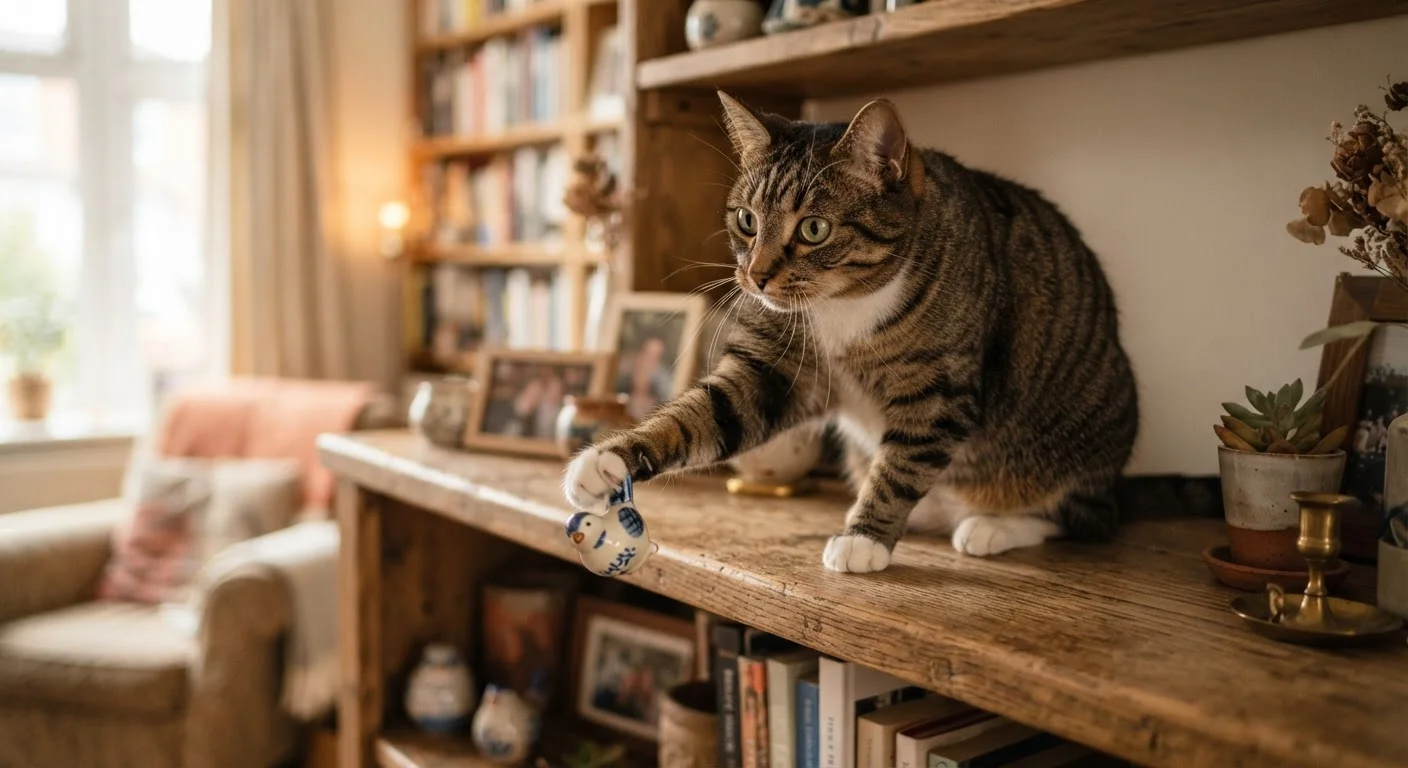
Few cat behaviors generate as much laughter - and mild exasperation - as the slow, deliberate paw push that sends a coffee mug tumbling off the counter. It looks calculated. It feels personal. But animal behaviorists are clear: cats do not knock things over out of spite, revenge, or a desire to punish you.
What's actually happening is a combination of instinct, sensory curiosity, and learned association. Cats are hardwired as predators, and any small object sitting on a flat surface mimics the profile of potential prey. The impulse to bat at it isn't dramatically different from the swat they'd direct at a mouse or a rustling leaf. The object moving - and especially falling - produces exactly the kind of unpredictable motion that triggers a cat's prey-detection instincts.
Understanding this reframes the whole dynamic. Your cat isn't making a statement about your morning routine. It's running a deeply embedded behavioral program. See our guide to common pet behavior myths for more examples of instinct-driven actions that owners often misread as deliberate defiance.
The Real Drivers Behind the Behavior
Several distinct motivations contribute to this habit, and most cats engage in it for more than one reason at a time.
~74%
U.S. households with cats reporting object-knocking behavior
Survey data from pet behavior research consistently finds object displacement among the most frequently reported feline behaviors by owners, though methodologies vary by study.
2-4 years
Peak age range for attention-seeking behaviors in cats
Veterinary behaviorists note that young adult cats - with high energy and developed social cognition - most commonly exhibit learned attention-seeking behaviors like object displacement.
Predatory Instinct
Cats use their paws to investigate objects the same way they'd probe a potentially live animal - cautiously at first, then with increasing force. An object that wobbles, rolls, or falls confirms it's "reactive," satisfying the hunting sequence even without an actual catch.
Sensory Exploration
Cats' paw pads are densely packed with sensory receptors. Tapping an unfamiliar object on a surface is a form of tactile investigation - they're gathering information about texture, weight, and stability before committing to a full interaction.
Attention-Seeking
This is where learned behavior enters the picture. The first time a cat knocked something off your nightstand and you leaped out of bed, it received immediate, intense attention. Cats are observant and quick to associate cause and effect. If the behavior reliably produces a reaction - any reaction - many cats will repeat it. This is especially common in cats that aren't getting enough interactive engagement throughout the day.
Boredom and Under-Stimulation
Indoor cats in particular can struggle with insufficient mental and physical outlets. Manufacturing chaos is one way a cat creates its own stimulation. Our article on what indoor cats actually need each day covers how structured enrichment can address this at the root.
What Your Cat's Body Language Tells You in the Moment
Watching how your cat approaches the behavior reveals which driver is most active. A cat in full predatory mode will often chirp, crouch slightly, and show dilated pupils before the swipe. A cat seeking attention may make eye contact with you before and after knocking the object, watching your face for a response.
Tail position, ear orientation, and vocalizations all contribute additional information. A relaxed, upright tail usually signals curiosity rather than agitation. Flattened ears or a puffed tail would suggest a different emotional state entirely. For a deeper look at reading these cues, see our guide to cat body language.
Ignore the Behavior, Not the Cat
When your cat knocks something over seeking attention, try walking out of the room calmly rather than reacting. This removes the reward without punishing your cat. Then, when your cat is calm and not demanding attention, initiate play or interaction - that teaches them what actually works.
Recognizing the motivation behind a specific incident makes it easier to respond constructively rather than reactively.
How to Respond Without Making It Worse
The instinct to say "No!" or dramatically retrieve a fallen object is understandable - but it often backfires. Attention, even negative attention, can cement the habit. Behaviorists generally recommend a calm non-response when possible: don't react, don't make eye contact, and don't rush to pick up what fell.
At the same time, addressing the underlying need matters more than managing individual incidents. If the behavior spikes at predictable times - early morning, just before feeding, or during stretches when you're focused elsewhere - those are signals about unmet needs rather than random mischief.
Proactive strategies that tend to help include:
- Scheduled interactive play sessions using wand toys or laser pointers
- Puzzle feeders that require problem-solving at mealtimes
- Vertical enrichment - cat trees, wall shelves, or window perches - that give cats appropriate outlets for climbing and observation
- Consistent daily routines that reduce anxiety and anticipation-driven acting out
Cats that engage in the behavior compulsively, or that seem distressed rather than playful, may benefit from a conversation with a veterinarian or a certified applied animal behaviorist to rule out anxiety or other underlying factors.
Frequently Asked Questions
The stare is usually the point. Cats quickly learn that knocking something over gets an immediate reaction from their owner. Even a scolding counts as attention, which can reinforce the behavior over time.
It can be. Cats that lack adequate mental stimulation or play opportunities are more likely to manufacture their own entertainment, and pushing objects off surfaces is a reliable way to create movement and noise. Increasing enrichment activities often helps.
Yes, in the sense that it's a voluntary, deliberate action - not an accident. However, "purpose" in the human sense (malice, revenge) doesn't apply. Cats are acting on instinct and learned associations, not plotting against you.
Avoid reacting dramatically, since reactions can reward the behavior. Instead, increase interactive play, provide puzzle feeders, and ensure your cat has enough vertical space to climb and explore. Consistency in routine also reduces attention-seeking behavior.
Younger, more active cats and those kept indoors without adequate stimulation tend to display it more frequently. However, any cat can engage in it, especially if the behavior has been accidentally reinforced by owner attention.
The content on this site is for informational purposes only and is not a substitute for professional advice. Always consult a qualified professional for guidance specific to your situation.