

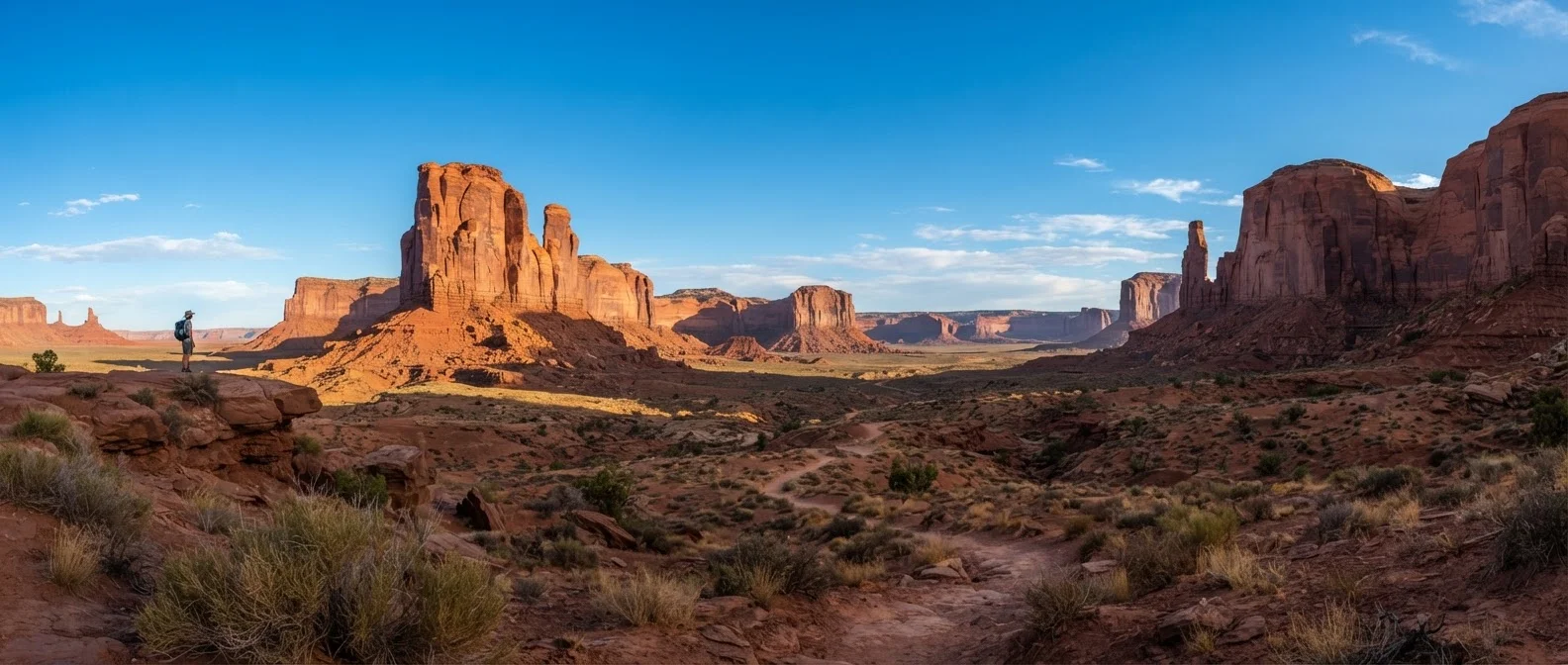
Option A
Sedona, Arizona
The spiritual, scenery-first retreat with resort-level comfort.
Best for: Travelers seeking a mix of gentle hiking, wellness experiences, and easy access to dramatic scenery without rough backcountry conditions.
Option B
Moab, Utah
The adventure hub for off-road, technical, and endurance outdoor pursuits.
Best for: Active travelers who want world-class technical hiking, mountain biking, off-roading, and proximity to two major national parks.
Terrain and Outdoor Activities
Both Sedona and Moab are defined by their red rock geology, but the outdoor experiences they offer sit at different points on the difficulty spectrum.
Sedona is threaded with over 200 miles of trails, most of which are accessible to hikers of moderate fitness. Routes like Cathedral Rock and Bell Rock offer rewarding climbs with minimal technical exposure. Jeep tours are popular for non-hikers who want to explore the backcountry without lacing up. The terrain is visually dramatic but rarely demands specialized skills or equipment.
Moab, by contrast, is organized around challenge. Arches National Park's Delicate Arch trail is manageable for most visitors, but much of the surrounding landscape - including routes through Canyonlands' Needles or Maze districts - requires navigation ability, physical conditioning, and in some cases, permits and technical gear. Mountain biking is a core activity here in a way it simply isn't in Sedona. River rafting on the Colorado adds another dimension entirely.
| Criterion | Sedona, Arizona | Moab, Utah |
|---|---|---|
| Trail difficulty | Mostly easy to moderate | Moderate to very challenging |
| National park access | No adjacent national parks | Arches & Canyonlands nearby |
| Mountain biking | Limited, casual options | World-class trails available |
| Resort/spa amenities | Abundant, well-developed | Limited, basic lodging focus |
| Summer heat | Warm but manageable (~90s°F) | Extreme (100-105°F regularly) |
| Airport proximity | ~2 hrs from Phoenix | ~4-5 hrs from Salt Lake City |
| Vehicle requirements | Standard 2WD sufficient | 4WD needed for some routes |
| Town atmosphere | Resort, wellness-oriented | Outdoor adventure-focused |
Vibe, Crowds, and Infrastructure
The two towns feel noticeably different even before you step onto a trail. Sedona has a polished, resort-town atmosphere. Galleries, spas, and upscale restaurants line its main commercial corridor. It draws a broad demographic - couples on wellness retreats, retirees, and international visitors - and that mix shapes the pace and tone of the place.
Moab has a grittier, more outdoors-focused energy. The town is smaller, the amenities more utilitarian, and the visitor base skews toward hikers, cyclists, climbers, and off-road enthusiasts. That said, Moab's profile has risen sharply in recent years, and it now faces significant pressure from visitor volume. Both destinations are worth examining in the context of how crowded popular American destinations have become - for more on that dynamic, see what overtourism really means for places like these.
Check Entry Requirements Before You Go
Entry conditions at national parks near Moab - including timed-entry reservations at Arches - can change seasonally and with little advance notice. Always verify current requirements directly on the National Park Service website before finalizing travel plans. Sedona's public trailheads generally do not require reservations, but parking fees and red rock passes may apply.
Parking at trailheads in both destinations fills early - sometimes before 8 a.m. during peak season. Shuttle systems exist in parts of Sedona, and Arches National Park has operated timed-entry reservations during busy periods. Verify current entry requirements directly with the National Park Service before your trip.
Climate and Best Time to Visit
Timing your visit is more consequential in the desert than in many other regions, and Sedona and Moab have meaningfully different climate profiles.
Sedona sits at roughly 4,500 feet elevation, which moderates summer temperatures to the mid-90s°F range - warm but manageable with early starts. Spring (March-May) and fall (September-November) are peak seasons for good reason: mild temperatures, clear skies, and reliable trail conditions. Winters are cool but generally snow-free in town, making Sedona a genuinely viable year-round destination.
Moab at around 4,000 feet is hotter and more extreme. Summer highs regularly reach 100-105°F, making midday outdoor activity genuinely dangerous, particularly for children, older adults, and anyone not acclimatized to dry heat. Spring and fall are strongly preferred by experienced visitors. Winter in Moab can bring snow and frozen trail conditions, especially at higher elevations in the national parks, which adds a different kind of challenge.
~1.6M
Annual visitors to Arches National Park
According to National Park Service data, Arches has seen visitor counts exceed 1.6 million in recent years, prompting timed-entry systems during peak periods.
4,500 ft
Sedona's elevation above sea level
Sedona's higher elevation compared to lower desert areas contributes to notably cooler summer temperatures, making it more accessible for warm-weather hiking.
200+ miles
Trails in Sedona's network
Sedona's trail system spans a wide range of difficulty levels, managed across Coconino National Forest and several designated recreation areas.
Accessibility and Trip Planning Considerations
Getting to each destination and navigating once you arrive involves different logistics.
Sedona is about 2 hours from Phoenix Sky Harbor International Airport via a straightforward highway drive. Many trails are reachable by standard vehicle, and a two-wheel-drive rental car handles the vast majority of visitor routes. The town is compact enough that some areas can be navigated on foot or by shuttle, reducing parking headaches.
Moab is more remote. The nearest major airport is Salt Lake City, roughly 4-5 hours away, though Grand Junction, Colorado (about 2 hours) offers limited commercial service. A vehicle is essential - there is no meaningful public transit in or around Moab. Some backcountry roads require high-clearance or 4WD vehicles. If you're planning to visit both Arches and Canyonlands, budget a full day per park minimum; trying to combine them in a single day leaves little time for meaningful exploration.
Both destinations offer lodging across a range of price points, though options fill quickly during peak seasons. Booking several months in advance is a reasonable precaution for either location if travel dates fall between March and October.
The content on this site is for informational purposes only and is not a substitute for professional advice. Always consult a qualified professional for guidance specific to your situation.