

Option A
Debt Snowball Method
The motivation-first, momentum-driven approach.
Best for: People who need early psychological wins to stay committed to a long debt payoff journey.
Option B
Debt Avalanche Method
The mathematically optimal, interest-minimizing strategy.
Best for: People who are disciplined enough to stay the course while targeting their highest-interest debts first.
How Each Method Actually Works
Both the debt snowball and debt avalanche are structured repayment strategies that share a common mechanic: you make minimum payments on all your debts, then direct any extra money toward one designated target account. The difference is in how that target is chosen.
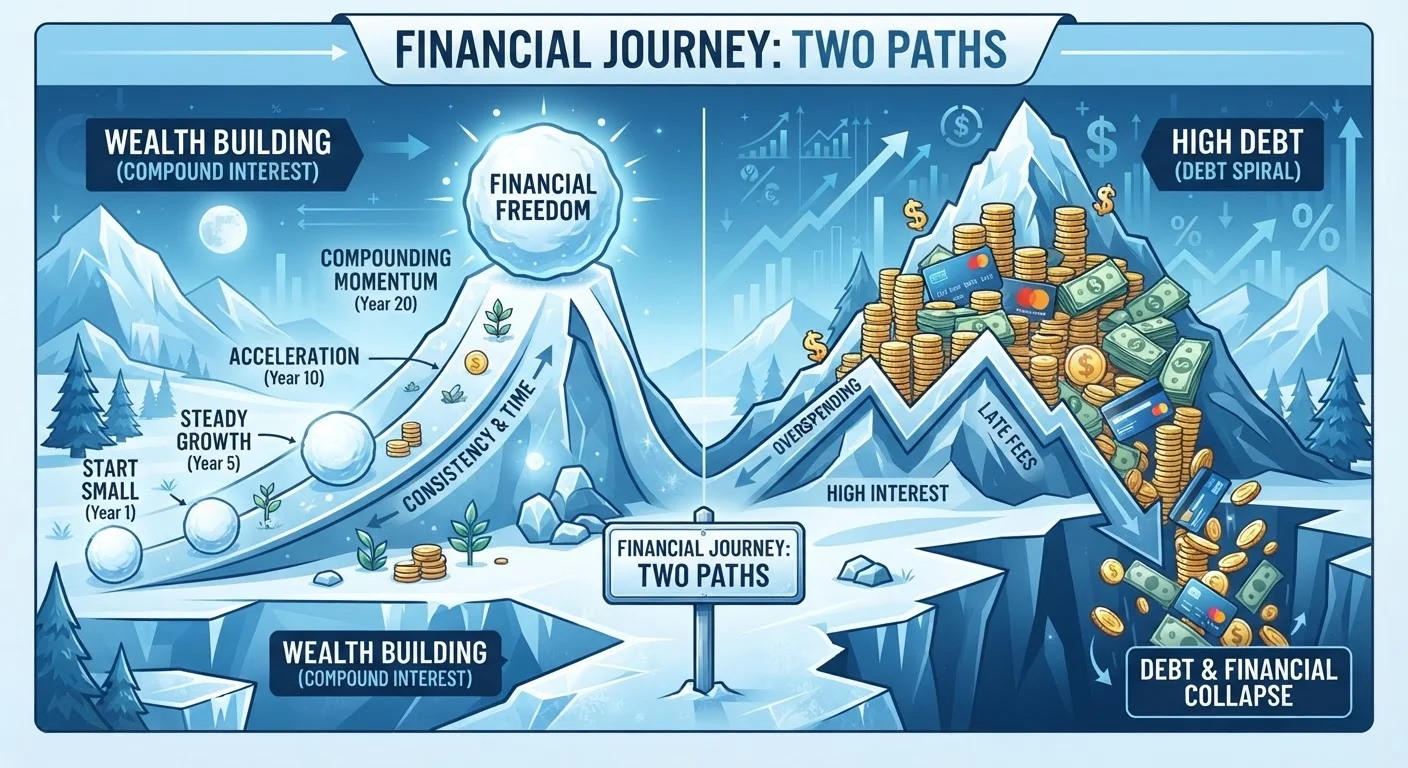
Debt Snowball: You rank your debts from the smallest balance to the largest and focus extra payments on the smallest first. Once that account reaches zero, you redirect its payment - now freed up - toward the next smallest. Over time, the amount you can throw at each successive debt grows, like a snowball rolling downhill. Understanding what separates different types of debt can help you decide which balances to include in your list.
Debt Avalanche: You rank your debts by interest rate, from highest to lowest, and direct extra payments toward the most expensive debt first. Interest rate determines the order, not balance size. Once the top-rate account is paid off, you cascade that payment to the next highest-rate debt. This approach is designed to reduce the total interest you pay across all accounts.
| Criterion | Debt Snowball | Debt Avalanche |
|---|---|---|
| Payoff order | Smallest balance first | Highest interest rate first |
| Total interest paid | Generally more | Generally less |
| Early motivation | High - accounts close quickly | Lower - progress is slower to see |
| Mathematical efficiency | Lower | Higher |
| Behavioral advantage | Strong - quick wins reinforce habits | Requires sustained discipline |
| Best when rates vary widely | Less ideal | Most advantageous |
| Complexity | Simple to understand and track | Slightly more analytical setup |
Neither method changes how much you owe today or lowers your interest rates. What they change is the sequence - and sequence has real consequences for both your wallet and your willpower.
The Real Cost Difference Between the Two Methods
The avalanche method's mathematical advantage is real. When you leave a high-interest balance growing while paying off smaller, cheaper debts first, that high-rate account keeps compounding. Interest on revolving debt compounds in ways that aren't always obvious, and minimum payments often cover little more than the interest itself.
~20%
Average credit card APR in the US
According to Federal Reserve data, average credit card interest rates have hovered near or above 20% APR in recent years, making high-rate balances especially costly to carry.
Minimum only
Payment strategy that maximizes interest paid
Paying only the minimum on revolving credit accounts can extend repayment timelines by years and multiply the total interest paid, according to consumer finance education resources.
The snowball, by contrast, may result in paying more total interest over the life of your debts - because you're allowing high-rate accounts to linger while you pay off smaller, cheaper ones first. In some cases, the difference is modest. In others - particularly when a high-rate account carries a large balance - it can be substantial.
That said, the snowball's cost is not simply waste. The psychological benefit of account closure is a legitimate factor in debt payoff success. A strategy you abandon halfway through costs more than a slightly less efficient one you actually complete. For readers also weighing whether to prioritize debt payoff over saving, the two goals don't have to conflict.
It's also worth noting that subtle habits can quietly undermine either strategy - regardless of which method you choose. Consistency in applying your chosen approach matters more than which one you select.
This article is for general informational and educational purposes only and does not constitute personalized financial or legal advice. Consult a qualified financial professional for guidance specific to your situation.
The content on this site is for informational purposes only and is not a substitute for professional advice. Always consult a qualified professional for guidance specific to your situation.