

Why Fitness Jargon Matters
Walk into any gym or open a beginner workout app and you'll immediately encounter terms like reps, supersets, and RPE. Without a working vocabulary, following even a basic program becomes guesswork. This reference guide decodes the most common exercise terms so you can read workout instructions with confidence from day one.
Understanding these concepts also sets you up for smarter training decisions. Once you grasp what progressive overload actually means, for example, you'll understand why simply doing the same routine indefinitely stops producing results - a dynamic explained further in why beginners plateau so quickly.
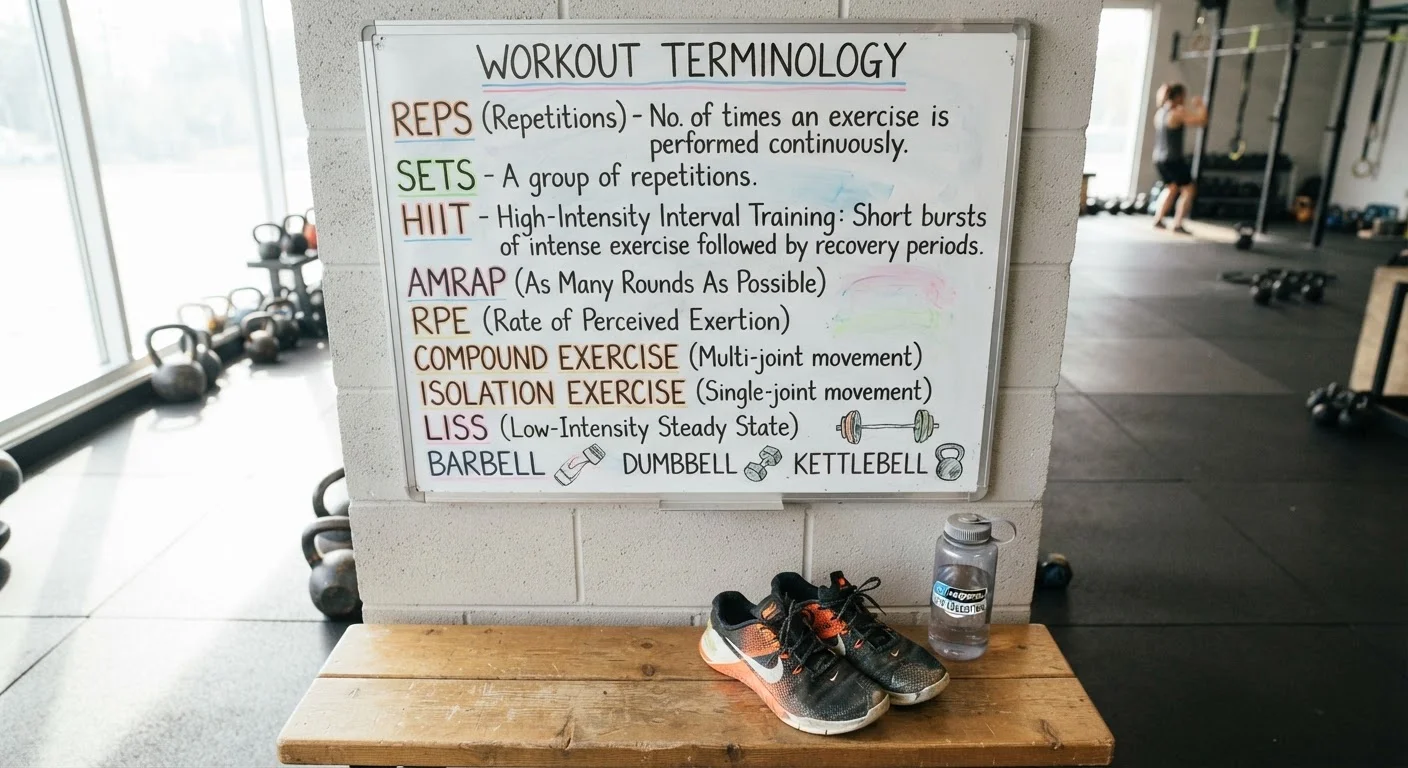
Rep (Repetition)
One complete execution of an exercise movement. For example, lowering into a squat and returning to standing counts as one rep.
Set
A fixed number of consecutive reps performed without resting. Programs typically prescribe multiple sets per exercise.
Progressive Overload
The practice of incrementally increasing training stress - via heavier weight, more reps, or reduced rest - to keep the body adapting over time.
HIIT
High-Intensity Interval Training. A format alternating short maximal-effort bursts with recovery periods, used primarily for cardiovascular conditioning.
RPE (Rate of Perceived Exertion)
A subjective 1-10 scale measuring how hard an effort feels. RPE 7 is challenging but sustainable; RPE 10 is maximal effort.
Compound Exercise
A movement that recruits multiple muscle groups and joints at once, such as squats, deadlifts, or bench press.
Isolation Exercise
An exercise targeting one specific muscle group through a single joint, like a bicep curl or leg extension.
Periodization
A structured approach to planning training that varies volume and intensity over defined phases to maximize adaptation and reduce burnout.
Superset
Performing two exercises consecutively with minimal rest, usually pairing opposing or unrelated muscle groups to increase training efficiency.
1RM (One-Rep Max)
The maximum load you can lift for a single complete repetition of an exercise. Commonly used as a reference point for calculating training weights.
Eccentric Phase
The lengthening portion of a movement - for example, lowering the bar during a bicep curl. Often associated with muscle soreness when emphasized.
Concentric Phase
The shortening, or 'working,' portion of a movement - for example, curling the bar upward. Most people think of this as the main effort phase.
Core Training Terms You'll See Constantly
These are the building blocks of almost every workout plan you'll encounter:
- Rep (Repetition): One complete movement cycle - one squat down and back up equals one rep.
- Set: A group of consecutive reps performed without resting. "3 sets of 10" means you do 10 reps, rest, then repeat that sequence twice more.
- Rest interval: The recovery time between sets. Shorter rests (30-60 seconds) are common in endurance-style training; longer rests (2-3 minutes) suit heavy strength work.
- Progressive overload: Gradually increasing the demand on your body - through more weight, reps, sets, or reduced rest - so it continues to adapt. This principle underpins every effective program, as explored in the training principles behind every effective fitness program.
- 1RM (One-Rep Max): The maximum weight you can lift for exactly one rep of a given exercise. Often used to calculate training loads as a percentage.
| Minimum recommended activity | 150 minutes of moderate aerobic activity per week for adults (U.S. Department of Health and Human Services Physical Activity Guidelines) |
| Primary benefit of compound exercises | Engage multiple muscle groups simultaneously, improving overall efficiency |
| Typical HIIT session length | 20-30 minutes including warm-up and cool-down |
| Progressive overload principle | Gradually increase training demand to maintain ongoing adaptation (American College of Sports Medicine (ACSM)) |
| Common rest between heavy strength sets | 2-3 minutes |
Program Structures and Training Styles
Fitness programs use specific formats to organize how exercises are grouped and sequenced:
- HIIT (High-Intensity Interval Training): Alternating short bursts of intense effort with brief recovery periods. Commonly used for cardiovascular conditioning.
- Circuit training: Moving through a series of exercises back-to-back with minimal rest, then repeating the circuit.
- Superset: Performing two exercises consecutively with little or no rest between them, typically targeting different muscle groups.
- Compound exercise: A movement engaging multiple joints and muscle groups simultaneously - squats, deadlifts, and push-ups are examples.
- Isolation exercise: A movement targeting a single muscle group with one primary joint involved, such as a bicep curl.
- Periodization: Deliberately varying training volume and intensity over weeks or months to drive continued adaptation and reduce injury risk.
Before committing to any of these structures, it's worth reviewing what to consider before starting a new exercise routine, especially if you have any existing health conditions.
This article is for general informational and educational purposes only and does not constitute medical or fitness advice. Consult a qualified healthcare professional or certified fitness professional before beginning a new exercise program.
The content on this site is for informational purposes only and is not a substitute for professional advice. Always consult a qualified professional for guidance specific to your situation.