

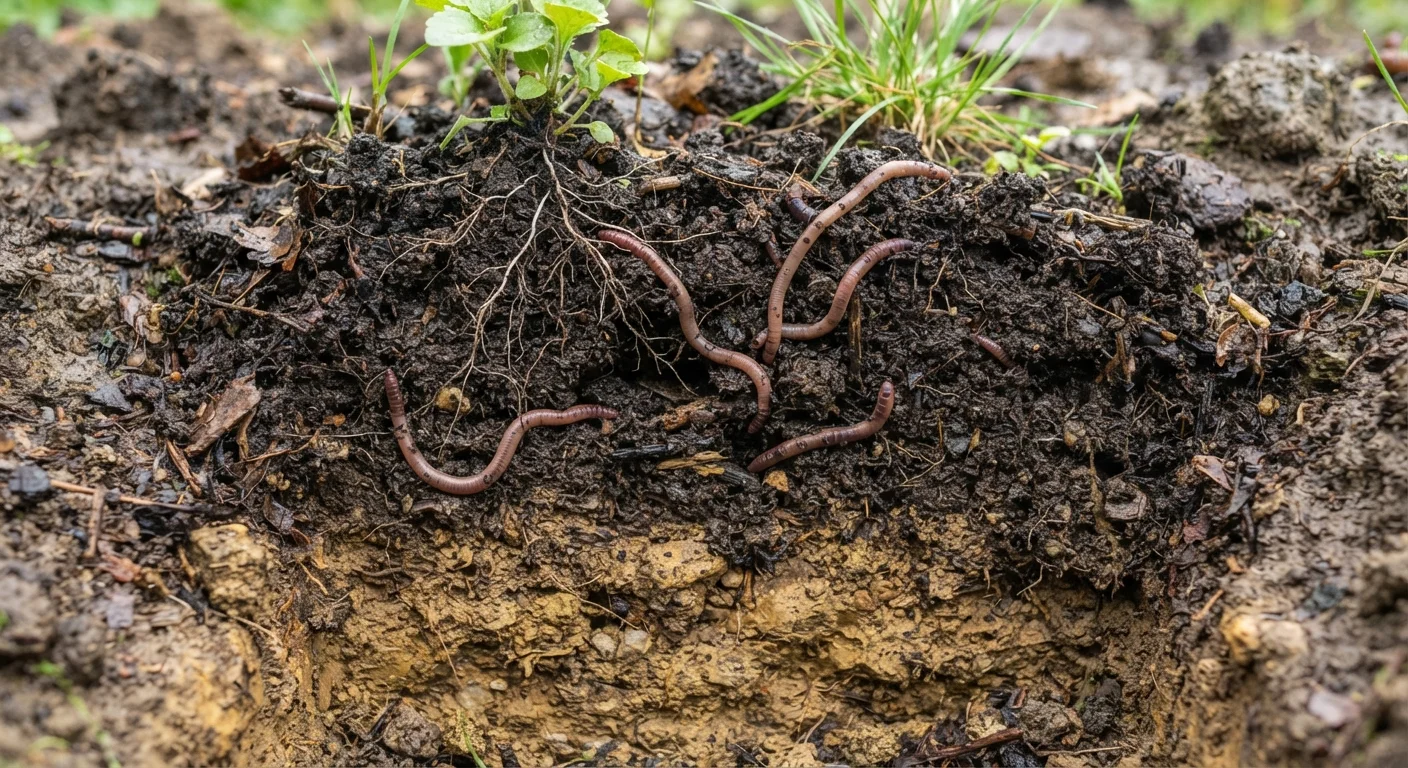
The Five Ingredients Every Soil Contains
Pick up a handful of garden soil and you're holding five distinct things at once: mineral particles, organic matter, water, air, and living organisms. Ideal garden soil contains roughly 45% minerals, 25% water, 25% air, and 5% organic matter by volume - though most home gardens fall well short of that last figure.
Mineral particles come from the slow weathering of bedrock and determine your soil's texture. Organic matter - decomposed plant and animal material - acts as the soil's engine, feeding microbes and releasing nutrients. Water and air fill the pore spaces between particles; plants need both to drive root function and gas exchange. And the living organisms? There can be more microbes in a single teaspoon of healthy topsoil than there are people on Earth.
1 Billion+
Microorganisms per teaspoon of healthy soil
Soil ecologists estimate that a single teaspoon of biologically active topsoil can contain over one billion individual bacteria alone, according to USDA Natural Resources Conservation Service educational materials.
5%
Ideal organic matter content by volume
Most home garden soils contain 1-3% organic matter; the USDA and cooperative extension services commonly cite 5% as a productive target for vegetable and ornamental beds.
6.0-7.0
Optimal pH range for most vegetables
This range is widely recommended by university extension programs across the U.S. as the window in which most common nutrients are most available to plant roots.
Sand, Silt, and Clay: Understanding Soil Texture
Soil texture describes the relative proportions of three mineral particle sizes: sand (the largest, gritty to the touch), silt (medium, smooth like flour), and clay (the finest, sticky when wet). The mix determines how your soil drains, warms up in spring, and holds nutrients.
- Sandy soil drains quickly, warms fast, and is easy to work - but it struggles to hold water or nutrients.
- Clay soil retains moisture and nutrients well but compacts easily, drains slowly, and becomes rock-hard when dry.
- Silty soil is moderately fertile and drains reasonably well but can crust over after heavy rain.
The gardener's goal is loam - roughly 40% sand, 40% silt, and 20% clay - which balances drainage, moisture retention, and nutrient availability. You can get a rough sense of your texture by wetting a small soil sample and rolling it between your fingers: sand feels gritty, silt feels silky, and clay feels sticky and holds its shape. Whether you're planning raised beds or in-ground planting, knowing your native texture helps you plan amendments wisely.
Try the Jar Test for Soil Texture
Fill a clear jar one-third with soil, add water to nearly the top, shake vigorously, and let it settle for 24 hours. Sand sinks first (within minutes), silt settles in the middle layer, and clay forms the top layer - giving you a visible breakdown of your soil's composition without any lab equipment. This simple test costs nothing and takes just a few minutes of active effort.
Organic Matter and Soil Biology: The Living Engine
Organic matter is the fraction of soil that was once alive - fallen leaves, decomposed roots, animal waste, fungal threads. Though it makes up a small percentage by volume, it has an outsized impact: it improves structure in both clay and sandy soils, feeds soil organisms, and slowly releases nutrients that plants can absorb.
The biology within that organic matter is equally important. Bacteria, fungi, nematodes, protozoa, and earthworms form a web of activity that breaks down raw material into plant-available nutrients. Mycorrhizal fungi, for instance, extend thread-like networks around plant roots and effectively expand the root's reach for water and phosphorus. Earthworms physically mix and aerate soil while their castings (waste) are rich in nutrients and beneficial microbes.
The single most accessible way to build organic matter is composting. Turning kitchen scraps into compost is a practical first step that pays dividends in every garden bed you treat. Even modest additions of finished compost each season gradually shift your soil toward that productive loamy ideal.
A gardener in the Midwest notices her tomatoes are yellowing even though she fertilized heavily. A soil test reveals her pH is 7.8 - too alkaline for iron uptake.
A homeowner in the Southeast has sandy soil that dries out within a day of watering, forcing him to irrigate constantly throughout summer.
A community gardener digs into her plot and finds no earthworms - just compacted, gray-brown soil that smells faintly sour.
Soil pH and Nutrient Availability
Soil pH measures the acidity or alkalinity of your soil on a scale from 0 (extremely acidic) to 14 (extremely alkaline), with 7.0 being neutral. Most vegetables and ornamentals perform best in a range of roughly 6.0 to 7.0 - slightly acidic to neutral.
Why does pH matter so much? Because it controls whether nutrients already present in the soil are chemically accessible to plant roots. Iron, manganese, and phosphorus, for example, can become locked up in highly alkaline soils even if they exist in abundance. Conversely, very acidic soils can release aluminum and manganese to toxic levels.
You can adjust pH over time: ground limestone raises it (makes soil less acidic), while elemental sulfur or acidic organic amendments lower it. However, large swings take time and multiple seasons to achieve - patience is essential. A basic soil test, available through many cooperative extension services, tells you both your current pH and which nutrients may be deficient. If you're planning your first vegetable garden, getting a soil test done early is one of the highest-value steps you can take.
“Healthy soil is the foundation of the food system. It filters our water, provides nutrients to plants and animals, and is home to an incredible amount of biodiversity that we are still working to understand.”
— USDA Natural Resources Conservation Service, U.S. federal agency responsible for soil conservation and agricultural land stewardship
Layers of the Soil Profile
Soil is not uniform from surface to bedrock. It's organized into distinct horizons - horizontal layers with different compositions and functions:
- O Horizon (Organic Layer)
- Decomposing leaves and plant debris on the surface. This layer feeds the topsoil below.
- A Horizon (Topsoil)
- The dark, biologically active layer where most root growth and nutrient cycling occur. Typically 6-12 inches deep in garden settings.
- B Horizon (Subsoil)
- Denser and lower in organic matter; roots penetrate here for water and anchorage but biological activity slows significantly.
- C Horizon (Parent Material)
- Partially weathered rock from which the soil above was eventually formed.
Most garden work focuses on the A horizon - building its depth, organic content, and biological richness. Understanding this layered structure also helps when you encounter drainage problems or compaction: the issue may lie in the subsoil, not just the surface.
Soil health also influences how pesticides and other chemicals move through and interact with the ground. For a fuller picture, see our article on pesticides in the home garden.
Frequently Asked Questions
Healthy soil is dark, loose, and has a pleasant earthy smell. You should see earthworms when you dig a shovelful, and the soil should crumble rather than clump into hard, dry chunks or smear like clay. A basic soil test from your local cooperative extension service can confirm pH and nutrient levels.
Adding organic matter - compost, aged manure, or leaf mold - is the most effective and accessible way to improve almost any soil type. It improves drainage in clay soils, increases moisture retention in sandy soils, and feeds the microbial life that makes nutrients available to plants. Consistent additions over one to two seasons produce noticeable results.
Soil pH measures acidity or alkalinity on a scale from 0 to 14, with 7.0 being neutral. Most garden plants absorb nutrients most efficiently in a slightly acidic to neutral range (roughly 6.0-7.0). Outside that range, certain nutrients become chemically locked up even if they're present in the soil, leading to deficiencies despite adequate fertilizing.
Yes - in fact, many gardeners and soil scientists favor minimal or no-till approaches because tilling disrupts fungal networks, harms earthworms, and can accelerate the loss of organic matter. Top-dressing beds with compost and allowing it to work down naturally is an effective alternative that preserves soil structure over time.
Topsoil is the uppermost layer - typically the top 6 to 12 inches - and is where most organic matter, biological activity, and plant root growth occurs. Subsoil lies below and is generally denser, lower in organic content, and less biologically active. Most garden improvements target the topsoil layer.
Biologically active, well-structured soil supports beneficial organisms that suppress harmful pathogens and pests naturally. Plants growing in nutrient-balanced soil also tend to develop stronger cell walls and immune responses, making them less attractive to certain insects. Pesticide use can affect soil biology, so it's worth understanding that relationship - see our article on pesticides in the home garden for more context.
The content on this site is for informational purposes only and is not a substitute for professional advice. Always consult a qualified professional for guidance specific to your situation.