

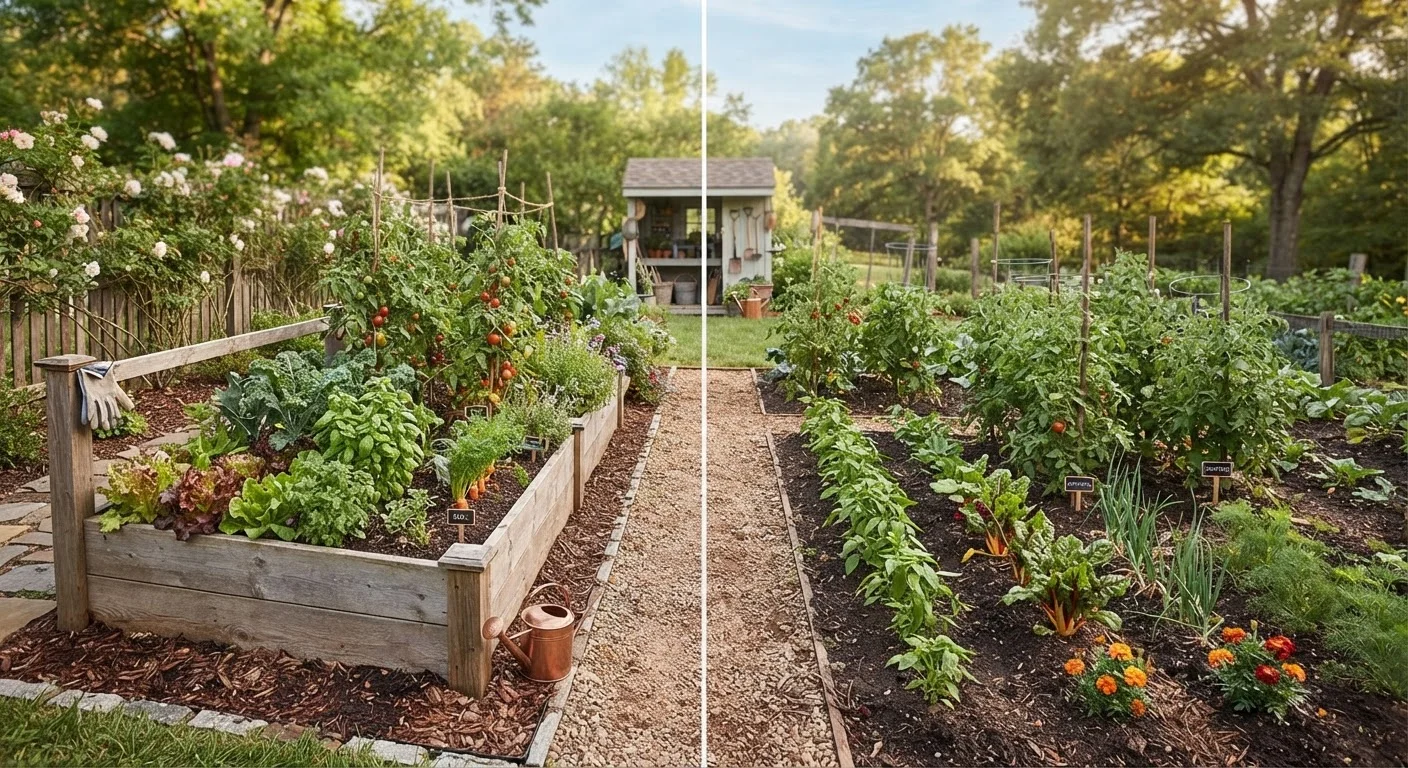
Option A
Raised Garden Beds
The controlled, accessible growing environment.
Best for: Gardeners dealing with poor native soil, limited mobility, or who want precise drainage and soil management.
Option B
In-Ground Planting
The traditional, expansive approach to growing.
Best for: Gardeners with healthy native soil, large planting areas, and lower startup budgets who want low-infrastructure growing.
Soil Control and Drainage
Soil quality is the foundation of any successful garden, and this is where raised beds and in-ground planting diverge most sharply. With a raised bed, you choose every component - typically a blend of topsoil, compost, and a material like perlite or aged bark to improve drainage. The result is a loose, nutrient-rich environment that most vegetable roots love.
In-ground planting relies on what your yard already has. If you're fortunate to have loamy, well-draining native soil, this works in your favor. If your yard has heavy clay that puddles after rain, or sandy soil that drains so fast it dries out quickly, you'll need to invest significant time in amendments before planting. Soil testing - available through many local cooperative extension services - can tell you exactly what your native soil lacks before you start.
Raised beds also drain more predictably because water moves down through a defined soil column rather than spreading laterally into native clay or hardpan. This makes overwatering less likely in well-constructed beds. For a deeper look at how water delivery interacts with garden structure, see our guide on drip irrigation vs. sprinkler systems.
| Criterion | Raised Beds | In-Ground Planting |
|---|---|---|
| Startup cost | Moderate to high | Low |
| Soil control | Complete - custom mix | Depends on native soil |
| Drainage | Highly reliable | Varies by site |
| Weed pressure | Generally low | Moderate to high |
| Spring warm-up | Faster - extends season | Slower - ground-level |
| Scalability | Limited by build cost | Easily expanded |
| Accessibility | Excellent with tall builds | Requires bending |
| Soil ecosystem | More controlled | Richer natural biology |
Cost, Setup, and Long-Term Investment
In-ground planting wins on upfront cost almost every time. A modest plot needs little more than soil amendments, compost, and basic hand tools. Even significantly expanding an in-ground garden rarely requires major material purchases.
Raised beds carry a real startup cost. Lumber, metal, or composite bed materials, plus a quality soil mix to fill them, can run anywhere from modest to substantial depending on bed size and material. However, that investment tends to pay off over time: quality fill soil rarely needs replacing, and a well-built wooden bed can last a decade or more with basic upkeep.
6-8 inches
Minimum recommended raised bed depth for vegetables
Most vegetable root systems need at least 6 inches of loose soil; deeper beds (12+ inches) support root crops like carrots and parsnips.
3-4 weeks
Earlier planting possible in raised beds
Elevated soil warms faster in spring, allowing earlier planting of cool-season crops compared to ground-level beds in comparable climates.
It's worth factoring in the cost of soil amendments for in-ground gardens over multiple seasons. Clay or sandy soils often require repeated additions of compost and organic matter to maintain good structure. Enriching either system with home compost is one of the most cost-effective strategies - our guide to composting at home explains how to build that supply yourself.
Season Length, Weed Pressure, and Maintenance
One underappreciated advantage of raised beds is how quickly they warm up in early spring. Elevated soil absorbs heat faster than ground-level beds, which can allow earlier planting of cool-season crops like lettuce, spinach, and peas. In cooler climates, this matters considerably.
Weed pressure is generally lower in raised beds because you're filling with sterile or weed-free soil and creating a defined perimeter. In-ground gardens pull weeds up from the surrounding soil and seed bank constantly, requiring more regular attention. Applying the right mulch to either system reduces that burden - our mulch selection guide breaks down which materials work best for different bed types.
Pest and disease management can favor raised beds as well, since the contained environment makes it easier to install row covers or netting. In-ground gardens, however, benefit from greater contact with natural soil organisms and ground-dwelling beneficial insects, which can support a more balanced garden ecosystem over time. Planning what you plant matters in both systems - see our article on companion planting pairs that actually work for strategies that apply regardless of your chosen method.
Which Approach Fits Your Yard?
The right choice depends heavily on your specific conditions. Evaluate your native soil first - a basic soil test is the most practical starting point for any new gardener. If your soil drains well and doesn't have a history of contamination, in-ground planting is a perfectly solid foundation that can grow with you over time.
If your yard has poor drainage, heavy clay, slopes, or a history of construction fill, raised beds give you a controlled environment that sidesteps those problems rather than fighting them. They're also worth considering if you're designing a backyard with multiple functional zones - our guide to designing outdoor living spaces offers useful frameworks for integrating garden beds into a broader yard plan.
For gardeners with limited space, neither approach is automatically better - but raised beds do allow very intensive planting in a small footprint. If you're working with a compact urban or suburban lot, it's worth reading our piece on growing food in small spaces for additional strategies. Many experienced gardeners ultimately use both methods together, matching the approach to each part of their yard based on soil conditions, sunlight, and what they want to grow.
A Note on Treated Wood Materials
If you're building wooden raised beds for edibles, choose materials carefully. Modern pressure-treated lumber uses alkaline copper quaternary (ACQ) rather than older arsenic-based treatments, and is generally considered safe for vegetable gardens by many extension services - but research is ongoing. Cedar and redwood are naturally rot-resistant alternatives that require no treatment. When in doubt, consult your local cooperative extension office for current guidance specific to your region.
The content on this site is for informational purposes only and is not a substitute for professional advice. Always consult a qualified professional for guidance specific to your situation.