

Start here
How to Think About Flooring Before You Shop
Explore options
Hardwood and Engineered Wood
Compare budget picks
Laminate, Vinyl, and LVP
Consider hard surfaces
Tile and Natural Stone
Weigh soft options
Carpet
Apply it
Matching the Floor to the Room
How to Think About Flooring Before You Shop
Before comparing materials, narrow your decision with three practical questions: Where is this floor going? How much use will it get? And what's the moisture situation? A kitchen that spills happen in every week has completely different needs than a bedroom where bare feet hit the floor each morning.
Also consider your subfloor - the structural layer beneath the finished floor. Its condition and material (concrete slab vs. wood joists) determine which flooring types are even viable. Some materials require a perfectly level, dry surface; others are more forgiving. If you're new to homeownership, the broader guide to home maintenance for first-time owners is a helpful starting point for understanding your home's systems before tackling upgrades.
Subfloor
The structural layer of wood or concrete beneath your finished floor. Its condition and flatness directly affect which flooring materials can be installed and how well they'll perform.
Floating floor
A flooring installation method where planks or tiles click or lock together and rest on the subfloor without being nailed or glued down. Common with laminate and LVP.
Wear layer
The protective top coat on engineered wood, laminate, and vinyl flooring. A thicker wear layer generally means better scratch and stain resistance and a longer lifespan.
Acclimation
The process of leaving flooring materials in the installation space for a period before installation so they adjust to the room's temperature and humidity. Skipping this step can cause warping or gapping.
Grout
The material used to fill the joints between tiles. It helps seal the floor and keeps tiles aligned, but it requires periodic sealing and cleaning to prevent staining and moisture intrusion.
Below grade
Any area of a home that is fully or partially below ground level, such as a basement. Below-grade spaces have higher moisture risk, which limits suitable flooring options.
Hardwood and Engineered Wood
Solid hardwood is milled from a single piece of wood - typically oak, maple, hickory, or walnut - and can be sanded and refinished multiple times over decades. It adds warmth, character, and is frequently cited by real estate professionals as a selling point. The tradeoff: it expands and contracts with humidity, making it a poor fit for basements or bathrooms.
Engineered wood is constructed with a real hardwood veneer bonded over multiple layers of plywood. It's more dimensionally stable than solid hardwood and can be installed in spaces with mild moisture variation, including over concrete slabs. It can often be refinished once or twice, depending on the veneer thickness.
Both options generally require professional installation and a proper acclimation period - leaving the flooring in the room for 48-72 hours so it adjusts to the home's humidity before installation.
Laminate, Vinyl, and LVP
Laminate uses a photographic layer printed to look like wood or stone, bonded to a fiberboard core. It's scratch-resistant and typically more affordable than hardwood, but the fiberboard core makes it vulnerable to moisture damage. It's a reasonable choice for living rooms and hallways, but should be kept away from wet areas.
Luxury vinyl plank (LVP) has become one of the most popular flooring choices in recent years for good reason. It's 100% synthetic, fully waterproof, comfortable underfoot, and available in a wide range of realistic wood and stone appearances. LVP installs as a floating floor, making it manageable for confident DIYers. For a detailed side-by-side look at how LVP performs in high-moisture rooms, see our article on bathroom tile vs. luxury vinyl plank.
Check the Wear Layer Before You Buy LVP
Luxury vinyl plank products vary significantly in quality. One of the most important specs to check is the wear layer thickness, typically measured in mils (thousandths of an inch). For high-traffic areas or homes with pets, look for a wear layer of 12 mils or more. Thinner wear layers may scratch or wear through faster in demanding conditions.
Tile and Natural Stone
Ceramic and porcelain tile are among the most durable flooring options available. Porcelain, in particular, is dense, low-maintenance, and highly resistant to moisture - making it the go-to for bathrooms, laundry rooms, and kitchens. Tile does not scratch or stain easily, and with proper grout sealing, it can last for decades.
Natural stone - marble, travertine, slate, and limestone - offers a distinctive aesthetic but requires more maintenance than porcelain. Most stone must be sealed periodically to prevent staining and moisture penetration. Stone is also heavy, which may affect structural requirements, and it's typically more expensive.
The main drawbacks of tile: it's hard underfoot, cold in winter without radiant heat, and grout lines require regular cleaning. Installation is also complex - proper substrate preparation, consistent spacing, and waterproofing membranes in wet areas are essential. This is generally not a first-time DIY project for large spaces.
Tile Installation Requires Proper Waterproofing
In wet areas like showers and bathroom floors, tile alone does not waterproof the space - the substrate beneath must also be waterproofed using a membrane or appropriate backer board. Installing tile over an unprotected substrate is a common mistake that can lead to water damage, mold, and eventual tile failure. Consult a licensed tile contractor if you're unsure about substrate preparation.
Carpet
Carpet remains the most comfortable option underfoot and provides excellent acoustic insulation - it dampens sound in ways hard surfaces simply can't match. It's the top choice for bedrooms, home offices, and lower-traffic family rooms. Carpet is also generally the most affordable flooring option by square foot.
The trade-offs are real: carpet traps allergens, pet dander, and dust more readily than hard surfaces, and it stains. Modern carpet fibers and treatments have improved considerably, but high-traffic areas or pet-heavy households may find carpet wears out faster than hard flooring. Expect a typical carpet lifespan of 8-15 years depending on fiber quality and traffic levels.
Carpet does not belong in bathrooms, laundry rooms, or kitchens. Moisture and carpet are a poor combination that can lead to mold growth.
Matching the Floor to the Room
Here's a practical room-by-room summary to anchor your decisions:
- Living room: Hardwood, engineered wood, LVP, or laminate all work well. Consider traffic and whether pets or children are factors.
- Kitchen: Tile and LVP lead here - both handle spills and heavy use. Hardwood is sometimes used but carries moisture risk.
- Bathroom: Tile or LVP only. Never install carpet or standard laminate in a bathroom.
- Bedroom: Carpet offers comfort and warmth; hardwood or engineered wood are solid alternatives if you prefer hard surfaces.
- Basement: LVP is often the best option - it handles moisture and sits comfortably on concrete. Avoid solid hardwood below grade.
- Entryway/mudroom: Tile or LVP; both withstand dirt, tracked-in moisture, and heavy foot traffic.
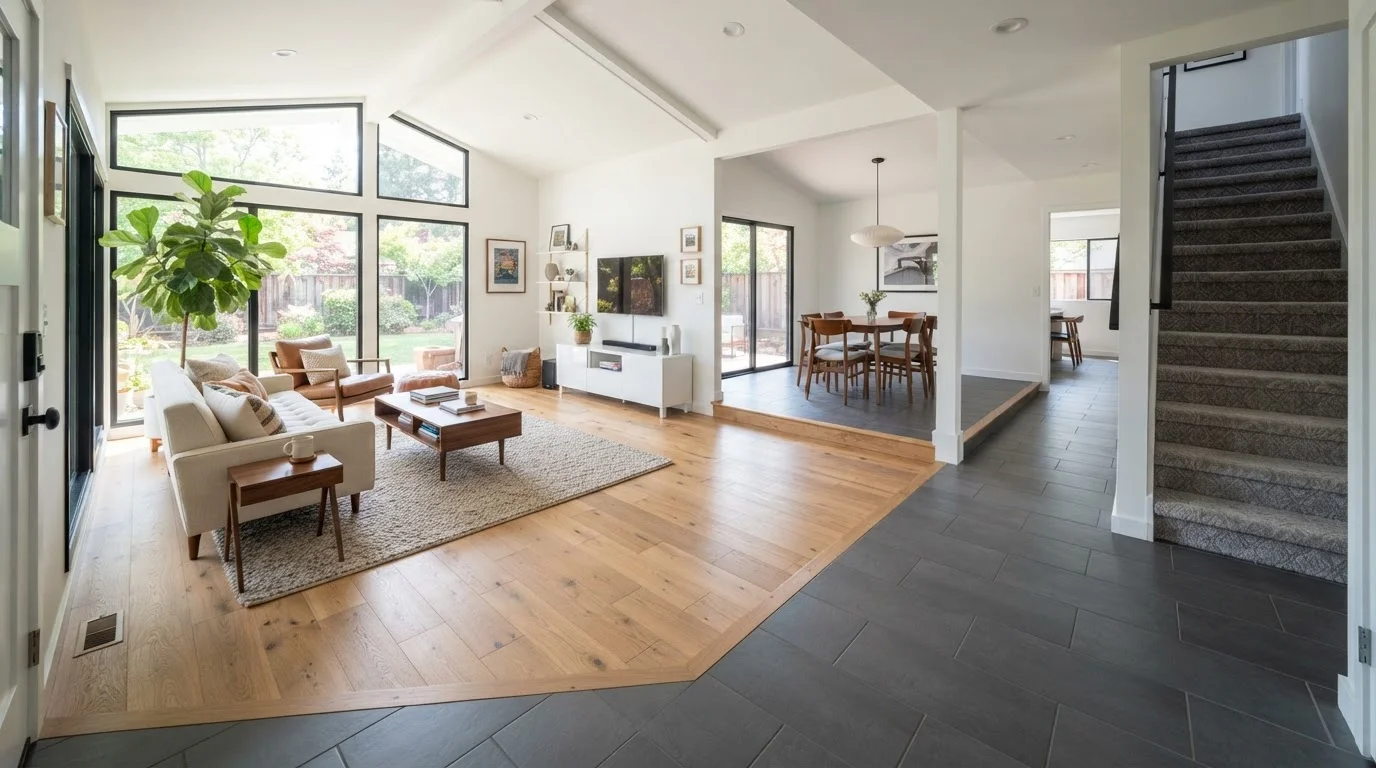
If you're renovating multiple rooms and considering an open-concept layout, flooring continuity becomes an important design decision. The article open-concept conversions: what the floor plans don't tell you covers how structural changes affect your overall renovation plan.
Frequently Asked Questions
Floating floors - including many laminate and luxury vinyl plank products - are generally the most DIY-friendly because they click or lock together without adhesive or nails. Tile and hardwood typically require more skill and specialized tools, making professional installation more common for those materials.
Luxury vinyl plank and tile are generally the most resilient choices for busy households - both resist scratches, moisture, and heavy foot traffic. Hardwood can work but may show wear faster with active pets or young children.
Standard laminate is water-resistant but not waterproof - standing water can seep into seams and cause swelling over time. Some newer laminate products offer improved moisture protection, but luxury vinyl plank remains the better choice for high-moisture spaces.
Hardwood floors are widely regarded by real estate professionals as a positive factor in home valuation, though the effect varies by market. Other flooring types can also support value when they are in good condition and appropriate for the room.
The subfloor should be structurally sound, level within the manufacturer's tolerances (usually within 3/16 inch over 10 feet), dry, and free of squeaks or soft spots. A flooring contractor or inspector can assess subfloor condition before installation begins.
In some cases, yes - certain floating floors can go over existing vinyl or tile if the surface is level and in good condition. However, adding height can cause issues at doorways and transitions, and some materials should not be layered. Check manufacturer guidelines and local building codes.
The content on this site is for informational purposes only and is not a substitute for professional advice. Always consult a qualified professional for guidance specific to your situation.