

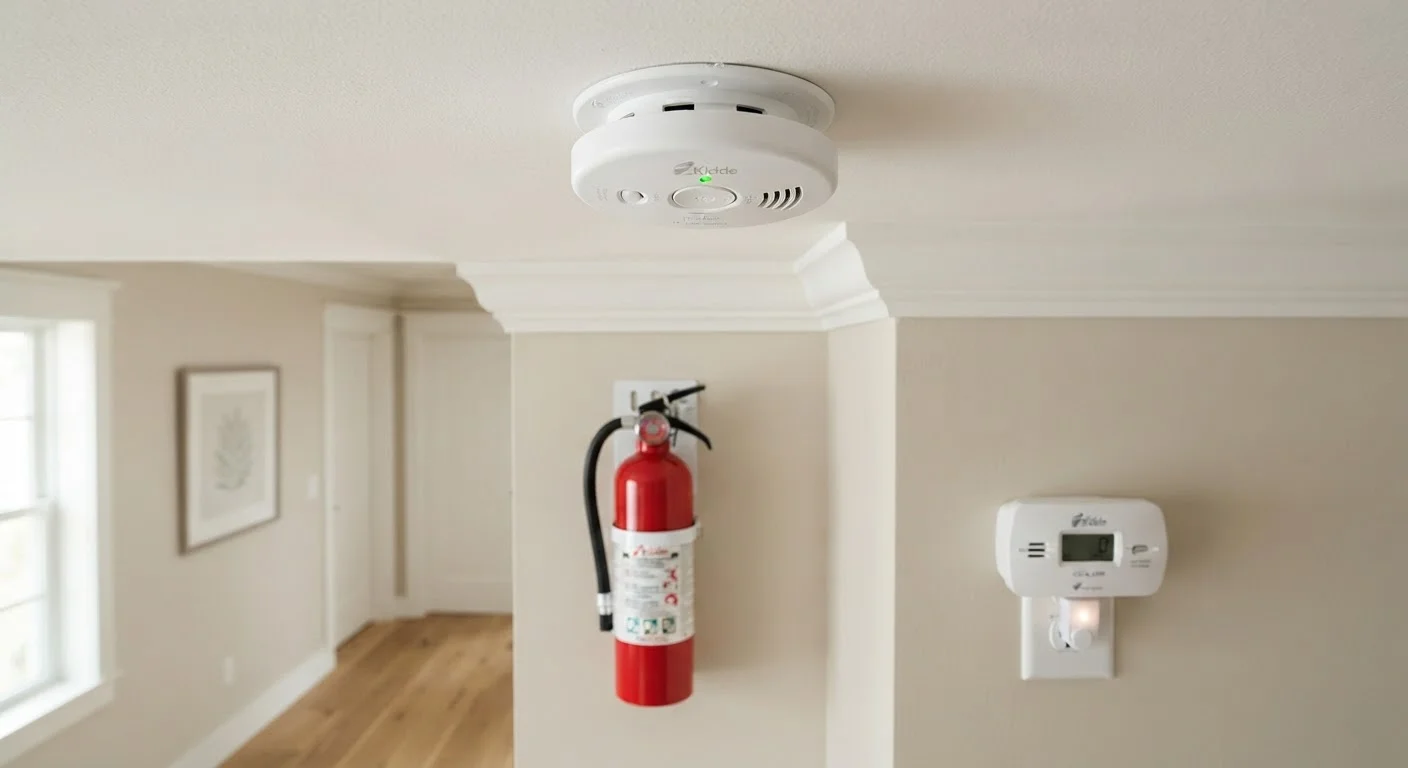
Why Life-Safety Device Myths Are Genuinely Dangerous
Smoke detectors, carbon monoxide (CO) alarms, and fire extinguishers are among the most important safety tools in any home - and among the most misunderstood. Misconceptions about how they work, where they go, and when they need attention are widespread, and the consequences of those misunderstandings can be severe.
Unlike a leaky faucet or a cracked tile, a malfunctioning life-safety device gives no visible warning that it has failed. Many homeowners operate under assumptions absorbed from old advice, outdated product generations, or simply never questioning what they were told. This article addresses the most common myths directly, so you know what correct maintenance actually looks like.
If you're newer to homeownership and building out your maintenance routines, see our guide for first-time owners for a broader foundation to build from.
Myth
If the battery is fresh and the alarm chirps when tested, the smoke detector is working fine.
Fact
A detector that chirps during a test only confirms the horn and battery circuit work - not that the smoke sensor itself is still functional.
Smoke sensing technology degrades over time. The U.S. Fire Administration and the National Fire Protection Association (NFPA) recommend replacing smoke detectors every 10 years from the manufacture date - not the installation date. A decade-old detector may pass the audible test while having a sensor that no longer responds reliably to actual smoke particles. Check the manufacture date stamped on the back of the unit.
Myth
One smoke detector per floor is enough to protect the whole home.
Fact
NFPA 72 calls for smoke alarms inside every sleeping room, outside each sleeping area, and on every level including the basement.
A single hallway alarm may not trigger quickly enough if a fire starts in a closed bedroom at the far end of the house. Interconnected alarms - wired or wireless - solve this problem: when one detects smoke, all alarms in the home sound simultaneously. Modern wireless interconnect systems make this achievable without rewiring. Proper coverage is especially important in homes with long hallways, multiple stories, or rooms with closed doors at night.
Myth
Carbon monoxide alarms only need to go in the kitchen or near the furnace.
Fact
CO alarms are most critical near sleeping areas, where occupants are unconscious and unable to detect early symptoms.
Carbon monoxide is colorless, odorless, and causes symptoms - headache, dizziness, confusion - that can be mistaken for illness during waking hours. During sleep, those warning signals go unnoticed. The Centers for Disease Control and Prevention (CDC) recommends CO alarms on every level of the home and within 10 feet of each bedroom door. Placement in the kitchen directly above a gas range or in an attached garage is discouraged because combustion byproducts from normal cooking or car exhaust can trigger unnecessary alarms.
Myth
As long as the pressure gauge reads in the green zone, the fire extinguisher is ready to use.
Fact
A green gauge reading confirms pressure, but not whether the extinguishing agent is still effective or whether the unit is mechanically sound.
Dry chemical extinguishers can experience powder compaction or internal corrosion that renders them ineffective despite a normal gauge reading. Seals degrade, nozzles can clog, and cylinders develop weaknesses invisible from outside. Annual professional inspections - required by NFPA 10 for most residential and commercial settings - assess these internal factors. Most extinguishers also carry a manufacturer-recommended service life of 5 to 12 years depending on type, after which replacement or hydrostatic testing is warranted.
Myth
Carbon monoxide alarms don't expire - they last as long as they keep powering on.
Fact
Most CO alarms have a manufacturer-specified service life of 5 to 7 years and should be replaced at that interval regardless of function.
The electrochemical sensors inside CO alarms gradually lose sensitivity over time, even when the unit still powers on and responds to the test button. Like smoke detectors, the test function checks the alarm circuit - not the sensor's current detection capability. The manufacture date is typically printed on the back label. Many homeowners skip this replacement because the unit shows no signs of failure, but an expired CO alarm may not detect a dangerous accumulation until levels are already dangerous.
What Proper Maintenance Actually Looks Like
Understanding the myths is only half the job. Putting correct habits into practice is where safety is actually built.
3 in 5
Home fire deaths with missing or non-working smoke alarms
According to the National Fire Protection Association, roughly three of every five home fire deaths occur in homes with no smoke alarms or alarms that failed to operate.
~400
Annual U.S. deaths from unintentional CO poisoning
The CDC estimates approximately 400 Americans die each year from unintentional, non-fire-related carbon monoxide poisoning - most occurring in residential settings.
Smoke detectors should be tested by pressing the test button monthly. Vacuum the vents gently once a year to remove dust accumulation, which can desensitize sensors over time. Replace the entire unit at the 10-year mark regardless of apparent function. Use ionization detectors in hallways and combination or photoelectric detectors near kitchens to reduce nuisance alarms without sacrificing protection.
CO alarms require the same monthly test discipline. Check the manufacture date printed on the back - most units carry a 5-to-7-year service life. Install them on every level of the home and within 10 feet of each sleeping area. Basements with fuel-burning appliances need coverage too. Never place a CO alarm directly above a gas stove or in a garage, where normal combustion fumes would cause constant false alerts.
Fire extinguishers need a quick visual inspection monthly: confirm the pressure gauge needle is in the green zone, the pin and tamper seal are intact, and the unit shows no visible corrosion or damage. A professional inspection - required annually under most fire codes - verifies internal integrity that a gauge reading alone cannot. Extinguishers should be mounted in accessible, visible locations: kitchens, garages, and near any workshop or utility space are sensible starting points.
Neglecting these devices is one of the maintenance tasks homeowners routinely skip - with consequences that go well beyond a repair bill. If you're a landlord, be aware that proper functioning and placement of these devices is typically a legal requirement; our article on maintenance responsibilities for rental properties covers what that means in practice.
Never Disable an Alarm to Stop Nuisance Triggers
Removing a battery or covering a detector to silence cooking smoke or steam is one of the most common - and dangerous - responses to nuisance alarms. A disabled detector offers zero protection. Instead, address the root cause: relocate the unit away from the cooking area, improve kitchen ventilation, or switch to a photoelectric detector, which is generally less sensitive to cooking particles. Temporarily silencing with the hush button is safe; permanent disabling is not.
This article is for general informational purposes only. Always consult your local fire code, device manufacturer guidelines, and a qualified fire safety professional for requirements specific to your home and jurisdiction.
The content on this site is for informational purposes only and is not a substitute for professional advice. Always consult a qualified professional for guidance specific to your situation.