

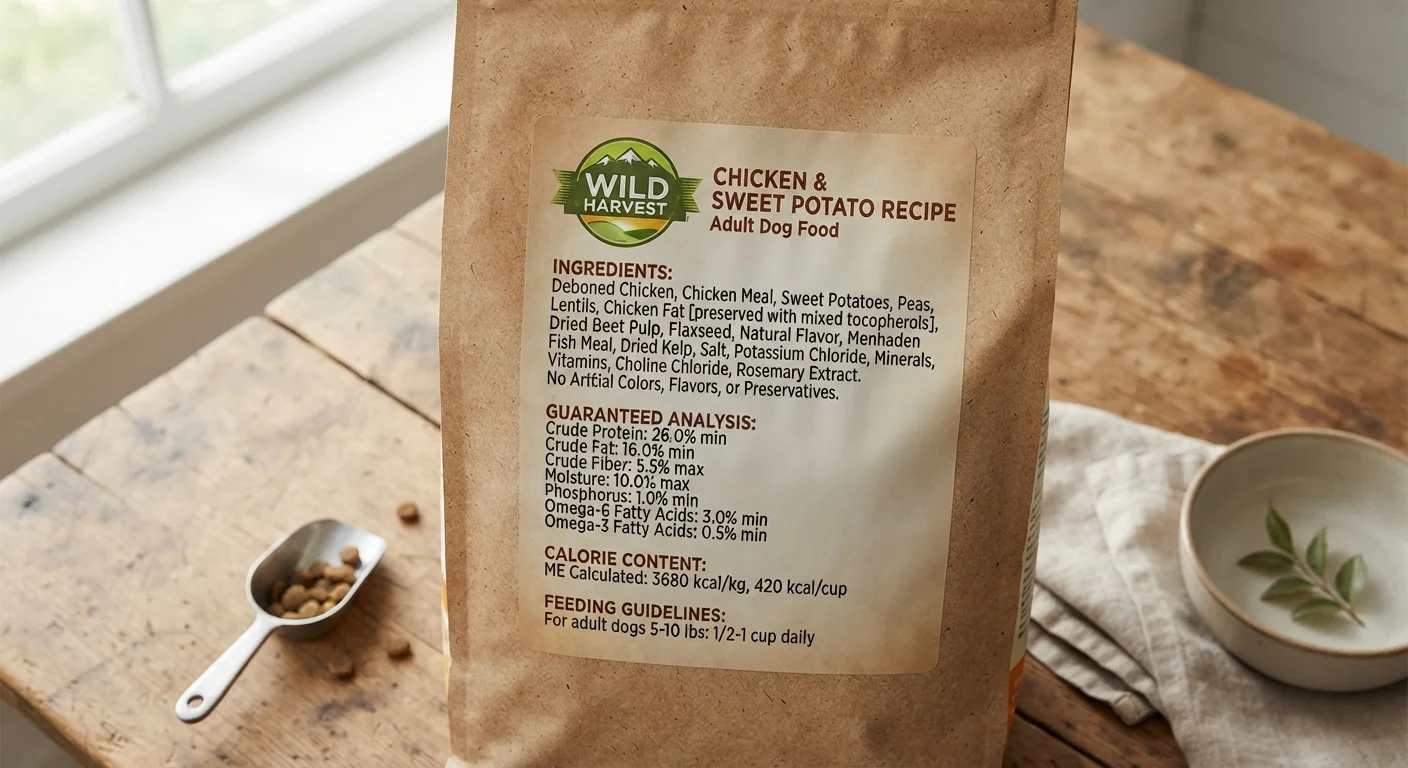
Why Pet Food Labels Can Be So Confusing
Walk down any pet food aisle and you'll encounter a parade of claims: "complete and balanced," "human-grade," "natural," "grain-free." Some of these terms carry precise regulatory meaning. Others are largely marketing language with no legal definition at all. Knowing the difference helps you make genuinely informed choices for your dog or cat - not just respond to packaging designed to appeal to pet-loving instincts.
In the United States, pet food labeling is regulated at both the federal level by the FDA and at the state level, largely guided by standards set by the AAFCO. AAFCO does not itself have regulatory authority, but its model regulations are adopted by most states, making them the de facto national standard. Understanding which terms come from AAFCO definitions - and which don't - is the first step to reading a label accurately.
| Regulatory body | FDA (federal) + AAFCO model regulations (adopted by most states) |
| "Complete and Balanced" requirement | Must meet AAFCO nutrient profiles or pass feeding trials (AAFCO Model Regulations) |
| "95% Rule" ingredient threshold | Named ingredient must be ≥95% of total product weight (excluding water) (AAFCO) |
| "With [Ingredient]" threshold | Only 3% of total product weight required (AAFCO) |
| "Natural" - regulated? | Yes, by AAFCO definition; does not mean organic or unprocessed (AAFCO) |
| "Human-grade" - regulated? | No official AAFCO definition for the full product claim |
Regulated Terms: What They Actually Guarantee
"Complete and Balanced" is one of the most meaningful phrases you'll see. When a food carries this claim, it must meet AAFCO nutrient profiles for the stated life stage (e.g., adult maintenance or growth/reproduction). The manufacturer must either formulate to those profiles or conduct feeding trials. This phrase tells you the food is designed to serve as a primary diet - not a treat or supplement.
Life stage designations matter significantly. A food labeled for "All Life Stages" meets the requirements for the most demanding stage - growth and reproduction - which means puppies and kittens can eat it, but the nutrient density may be higher than an adult or senior pet needs.
The "95% Rule," "25% Rule," and "3% Rule" govern how prominently an ingredient can be named on the package. If a product says "Salmon Cat Food," salmon must make up at least 95% of the total product weight (excluding water). A name like "Salmon Dinner" or "Salmon Entrée" only requires 25%. A descriptor like "with Salmon" requires just 3%. These distinctions are easy to miss but significant.
"Natural" has an AAFCO definition: ingredients derived solely from plant, animal, or mined sources that haven't been chemically synthesized. However, individual vitamins and minerals added to meet nutritional requirements are often synthetic, so a food can be labeled "natural" while still containing them - manufacturers typically add a qualifier such as "with added vitamins and minerals." The term does not mean organic, unprocessed, or nutritionally superior.
AAFCO
The Association of American Feed Control Officials. A private organization whose model regulations for pet food labeling and nutrition are adopted by most U.S. states, making them the practical national standard.
Complete and Balanced
An AAFCO-regulated claim indicating a food meets established nutrient profiles for a specific life stage. Foods carrying this label can legally serve as a pet's sole diet.
As-Fed Basis
Nutrient or ingredient values measured including the food's moisture content. Because moisture dilutes the percentages, dry and wet foods can look very different on a per-ingredient basis until moisture is accounted for.
Dry Matter Basis
Nutrient values calculated after removing all moisture from the food. This is the most accurate way to compare the actual nutrient content of wet and dry foods side by side.
Dilated Cardiomyopathy (DCM)
A heart condition in dogs characterized by an enlarged, weakened heart muscle. The FDA has investigated a possible association with certain grain-free diets, though causation has not been definitively established.
Life Stage
The phase of an animal's life - such as growth, adult maintenance, or reproduction - for which a food's nutrient profile is designed. Matching life stage to your pet's needs matters for appropriate nutrition.
Unregulated or Loosely Defined Terms to Know
"Human-grade" sounds reassuring but has no official AAFCO definition in the context of pet food as a whole. For a food to legitimately use this claim, every ingredient and the entire manufacturing process would need to meet USDA standards for human consumption - a very high bar. Without that verification, the term is essentially a marketing descriptor, and there is currently no systematic regulatory enforcement of it on pet food labels.
"Grain-free" simply means the food contains no corn, wheat, rice, barley, or other grains. It does not mean low-carbohydrate - many grain-free formulas substitute legumes (peas, lentils) or potatoes, which are also carbohydrate sources. The FDA has been investigating a possible link between certain grain-free diets high in legumes and a heart condition called DCM in dogs. Research is ongoing and no definitive causal link has been established, but it's worth discussing with your veterinarian, especially for breeds already predisposed to cardiac issues. For more on how diet claims are scrutinized, see our article on separating myth from fact on raw pet food diets.
"Premium," "gourmet," and "ultra" carry no regulatory definition whatsoever and impose no ingredient or nutritional standards beyond baseline requirements. They are purely marketing language.
Reading the ingredient list itself is also informative. Ingredients are listed by weight before processing - which is why a moisture-rich ingredient like chicken may appear first even if it constitutes a smaller proportion of the finished dry food. Understanding this "as-fed" versus "dry matter" distinction helps you compare foods more accurately. For a parallel look at how ingredient lists work in other consumer products, see how skincare ingredient lists use concentration order - the same logic applies.
Making sense of pet food labels is part of building a solid daily pet care routine for your animal's long-term wellbeing. When in doubt, your veterinarian or a board-certified veterinary nutritionist is the best resource for guidance tailored to your specific pet's needs.
This article is for general informational purposes only and does not constitute veterinary or nutritional advice. Always consult a qualified veterinarian for guidance specific to your pet's health and dietary needs.
The content on this site is for informational purposes only and is not a substitute for professional advice. Always consult a qualified professional for guidance specific to your situation.