

Start here
Understanding Carry-On Size and Weight Rules
Next
What to Pack (and What to Leave Behind)
Then
Liquids, Gels, and TSA Rules
Apply it
Packing Techniques That Actually Work
Final step
At the Gate: What to Expect
Understanding Carry-On Size and Weight Rules
Before anything goes into your bag, you need to know how big that bag can be. Airlines set their own carry-on dimensions, and while many U.S. carriers allow bags around 22 x 14 x 9 inches (including handles and wheels), that is not a universal standard. International carriers and budget airlines often impose stricter limits, and some apply weight caps that domestic carriers do not.
The safest approach: look up the baggage policy on your airline's official website for the specific route and fare class you booked. Do this before you buy or borrow a bag. A rolling carry-on that works on one airline may be oversized on another.
Always Verify Limits with Your Specific Airline
Carry-on size and weight rules are set independently by each airline and can differ even between fare classes on the same carrier. Budget carriers in particular may enforce stricter or smaller limits. Check the airline's official website before you pack - not a third-party summary.
See the Trip Planning Hub for broader pre-departure preparation beyond just packing.
What to Pack (and What to Leave Behind)
The core principle of carry-on packing is intentionality: every item earns its place. Start by laying out everything you think you need, then cut it by roughly a third before placing anything in the bag.
Essentials That Always Go In
- Travel documents (passport, ID, boarding passes, any visas)
- Prescription medications and a copy of your prescription
- Phone, charger, and any critical electronics
- One to two days' worth of clothing beyond your planned trip length as a buffer
- A small toiletry kit compliant with TSA rules (see next section)
Common Items to Leave Out
- Full-size bottles of shampoo, conditioner, or lotion
- Books you probably will not read
- Duplicate items (two pairs of shoes that serve the same purpose)
- Anything you could buy at your destination if truly needed
If you are worried about overpacking, the real costs of overpacking article breaks down both the financial and physical toll in practical detail.
Carry-on bag
A piece of luggage small enough to fit in an aircraft's overhead bin that passengers bring into the cabin rather than checking at the counter.
Personal item
A smaller bag - such as a purse, backpack, or laptop bag - that fits under the seat in front of you. Most airlines allow this in addition to a carry-on.
TSA 3-1-1 rule
A U.S. Transportation Security Administration rule requiring that liquids in carry-on bags be in containers of 3.4 oz or less, placed in a single clear quart-sized zip-lock bag.
Gate check
When an airline takes your carry-on at the boarding gate - usually because overhead bins are full - and loads it in the cargo hold, returning it at the destination gate.
Packing cubes
Lightweight fabric organizers that zip closed and compress clothing, helping separate categories of items and use bag space more efficiently.
Liquids, Gels, and TSA Rules
The TSA 3-1-1 rule governs what liquids you can bring through a U.S. airport security checkpoint in your carry-on. Each liquid, gel, cream, or aerosol must be in a container of 3.4 oz (100 ml) or less. All containers must fit into one clear, quart-sized zip-lock bag, and you may bring one such bag per person.
At the checkpoint, remove this bag from your carry-on and place it in a screening bin by itself. Forgetting to do this is one of the most common causes of delays at security.
Medications Are Exempt from the 3-1-1 Rule
Liquid prescription medications in quantities exceeding 3.4 oz are permitted through TSA security but must be declared and removed from your bag for separate screening. Keep them accessible and inform the security officer. Always carry a copy of your prescription when traveling with medication.
Solid alternatives - bar soap, shampoo bars, solid deodorant, and stick sunscreen - sidestep the liquid rule entirely and are worth considering for longer trips where toiletry needs are higher.
Packing Techniques That Actually Work
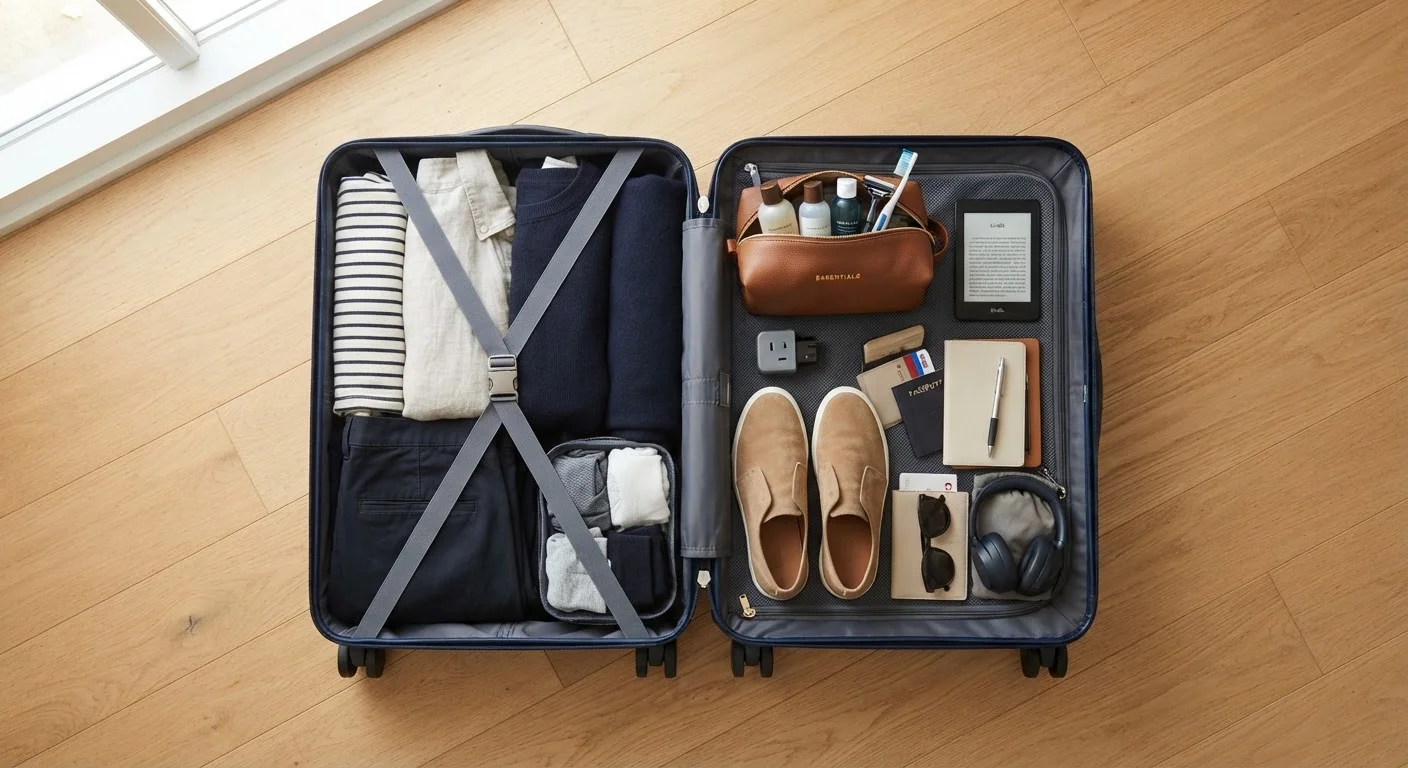
How you pack matters as much as what you pack. Two reliable methods that experienced carry-on travelers use consistently:
Rolling vs. Folding
Rolling clothing into tight cylinders reduces wrinkles in casual items and makes it easier to see everything at a glance. Structured pieces like blazers or dress shirts generally fold better to avoid creasing.
Using Packing Cubes
Packing cubes are zippered fabric organizers that separate clothing categories and compress contents. A common setup: one cube for tops, one for bottoms, one for undergarments and socks. Compression cubes can reduce the volume of soft items significantly.
Pack a Change of Clothes in Your Personal Item
Even on a carry-on-only trip, tuck one change of clothes and your essential toiletries into your personal item. If your carry-on gets gate-checked unexpectedly, you'll still have what you need right away.
Once packed, lift your bag as if storing it in an overhead bin. If you are struggling to lift it comfortably, it is too heavy - regardless of whether it meets size rules. You will need to manage it yourself throughout the airport.
For multi-city trips where you are unpacking and repacking repeatedly, the approach to staying organized across destinations offers further strategies tailored to that challenge.
At the Gate: What to Expect
Even a perfectly sized carry-on can be gate-checked if the flight is full and overhead bin space runs out. Airlines typically do this at no charge and return the bag at the jet bridge upon arrival - but it means your bag goes below with checked luggage temporarily.
To minimize this risk, board as early as your assigned group allows. Passengers who board last are most likely to find bins full.
Before your travel day, run through the full pre-departure checklist to make sure documents, reservations, and logistics are confirmed well in advance - packing is just one piece of a successful departure.
Carry-on-only travel does require more planning upfront, but for most trips it simplifies the experience: no baggage fees, no waiting at carousels, and no risk of a checked bag being delayed or lost.
Frequently Asked Questions
Most major US airlines allow a carry-on bag up to approximately 22 x 14 x 9 inches, including handles and wheels. However, limits vary by airline and even by fare class, so always check your specific carrier's policy before you travel.
Most airlines allow one carry-on bag plus one personal item, such as a backpack, purse, or laptop bag. The personal item must fit under the seat in front of you. Again, size rules differ by airline, so verify in advance.
Under the TSA 3-1-1 rule, liquids, gels, and aerosols must be in containers of 3.4 oz (100 ml) or less, all fitting in one clear quart-sized bag, with one bag per traveler. Items like full-size shampoos or water bottles must be placed in checked luggage or discarded.
Keep prescription medications, travel documents, electronics, valuables, and a change of clothes in your carry-on. Checked bags can be delayed or lost, so anything irreplaceable or urgently needed should travel with you in the cabin.
Yes, with planning it is very achievable. Many travelers manage week-long or even two-week trips with a single carry-on by choosing versatile clothing, doing laundry mid-trip, and using packing cubes to compress items efficiently.
It is possible on full flights. Airlines typically gate-check bags for free in this situation and return them at the jet bridge upon arrival. To reduce this risk, board as early as your boarding group allows.
The content on this site is for informational purposes only and is not a substitute for professional advice. Always consult a qualified professional for guidance specific to your situation.