

What Governs Airport Security in the U.S.
The Transportation Security Administration (TSA) is the federal agency responsible for security screening at nearly all commercial airports in the United States. Established after September 11, 2001, TSA operates under the Department of Homeland Security and sets the rules travelers must follow at checkpoints nationwide.
TSA's published guidelines are the authoritative source for what is and isn't allowed. Because rules can change, always verify current requirements at tsa.gov before you travel - not through unofficial third-party summaries. The agency also maintains a searchable tool called What Can I Bring? where you can look up specific items.
Before you even get to the checkpoint, your pre-departure prep matters. Our pre-trip checklist covers documents and essentials to confirm well before departure day.
Acceptable ID: REAL ID and Your Options
Starting May 7, 2025, TSA requires every domestic air traveler 18 and older to present a REAL ID-compliant document or an acceptable alternative. A standard driver's license issued before your state adopted REAL ID standards will no longer be accepted at checkpoints after that date.
A REAL ID-compliant license displays a star in the upper corner. If yours doesn't have one, check your state DMV's website for how to upgrade. Acceptable alternatives include a U.S. passport, passport card, DHS Trusted Traveler card (Global Entry, NEXUS, SENTRI), military ID, or permanent resident card.
REAL ID Deadline Is May 7, 2025
After May 7, 2025, a standard non-compliant state driver's license will no longer be accepted at TSA checkpoints for domestic air travel. If your license doesn't have the required star marking, bring a valid U.S. passport or update your license at your state DMV before your next flight. Check tsa.gov/real-id for the current list of compliant states and acceptable documents.
If you're unsure whether your license qualifies, bring a passport as a backup. TSA maintains a full list of acceptable IDs at tsa.gov/real-id. Arriving without compliant ID may result in being denied boarding.
The Liquids Rule, Explained Clearly
The 3-1-1 rule has been in place since 2006 and remains standard for carry-on bags. Each liquid, gel, aerosol, cream, or paste must be in a container of 3.4 ounces (100 milliliters) or less. All containers must fit in a single, clear, quart-sized zip-top bag - one bag per passenger, placed in a bin for separate screening.
Common items that catch travelers off-guard: peanut butter, yogurt, hummus, and similar spreadable foods count as gels. Snow globes, liquid-filled toys, and oversized perfume bottles have been confiscated at checkpoints. When in doubt, pack it in your checked bag.
Exceptions exist for breast milk, infant formula, and liquid medications - these may exceed 3.4 oz if reasonable quantities and must be declared to the officer. Duty-free liquids purchased after the security checkpoint in sealed tamper-evident bags may also be permitted on connecting flights, though rules vary by airline and international transit point.
Repack Your Liquids Bag at Home
The checkpoint is the wrong place to discover your moisturizer is 4 oz. Before any trip, pull out your liquids bag and confirm every container meets the 3.4 oz limit. Decant larger bottles into travel-sized containers the night before you leave. A few minutes at home prevents confiscation and lane delays.
What to Remove - and What Stays In Your Bag
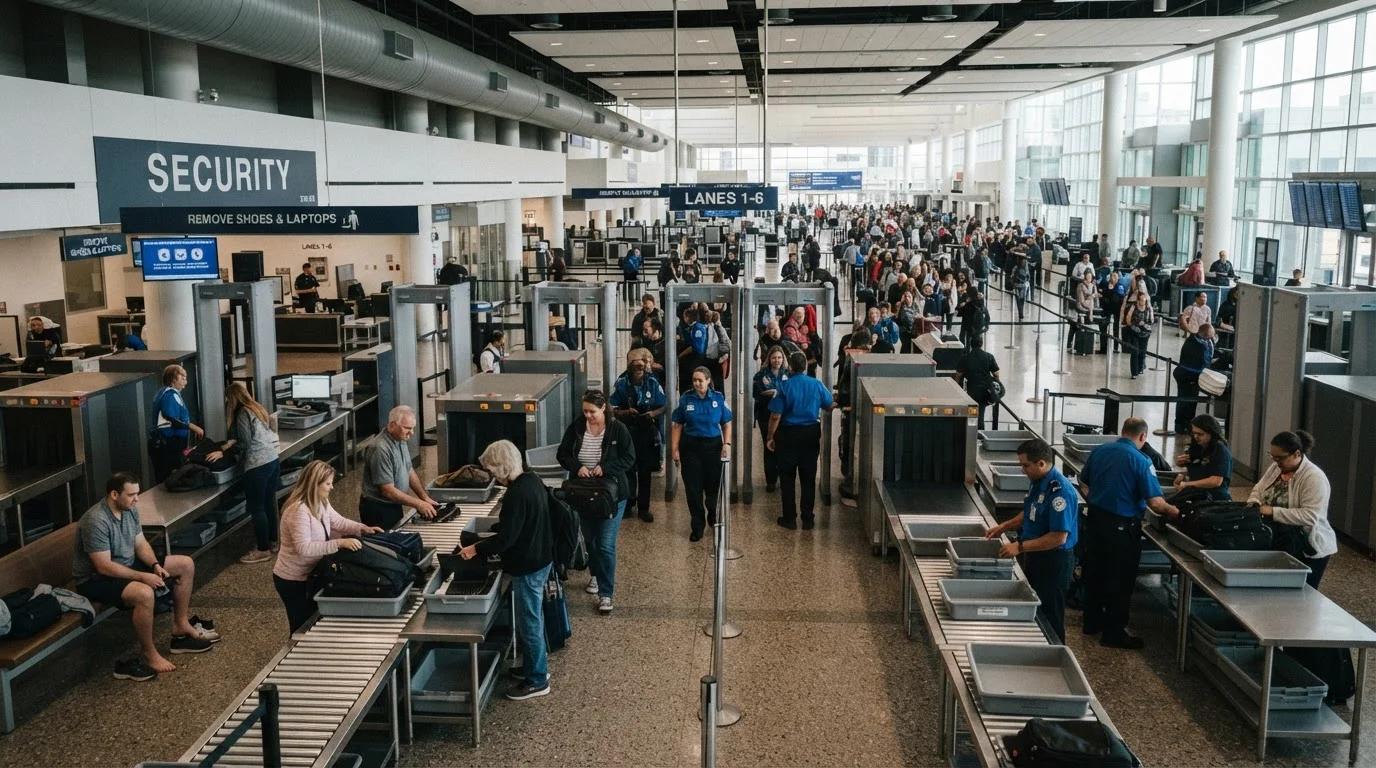
Standard screening lanes require travelers to remove: shoes, belts, jackets and coats, laptops (from bags), and the quart-sized liquids bag. Electronics larger than a cell phone - tablets, e-readers, portable chargers - must also come out and lay flat in a bin at most checkpoints.
Items that often trigger alarms: bulky sweaters worn over metal jewelry, forgotten change in coat pockets, and money clips. TSA officers cannot legally require you to power on your phone, but they can detain devices for additional screening. For more on protecting your data at the checkpoint, see our guide on keeping your devices safe while traveling.
After clearing the scanner, collect your belongings before fully dressing - move to a designated repacking area so you don't block the lane.
Pack your carry-on with screening in mind: place your liquids bag and laptop near the top of your bag so they're the first things you can pull out, not the last.
Fumbling at the bin area slows down the entire lane and increases your stress level - front-loading these items before you leave for the airport takes seconds and saves minutes at the checkpoint.
Wear slip-on shoes on travel days and avoid layered metal jewelry - it cuts the time you spend repacking at the checkpoint and reduces the chance of a secondary screening trigger.
Belt buckles, underwire, and layered necklaces are among the most common causes of incidental alarm triggers, often adding 5-10 minutes to a traveler's screening experience.
TSA PreCheck, Global Entry, and CLEAR
TSA PreCheck is a trusted traveler program that lets approved members use dedicated, expedited lanes where they typically keep shoes, belts, light jackets, laptops, and liquids in their bags. Enrollment requires an application, background check, and in-person appointment. Membership is valid for five years.
Global Entry is a CBP program that includes TSA PreCheck benefits and adds expedited re-entry to the U.S. from international travel. It requires a more thorough background check and an in-person interview. It's worth considering if you travel internationally even once or twice a year.
CLEAR is a private biometric service - not a government program - that uses fingerprints or iris scans to verify identity, allowing members to bypass the standard ID check line. CLEAR does not replace security screening; it works alongside TSA PreCheck or standard lanes.
2.5M+
Daily passengers screened by TSA
TSA screens more than 2.5 million travelers per day across U.S. airports, according to TSA published data.
15M+
Enrolled TSA PreCheck members
As of recent TSA reporting, over 15 million travelers are enrolled in the TSA PreCheck program.
~5 min
Average PreCheck lane wait time
TSA reports that approximately 99% of PreCheck passengers wait fewer than 10 minutes, with many clearing in around 5.
Enrollment in any trusted traveler program does not guarantee expedited screening on every flight - TSA reserves the right to direct any traveler through standard screening.
If You're Flagged, Pulled Aside, or Patted Down
Being selected for additional screening - whether by the scanner, a random selection system called SSSS (Secondary Security Screening Selection), or an officer's judgment - is not an accusation. It's a routine part of how TSA manages risk across millions of daily screenings.
During a pat-down, you have the right to request a same-gender officer and a private screening room. You may also ask for a witness to be present. Officers must explain the process before beginning. If you have concerns about how a screening was conducted, ask for a supervisor at the checkpoint or file a complaint with TSA's Contact Center afterward.
If a bag is flagged for manual inspection, TSA may open and search it in your presence or leave a notice inside if you've checked the bag. Prohibited items found during screening will be confiscated; in some cases, law enforcement may be contacted.
Traveling with Medications, Medical Devices, and Special Items
Prescription and over-the-counter medications in pill form are generally straightforward - no quantity limit applies, though keeping them in their original labeled containers helps avoid questions. Liquid medications must be declared separately and are exempt from the 3.4 oz limit when in reasonable quantities for the trip.
Insulin, syringes, CPAP machines, and similar medical devices are permitted in carry-on bags. Notify the officer at the beginning of screening and keep documentation (a letter from a healthcare provider can help, though TSA does not require it). Insulin that requires refrigeration may be packed with a gel ice pack.
Passengers with pacemakers, implanted devices, or prosthetics should inform the officer before entering the scanner. TSA has a program called TSA Cares that provides assistance to travelers with disabilities or medical needs - contact them at least 72 hours before your flight.
For a full pre-departure review of documents and health items, see our departure checklist.
This article provides general informational guidance about U.S. airport security procedures. Rules and requirements can change; always verify current TSA policies at tsa.gov and check with your airline before traveling.
The content on this site is for informational purposes only and is not a substitute for professional advice. Always consult a qualified professional for guidance specific to your situation.