

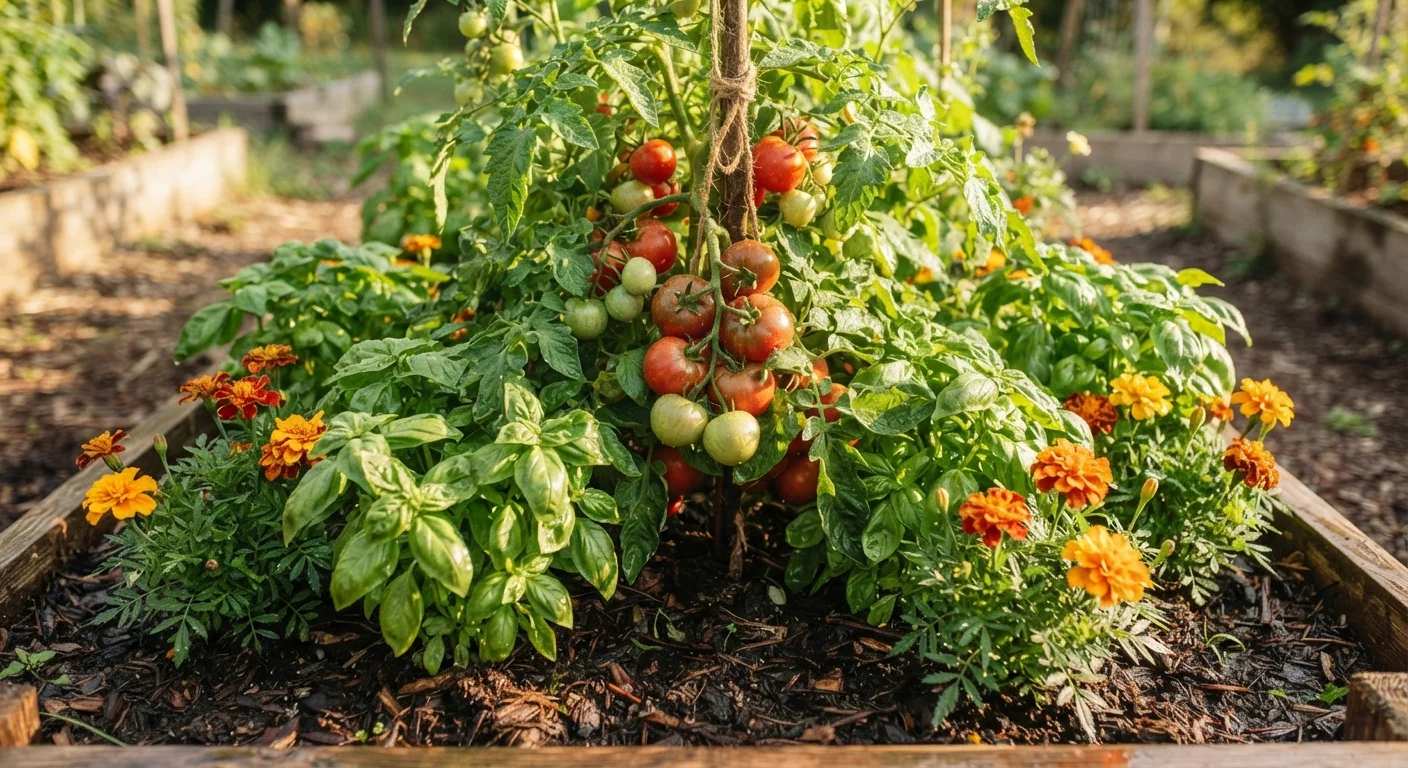
Why Companion Planting Is More Than Garden Folklore
Companion planting - the practice of growing different plants in close proximity for mutual benefit - has roots stretching back centuries. Indigenous agricultural traditions, including the well-known Three Sisters system of corn, beans, and squash, demonstrate that observational wisdom often anticipates formal research. Today, plant scientists continue to investigate the mechanisms behind these pairings, and while not every folk claim holds up under scrutiny, a meaningful number do.
The key mechanisms researchers have identified include chemical signaling (plants releasing volatile compounds that deter insects), nitrogen fixation (legumes enriching soil for neighboring crops), physical structure (taller plants shading or trellising shorter ones), and habitat creation (flowering plants drawing beneficial insects). Understanding which mechanism applies helps you choose pairings with realistic expectations - and avoid wasting bed space on combinations that offer little real benefit.
Whether you're gardening in raised beds or in the ground - see our guide on raised beds vs. in-ground planting - these principles apply across most home garden setups. Below are seven pairs backed by credible research or well-established horticultural reasoning.
Tomatoes and Basil
This is arguably the most popular companion pair, and the science offers some support. Basil releases volatile compounds - including linalool and estragole - that have been shown in laboratory settings to repel thrips, aphids, and certain moth species. Field studies have produced mixed results depending on planting density and variety, but many experienced gardeners report fewer pest incidents when basil is interplanted directly among tomatoes rather than planted nearby in a separate bed.
Practically, basil also benefits from the partial shade tomato foliage provides during peak summer heat, which can slow bolting. Plant basil within 12-18 inches of tomato stems for the best proximity effect.
Basil's volatile oils show measurable pest-deterring effects in controlled studies.
Corn, Beans, and Squash (Three Sisters)
This Indigenous planting system is one of the most well-documented examples of mutualistic companion planting. Each plant fills a distinct ecological role: corn provides a vertical trellis for climbing beans; beans fix atmospheric nitrogen into the soil through a symbiosis with Rhizobium bacteria, feeding the nitrogen-hungry corn; and squash spreads along the ground, suppressing weeds and retaining soil moisture with its large leaves.
Agronomic research supports the nitrogen-fixation benefit clearly. Studies have also confirmed reduced soil evaporation under squash canopy. The Three Sisters system is a compelling example of how structure, chemistry, and biology can work together without any synthetic inputs.
Beans fix atmospheric nitrogen into soil, directly feeding neighboring corn plants.
Carrots and Onions
The logic here is chemical interference. Onions (and their relatives, including leeks and chives) emit sulfur compounds that are thought to mask the scent of carrots from carrot flies (Psila rosae), which locate hosts primarily through volatile cues. Similarly, the strong scent of carrots may interfere with onion fly navigation.
Research on this pair is more limited than on the Three Sisters, but it aligns with the well-established principle of olfactory masking in pest management. Even if the effect is partial, interplanting these two crops uses bed space efficiently and has no known negative interactions between the plants themselves.
Onion sulfur compounds may mask carrot scent from pest insects navigating by smell.
Marigolds and Almost Anything
French marigolds (Tagetes patula) are among the most researched companion plants. Their roots secrete alpha-terthienyl, a compound toxic to root-knot nematodes - microscopic soil pests that can devastate tomatoes, peppers, and many other vegetables. Research confirms that a dense planting of marigolds maintained for a full season can meaningfully reduce nematode populations in the surrounding soil.
Above ground, marigold flowers attract beneficial insects including hoverflies and parasitic wasps, which prey on aphids and caterpillars. For nematode suppression, plant marigolds thickly and treat them as a soil crop for at least one growing season before replanting the bed with vegetables.
Marigold root secretions are scientifically confirmed to reduce soil nematode populations.
Dill and Brassicas
Dill attracts a wide range of beneficial predatory insects - particularly parasitic wasps in the family Braconidae - that parasitize caterpillars like cabbage loopers and imported cabbageworms, which are among the most destructive pests of broccoli, kale, cabbage, and Brussels sprouts. Flowering dill also draws hoverflies whose larvae consume aphids.
One important caveat: mature dill can inhibit carrot germination and growth, so keep dill away from carrot rows. Young dill transplants also tend to perform better as companions than direct-seeded plants, which may bolt quickly and lose their flowering benefit before it's needed. Pairing dill with brassicas also supports the pollinator-friendly garden goals many home growers are pursuing.
Flowering dill draws parasitic wasps that target cabbage-family caterpillar pests.
Lettuce and Tall Crops
Lettuce is a cool-season crop that bolts - sends up a flower stalk and turns bitter - when temperatures climb above roughly 75°F. Planting lettuce in the partial shade of taller crops like tomatoes, corn, or trellised cucumbers extends its productive season by several weeks in warm climates. This is a purely structural benefit, not a chemical one, but it's highly reliable and easy to implement.
The pairing also maximizes space: lettuce occupies the shaded understory that would otherwise be idle, making this combination particularly valuable in compact gardens. Spacing matters - lettuce still needs adequate air circulation to prevent fungal issues like downy mildew.
Tall crop shade can extend lettuce harvest by several weeks in warm-season gardens.
Nasturtiums as Trap Crops
Nasturtiums are frequently recommended as companion plants, but their primary benefit is often misunderstood. Rather than repelling aphids, nasturtiums strongly attract them - particularly black bean aphids. This makes them effective trap crops: they draw aphid colonies away from more valuable vegetables onto themselves, where the infestation can be monitored and managed (by hand-removal or a strong water spray) without touching food crops.
Nasturtiums also attract predatory insects, so a monitored trap crop can become a pest management hub. They're edible, easy to grow from seed, and work well at bed edges or in containers. Understanding their role as attractors rather than repellers is key to using them successfully.
Nasturtiums work as trap crops by luring aphids away from more valuable vegetables.
Getting the Most From Your Companion Planting Strategy
Companion planting is a complement to good gardening fundamentals, not a substitute for them. Healthy soil, appropriate watering, and correct spacing all matter more than any single pairing. If your beds lack organic matter, consider building a compost routine - our article on composting at home is a practical starting point for enriching your soil naturally.
Be realistic about outcomes. Research shows that companion planting can reduce pest pressure and support yields - it rarely eliminates problems entirely. Think of it as one layer in an integrated approach, alongside mulching, crop rotation, and, when necessary, responsible pest management. For a wider look at reducing chemical dependency in the garden, our piece on pesticides in the home garden offers useful context.
Gardeners working with limited space will find that many of these pairs are especially space-efficient. Our guide to growing food in small spaces covers how to maximize production in compact areas where thoughtful plant placement makes a real difference.
Start Small and Observe
Try one or two companion pairs in a single bed before redesigning your whole garden around them. Keep simple notes on pest pressure, yield, and plant health across seasons. Your specific soil, microclimate, and local pest populations will shape results more than any general guide can predict. Iterating based on your own observations is the most reliable path to a companion planting strategy that works in your yard.
The content on this site is for informational purposes only and is not a substitute for professional advice. Always consult a qualified professional for guidance specific to your situation.