

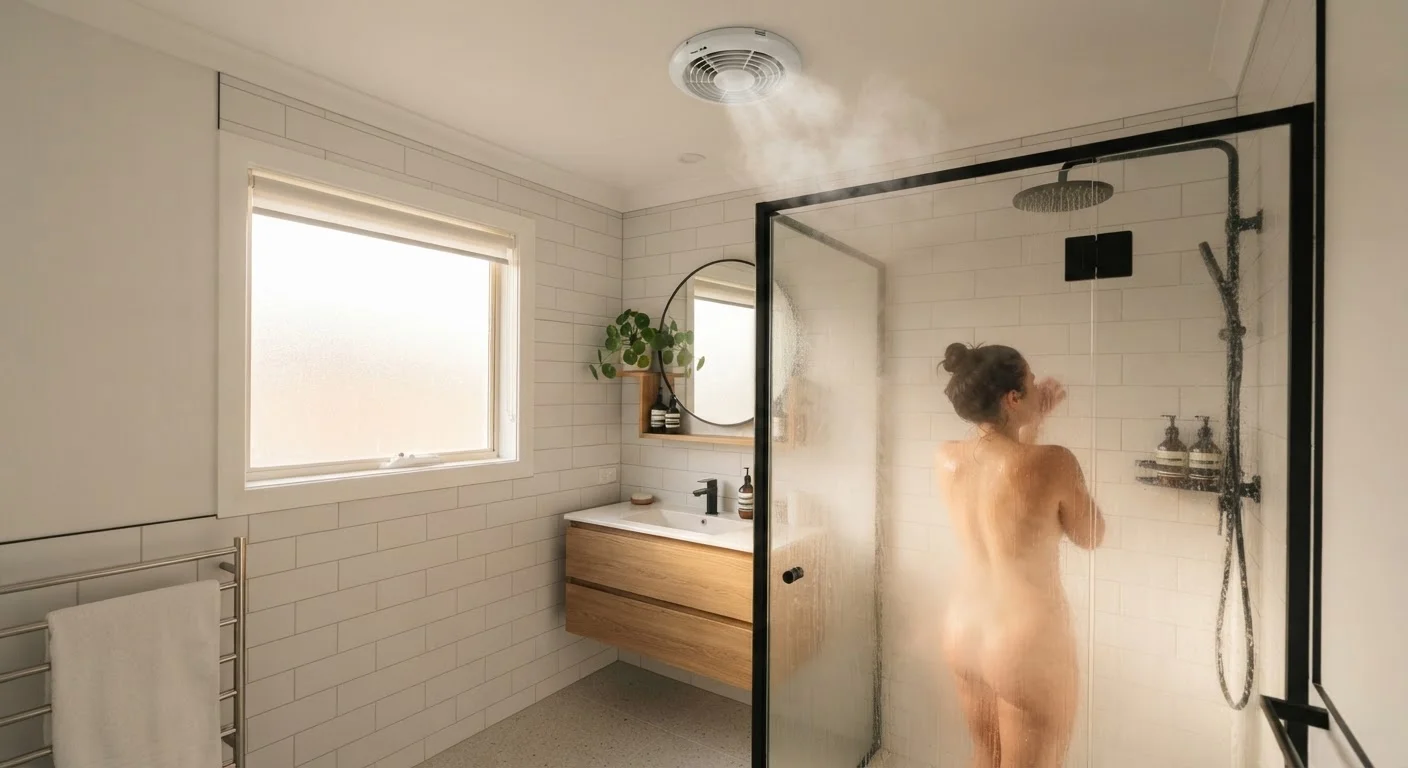
Why Airflow Is a Structural Concern, Not an Afterthought
Most homeowners think of ventilation as a comfort feature - something that clears steam or cooking smells. In reality, inadequate airflow in bathrooms and kitchens is one of the leading causes of preventable structural damage in American homes. Moisture generated by showers, boiling water, and dishwashers doesn't just evaporate harmlessly. It migrates into drywall, wood framing, insulation, and ceiling joists, where it feeds mold colonies and accelerates rot.
The damage often stays hidden for years. By the time a homeowner notices soft drywall, black staining on grout, or bubbling paint near the ceiling, the moisture has frequently been accumulating inside the building envelope for months. Addressing ventilation before visible damage appears is always less costly than remediation afterward.
Poor kitchen and bathroom ventilation also affects indoor air quality more broadly. Cooking produces carbon monoxide, nitrogen dioxide, and fine particulate matter - especially on gas ranges. Without an effective exhaust path, those pollutants recirculate throughout the living space. The same interconnected air pathways that carry moisture into wall cavities can carry combustion byproducts into bedrooms and common areas. This makes ventilation a whole-house concern, not just a room-by-room one. For a related look at how building systems interact, see our article on common HVAC misconceptions that quietly affect home performance.
50%
of homes with mold linked to moisture from inadequate ventilation
The EPA estimates that excess indoor moisture - much of it from cooking and bathing - is a primary contributor to mold growth in residential buildings.
1 CFM/sq ft
Minimum bathroom fan sizing standard
The Home Ventilating Institute (HVI) recommends at least 1 CFM per square foot of bathroom floor area as a baseline for effective moisture removal.
Up to 70%
airflow lost through improperly terminated ducts
Studies on residential exhaust systems have found that ducts routed incorrectly or with excessive bends can lose a significant portion of rated airflow capacity.
Bathroom Exhaust Fans: How They Work and Where They Fail
A bathroom exhaust fan draws humid air through a grille, passes it through a motor-driven impeller, and pushes it into a duct that should terminate at the exterior of the home. The critical word is should. One of the most common installation failures - particularly in homes built before the 1990s - is a duct that terminates in the attic rather than outside. This trades a moisture problem in the bathroom for a potentially worse one in the roof structure.
Fan sizing matters as much as installation. The Home Ventilating Institute (HVI) recommends a minimum of 1 CFM per square foot for bathrooms up to 100 square feet. A 50-square-foot bathroom needs at least a 50 CFM fan - yet many older homes have undersized units that were never upgraded when the bathroom was remodeled. Larger bathrooms, or those with steam showers, warrant higher-rated units.
Duct length and number of bends also reduce effective airflow. Each 90-degree elbow in a duct run reduces performance meaningfully, and long runs through unconditioned spaces can cause condensation inside the duct itself - another hidden moisture risk. Keeping duct runs as short and straight as possible, and insulating ducts that pass through cold attic spaces, are both standard best practices.
Test Your Fan Before You Replace It
Before purchasing a new exhaust fan, inspect the exterior duct termination for stuck dampers, disconnected flex duct, or pest obstructions. Many fans that seem underpowered are actually blocked at the termination point. Fixing the obstruction is faster and far less expensive than full replacement and may be all that's needed.
Range Hoods: Sizing, Ducting, and the Recirculating Limitation
A kitchen range hood serves two functions: capturing grease-laden air before it coats every surface in the kitchen, and removing moisture and combustion byproducts before they enter the living space. The effectiveness of a hood depends on three factors: capture area, airflow volume, and whether it actually exhausts to the outside.
Hood sizing should account for the cooktop's total BTU output. As a general principle, gas ranges with high-output burners require higher CFM hoods than standard electric cooktops. The hood should also extend at least as wide as the cooktop - ideally slightly wider - to capture rising air plumes before they escape to the sides. Mounting height affects performance too; hoods positioned too high above the cooking surface lose capture efficiency significantly.
Recirculating hoods - those without ductwork that filter air and return it to the room - are sometimes the only option in rental units or apartment kitchens where exterior ducting isn't possible. They reduce grease and some odors through charcoal filters, but they cannot remove moisture or combustion gases. Homeowners relying on ductless hoods should understand this limitation and factor it into their overall indoor air quality strategy. Moisture that isn't exhausted accumulates on walls and ceilings just as it does in a bathroom. This is part of a broader pattern of moisture intrusion that also affects other parts of the home - including the basement, as explored in our guide on diagnosing basement moisture sources.
A homeowner notices peeling paint on the ceiling above their shower and persistent musty odor despite regular cleaning. The exhaust fan runs but the duct was connected to a flex hose that came loose in the attic years ago.
A family remodels their kitchen with a powerful gas range but keeps the original low-CFM recirculating hood. Within six months, grease appears on cabinet fronts six feet from the stove and a faint cooking odor lingers for hours after meals.
A condo bathroom has a functioning exhaust fan, but the exterior wall cap's damper is frozen shut from years of disuse. The fan motor runs but almost no air moves.
Evaluating and Improving What You Already Have
Before replacing equipment, it helps to assess whether existing fans and hoods are actually performing. Hold a single sheet of tissue paper near an operating bathroom fan grille - it should be pulled firmly toward the fan and hold without assistance. If it flutters weakly or falls, the fan is either undersized, obstructed by a stuck damper, or has a duct problem. Kitchen hoods can be evaluated similarly by holding a piece of tissue near the edge of the capture area while cooking.
Checking the exterior termination point is equally important. Dampers - the small flaps that prevent outside air from entering when the fan isn't running - can stick shut due to corrosion or paint buildup, dramatically reducing effective airflow even when the fan motor is working fine. These are often accessible and cleanable without professional help.
When upgrading, humidity-sensing fans in bathrooms are a practical improvement over simple on/off switches. They run automatically when moisture levels rise and shut off when humidity normalizes, eliminating user error entirely. For kitchen hoods, variable-speed controls allow matching airflow to cooking intensity, which reduces noise and energy use during lighter cooking while maintaining full capacity when needed. These kinds of targeted upgrades can complement broader envelope improvements - similar to how attic insulation upgrades work alongside ventilation to reduce overall moisture movement through the building.
“Ventilation is the first line of defense against moisture damage in a home. A fan that vents nowhere - or nowhere effective - is just noise.”
— Building Science Corporation, Research organization specializing in residential building performance and moisture dynamics
Frequently Asked Questions
A general guideline is to run the fan for at least 15-20 minutes after showering to clear residual moisture from the air. A humidity-sensing fan can automate this by detecting when relative humidity drops back to normal levels. Running it longer never hurts, but shorter run times frequently leave enough moisture to cause problems.
No - venting exhaust into an attic introduces warm, humid air into an enclosed space, which commonly causes mold growth on roof sheathing and insulation damage. All bathroom and kitchen exhaust must terminate at an exterior wall cap or roof vent. This is typically required by building codes and is a common installation error in older homes.
A widely used rule of thumb is 1 CFM per square foot of bathroom floor area for rooms up to 100 square feet. Larger bathrooms, or those with separate toilet compartments and jetted tubs, require higher ratings. Check ASHRAE 62.2 guidelines or consult a licensed HVAC contractor for rooms with unusual layouts.
Recirculating (ductless) range hoods filter air through charcoal and push it back into the kitchen rather than exhausting it outside. They reduce grease and some odors but do not remove moisture, combustion byproducts, or heat. Ducted hoods that vent to the exterior are significantly more effective at protecting indoor air quality and surfaces.
Common signs include persistent condensation on mirrors or windows long after a shower, peeling paint or wallpaper near the ceiling, musty odors, visible mold on grout or caulk, and grease buildup on kitchen surfaces distant from the stove. Any of these suggests the exhaust system is undersized, obstructed, or improperly routed.
Replacing an existing fan in the same location is generally manageable for a confident DIYer. However, adding new ductwork, cutting new exterior penetrations, or working near electrical panels typically requires a permit and may need a licensed electrician or contractor. Always check local code requirements before starting.
The content on this site is for informational purposes only and is not a substitute for professional advice. Always consult a qualified professional for guidance specific to your situation.