

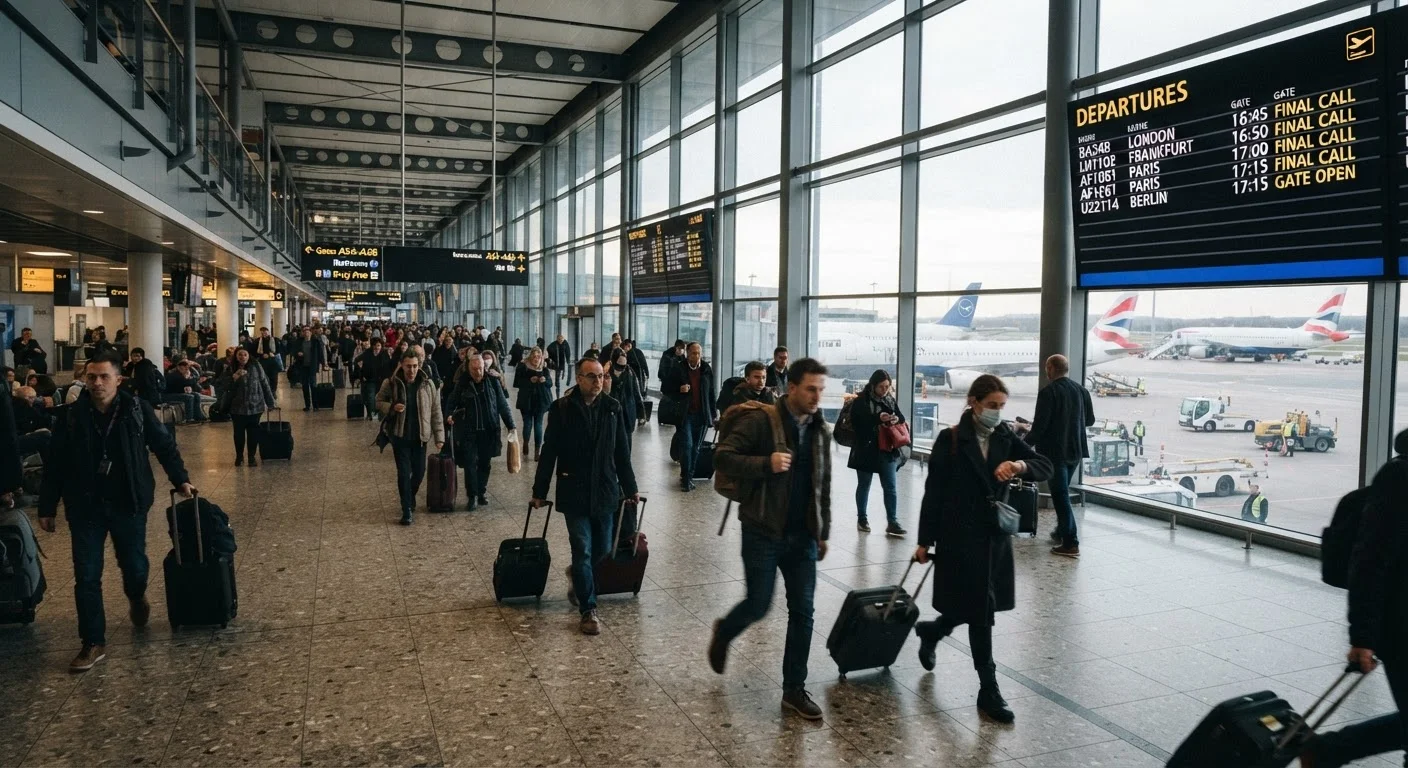
Option A
Short Connection
The time-efficient gamble.
Best for: Travelers on tight schedules willing to accept higher risk in exchange for a shorter total travel day.
Option B
Long Layover
The unhurried, lower-risk wait.
Best for: Travelers who prioritize reliability, comfort, or the chance to explore a hub city between flights.
What Actually Defines a 'Safe' Connection Time
A layover is the time between landing from one flight and departing on the next. What counts as a short or long layover isn't universal - it depends heavily on the airport, the type of connection, and what happens in between.
Most major U.S. airlines post what's called a Minimum Connection Time (MCT) - the shortest gap they consider operationally valid at each airport. These figures are set per airport and per connection type (domestic-to-domestic, international-to-domestic, etc.). An MCT at a compact regional airport might be 30 minutes; at a large hub with multiple terminals, it could be 90 minutes or more.
The MCT, however, is not a comfort guarantee. It assumes your inbound flight arrives on time and that you move efficiently. Delays, long jet bridges, crowded trains between terminals, and unusually long security lines can each erode that buffer. For practical planning purposes, many experienced travelers treat the MCT as an absolute floor, not a target.
| Criterion | Short Connection | Long Layover |
|---|---|---|
| Typical duration | 30-90 minutes | 3-10+ hours |
| Risk of missed flight | Higher, especially with delays | Very low |
| Total travel day length | Shorter overall | Longer, more tiring |
| Works well for international? | Risky without generous buffer | Yes, ample time for customs |
| Rebooking risk (separate tickets) | High personal cost if missed | Rarely relevant |
| City exploration possible? | No | Sometimes (6+ hours, visa permitting) |
| Stress level | High if flight runs late | Low, but boredom is a factor |
The Hidden Costs of Each Choice
Short connections compress your travel day but carry compounding risks. If your inbound flight is delayed - a routine occurrence - the math changes fast. You may reach your gate as the door closes. When flights are on separate tickets, the operating airline has no obligation to rebook you at no charge. You could face a full-fare same-day ticket or an overnight stay out of pocket. Even on a single itinerary, the airline's rebooking options may mean arriving at your destination many hours later than planned.
This is especially consequential on international itineraries. Clearing customs, collecting checked bags, re-checking them, and passing back through security is a multi-step process that can absorb 60-120 minutes at busy airports. A 75-minute international connection that looks viable in a booking engine can be a genuine gamble in practice. For more on how poor planning compounds into bigger problems, see why improvising at the airport usually backfires.
Long layovers remove most of the missed-flight anxiety, but they introduce their own friction. Four to ten hours in an airport terminal can be exhausting, especially after a red-eye or a long-haul flight. Without a plan, that time evaporates in a fog of overpriced food and uncomfortable seating. Travelers who check bags face an additional constraint: most airports won't allow re-entry to baggage claim mid-journey, making city excursions impractical unless the airport offers left-luggage facilities.
~20%
U.S. flights arriving late on average
The U.S. Bureau of Transportation Statistics reports that roughly one in five domestic flights arrives behind schedule in a typical year.
90+ min
Recommended buffer for U.S. international arrivals
CBP and airline guidance commonly suggests allowing 90 minutes or more for customs, baggage, and re-screening on international-to-domestic connections.
30-45 min
Inter-terminal transit time at major U.S. hubs
At airports such as Dallas/Fort Worth or Chicago O'Hare, moving between non-adjacent terminals via shuttle can take up to 45 minutes.
How to Evaluate Your Specific Situation
Before choosing an itinerary, answer these questions about your specific connection:
- Same terminal or different? Crossing terminals at airports like Chicago O'Hare, Dallas/Fort Worth, or Los Angeles can take 30-45 minutes on its own.
- Do you need to re-clear security? International arrivals in the U.S. must pass through customs and often re-screen - account for this explicitly.
- Is this one ticket or two? Separate tickets shift financial responsibility for a miss entirely to you.
- What's the historical on-time rate for that route? Publicly available flight statistics - through sources like the U.S. Bureau of Transportation Statistics - can reveal whether a specific route or airport is chronically delayed.
- What are your contingency options? If you miss the connection, are there multiple later flights that day, or is yours the last departure?
Fitting your layover decision into the broader arc of a well-structured trip is equally important. A good itinerary accounts for travel friction, not just sightseeing time - see how to build a trip itinerary that actually works for a fuller framework. For complex multi-stop journeys, the logistics only multiply, as explored in our guide to staying organized across a multi-city trip.
Making a Long Layover Work for You
If you've opted for or been assigned a long layover, a little planning converts dead time into usable time. Many major international airports - including those in cities like Tokyo, Doha, Singapore, and Amsterdam - offer airside amenities such as showers, lounges, sleeping pods, and even transit hotel rooms that don't require a visa or exiting the secure zone.
For layovers of six hours or more at international airports, a city visit is sometimes viable - but verify entry requirements first. The U.S. Department of State and your destination country's official immigration authority are the authoritative sources on whether your nationality requires a transit visa. Do not rely on travel forums alone for this determination.
For domestic long layovers, airport lounges (accessible through certain airline status programs or day passes), quiet concourse areas, and airport-run amenities can make the wait more comfortable. If you travel frequently with long connections, this kind of logistical thinking pairs well with the advice in how flexible itineraries differ from rigid travel schedules.
This article provides general travel information only. Entry requirements, visa rules, and airline policies change frequently - always verify current rules with official government sources and your airline before traveling.
The content on this site is for informational purposes only and is not a substitute for professional advice. Always consult a qualified professional for guidance specific to your situation.