

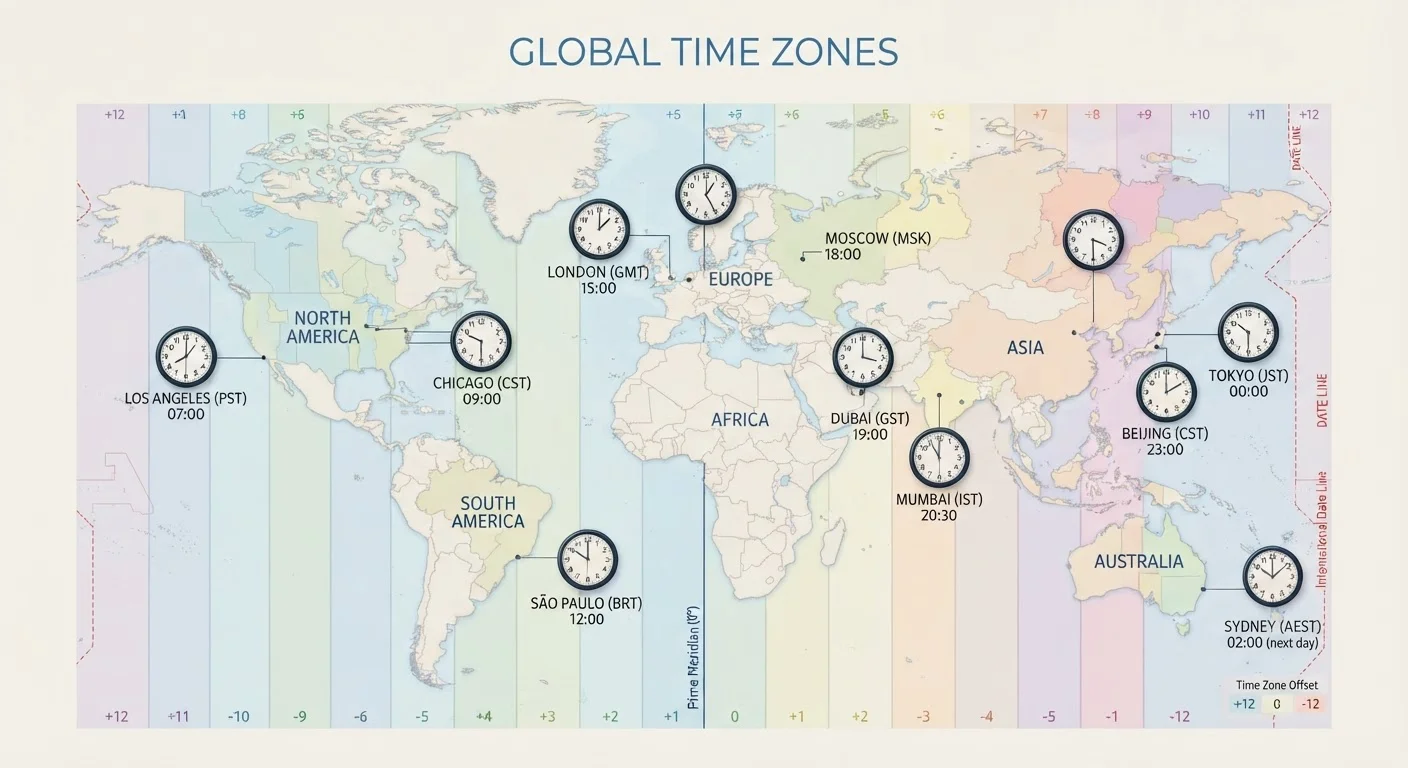
How to Read a UTC Offset
Every location on Earth is assigned a UTC offset - a value that tells you how many hours ahead of or behind Coordinated Universal Time (UTC) that place currently is. If a city is listed as UTC+3, local noon there corresponds to 9:00 a.m. UTC. A city at UTC−5 means local noon falls at 5:00 p.m. UTC.
UTC
Coordinated Universal Time - the global time standard against which all other time zones are measured. It has no offset and does not observe daylight saving time.
UTC Offset
The number of hours (and sometimes half-hours) a region is ahead of or behind UTC. For example, UTC−5 means five hours behind UTC.
Daylight Saving Time (DST)
A seasonal practice of advancing clocks by one hour during warmer months to extend evening daylight. Not all countries or regions observe DST.
International Date Line
An imaginary line near 180° longitude where the calendar date changes. Crossing it eastward moves you one day back; westward moves you one day forward.
Half-Hour Offset
Some time zones differ from UTC by 30 or 45 minutes rather than full hours, such as India (UTC+5:30) and Nepal (UTC+5:45).
Jet Lag
Temporary sleep disruption caused by rapid travel across multiple time zones, resulting in your body's internal clock being out of sync with local time.
To convert between two cities, find each city's offset and calculate the difference. For example: New York in winter is UTC−5 and London is UTC+0, so New York runs 5 hours behind London. Add 5 hours to New York's local time to get London's.
The calculation gets slightly more complicated with half-hour offsets. India (UTC+5:30) is a frequently misread example - when it's noon in London, it's 5:30 p.m. in Mumbai, not 5:00. Double-check any destination that uses a non-standard offset before scheduling anything time-sensitive.
For a full breakdown of what else goes into planning a trip abroad, see our first international trip planning guide.
Major World Regions and Their Offsets
The following reference covers standard (non-DST) offsets for major travel regions. Verify current offsets before travel, since DST and occasional political changes can shift them.
| Total standard time zones worldwide | 24 primary zones (with additional half- and quarter-hour offsets) |
| UTC offset range | UTC−12 to UTC+14 |
| Countries that do not observe DST | Majority - including Japan, China, India, and most of Africa |
| Widest single-country time zone span | Russia spans 11 time zones |
| China's official time zones | 1 (UTC+8), applied nationwide despite geographic breadth |
| US contiguous time zones | 4 - Eastern, Central, Mountain, Pacific |
| Region / City | Standard Offset | Observes DST? |
|---|---|---|
| New York (Eastern) | UTC−5 | Yes |
| Chicago (Central) | UTC−6 | Yes |
| Denver (Mountain) | UTC−7 | Yes |
| Los Angeles (Pacific) | UTC−8 | Yes |
| London | UTC+0 | Yes |
| Paris / Berlin / Rome | UTC+1 | Yes |
| Cairo / Athens | UTC+2 | Varies |
| Dubai | UTC+4 | No |
| Mumbai | UTC+5:30 | No |
| Bangkok / Jakarta | UTC+7 | No |
| Beijing / Singapore | UTC+8 | No |
| Tokyo | UTC+9 | No |
| Sydney | UTC+10/+11 | Yes (Southern Hemisphere) |
Southern Hemisphere destinations like Sydney observe DST during their summer - October through April - which is the opposite of North America and Europe. This catches many travelers off guard when planning calls with contacts in Australia.
Practical Scheduling: Flights, Calls, and Connections
Airline tickets display departure and arrival times in local time at each airport. A flight from Los Angeles to Tokyo that departs at 11:00 p.m. and arrives at 5:00 a.m. two days later is not a 30-hour flight - it crosses the International Date Line, gaining a calendar day. Always check the date column on your ticket, not just the clock time.
DST Dates Vary by Country
The United States and Europe shift their clocks on different weekends in spring and fall, creating a window of several weeks each year when the offset between them changes. Always confirm the exact offset around your travel dates using a current, official time zone converter rather than relying on a fixed offset you recall from a previous trip.
When scheduling an international video call or conference, anchor your planning to UTC. State the meeting time in UTC first - for example, "14:00 UTC" - and let each participant convert to their local time. This avoids the common error of forgetting that one participant's city recently shifted for DST while another did not.
For multi-stop itineraries, layover durations shown on a booking are typically calculated correctly by the airline's system - but travelers sometimes mis-read connection times when comparing tickets purchased separately. Always confirm that the arrival-to-departure gap is sufficient in local airport time, not UTC. If you're managing a complex multi-city itinerary, our guide to staying organized across a multi-city trip covers practical tools for tracking these details.
Finally, know that jet lag is a real physiological factor when crossing many time zones rapidly. Eastward travel tends to be harder than westward, because most people find it more difficult to advance their sleep schedule than to delay it. Factor in a recovery buffer day when precision timing - like an early business meeting - matters on arrival. For deeper context on how timing affects the whole travel experience, see planning a trip around seasonal travel.
The content on this site is for informational purposes only and is not a substitute for professional advice. Always consult a qualified professional for guidance specific to your situation.